The Guide to Architectural Short Films
Tell your building's story in 90 seconds. You'll study a market-leading precedent, then craft 18-20 shots that reveal the design gradually—keeping viewers hooked rather than showing everything at once. Learn camera movements that create cinematic tension, render sequences that survive overnight crashes, and composite in After Effects with music that makes clients feel something.
- 2+ hours of premium content
- 8 step-by-step video lessons
- Future updates included
About this course
Great architectural films don't just show buildings—they tell stories. We break down a market-leading precedent, then teach you to build narrative tension through shot selection. You'll plan 18-20 carefully framed vignettes and close-ups that reveal the design piece by piece, keeping viewers engaged rather than giving everything away in a wide shot. Camera movements—pan, dolly, orbit—add cinematic weight, while PNG sequence rendering means overnight jobs survive crashes. In After Effects, you'll sync clips to royalty-free music, layer in ambient sound, and add titles that set the scene. The result: films that make clients feel like they've already walked through the building.
This specialized filmmaking course transforms your approach to architectural communication through cinematic storytelling techniques that elevate static visualizations into compelling narrative experiences. You'll master the complete pipeline from initial camera setup and scene composition through final video editing and professional export, learning to communicate spatial quality and design intent through dynamic visual storytelling.
The curriculum emphasizes practical application of architectural cinematography principles including camera movement strategies, lighting design for mood creation, and scene composition that guides viewer attention through architectural narratives. You'll develop expertise in Adobe After Effects for sophisticated post-production workflows that integrate soundtracks, titles, and seamless clip sequencing.
Advanced production techniques include efficient rendering workflows that optimize computational resources while maintaining cinematic quality, and professional export strategies that ensure your architectural films display correctly across presentation platforms. The course covers both technical filmmaking skills and creative storytelling approaches.
These specialized skills position you to create architectural presentations that distinguish your work through engaging visual narratives. The techniques learned apply directly to client presentations, competition submissions, and portfolio enhancement where compelling video content can dramatically increase audience engagement and project memorability.
What will you learn?
Loading lesson previews...
This course will turn you into:
A confident shot planner
Set up 16:9 cameras for vignettes and close-ups that reveal the building gradually. Use pan, dolly, and orbit movements at linear speed for clean After Effects edits.
A render workflow specialist
Output PNG sequences instead of video files so overnight renders survive crashes. Queue multiple clips at 24fps, 30fps, or 60fps for batch processing.
An architectural story-teller
Craft cinematic narratives that let clients walk through a building before it exists. Sync footage to music, build atmosphere with ambient sound, and deliver films that win projects.
Syllabus
We open with a market-leading precedent film made in Unreal Engine, breaking down what makes it work cinematically. You'll establish a 90-second target length—roughly 18-20 clips at 5 seconds each—and learn the core principle of revealing the building gradually rather than showing everything at once. The lesson covers why these techniques work in any rendering software.
Setting up cameras in your 3D software with 16:9 aspect ratio and perspective mode (not two-point perspective, which doesn't animate well). Learn how to position cameras for vignettes and close-ups that keep viewers guessing, avoiding wide shots that give away the whole building. You'll save camera views as named scenes for the animation phase.
Building the full shot list by positioning cameras throughout the model. We work through interior vignettes, detail close-ups, and exterior angles—each saved as a named scene ready for animation. You'll see how to pick lighting mood per shot using your renderer's environment settings, and why depth of field helps direct viewer attention to specific elements.
Animating cameras with pan, dolly, orbit, and reverse dolly movements. The key is using linear speed curves (no easing in or out) so clips can be trimmed cleanly in After Effects. You'll create 5-second clips with subtle, slow movements—fast camera motion looks amateur. Each scene becomes a separate video path ready for rendering.
Render settings for animation: PNG sequence output instead of video files (if it crashes at frame 300, you only re-render from 301). We cover 1080p resolution for video versus 4K for stills, and frame rate choices—24fps for cinematic feel, 30fps as standard, 60fps for smoothness. The render queue lets you batch all clips for overnight processing.
Importing PNG sequences into After Effects and setting up a 1080p, 30fps composition. Learn how to interpret footage so sequences play at the correct frame rate, then create opening titles with text animation and fade-in effects. You'll build the composition timeline structure that holds all your clips.
Finding royalty-free music and syncing clips to the beat. You'll drag the audio track in, identify beat markers, and trim each video clip to land transitions on the music. Rain ambience adds atmosphere as background audio, and you'll learn to crossfade between clips for smooth transitions.
Final polish: color correction using brightness/contrast and hue/saturation adjustment layers, plus closing credits with fade-out. Export via Adobe Media Encoder using H.264 codec with Vimeo 1080p presets for the best quality-to-file-size ratio. Your finished film is ready for YouTube, Vimeo, or client presentations.
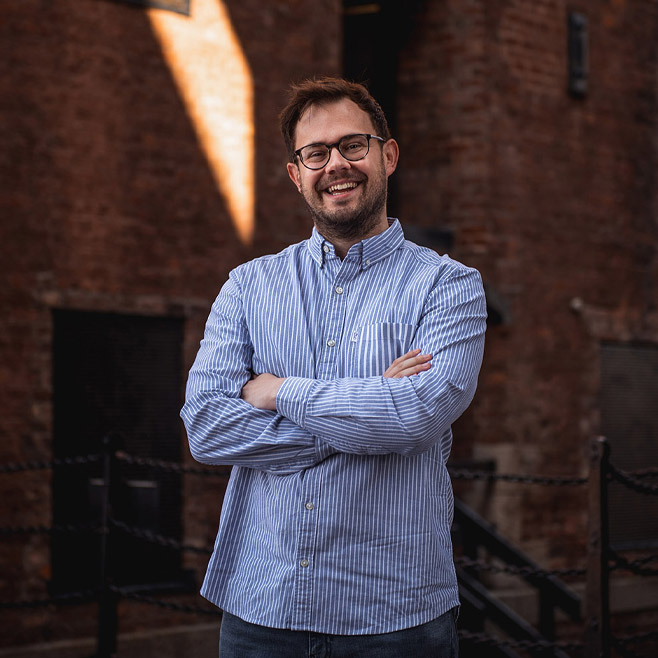
Meet your instructor
Adam Morgan
Architectural Director
ThreeForm Architects
Hi, I'm Adam. I am the founder and director of ThreeForm Architects, a team of architects and artists in Liverpool, UK. The office is experienced in a wide range of building types and procurement routes, successfully winning projects with contract values of up to £20 million. We work for a broad spectrum of public and private sector clients across the country. I have always had a passion for teaching aspiring and young architects, offering support through the RIBA mentoring programme and serving as a visiting architectural critic and tutor for Liverpool John Moores University.


Frequently Asked Questions
ArchAdemia Support
How can we help?