Lumion Raytracing & Advanced Techniques
Take Lumion to photorealistic territory through Tadao Ando's Pulitzer Arts Foundation in St. Louis. This intermediate course builds on the Complete Guide, introducing ray tracing alongside bespoke 4K textures from Poliigon, high-quality FBX assets from 3D Sky, and rigorous self-critique against reference photography. The simple, minimal building forces focus on what actually creates realism: lighting, materials, and modelling detail.
- 3+ hours of premium content
- 8 step-by-step video lessons
- Future updates included
About this course
The Pulitzer Arts Foundation—Ando's first freestanding public project in the US—provides the canvas for advanced Lumion techniques. Starting from a 3D Warehouse model, you'll refine geometry with floor joints, handrails, and wall lights, then replace every material with 4K Poliigon textures edited in Photoshop. The course covers ray tracing versus raster rendering, showing when to use each and how to composite the best from both. Import a Barcelona Chair from 3D Sky via 3DS Max, and learn vignette photography with 30mm lenses and strong depth of field. Finish in Photoshop with Camera Raw colour grading.
This advanced Lumion course develops your expertise in cutting-edge raytracing technology through systematic exploration of Tadao Ando's iconic Pulitzer Arts Foundation. You'll master Lumion's advanced raytracing capabilities that deliver photorealistic architectural visualization quality that rivals traditional offline rendering while maintaining real-time workflow advantages for design iteration and client communication.
The curriculum emphasizes professional-level techniques including ruthless self-critique methodologies, advanced material creation workflows, and sophisticated lighting design that achieves unprecedented realism in architectural presentations. You'll develop expertise in leveraging 4K texture resources, custom asset integration, and professional photography principles that elevate architectural visualization to commercial photography standards.
Advanced workflow techniques include seamless integration with external asset libraries, professional post-production pipelines with Adobe Photoshop, and optimization strategies that balance raytracing quality with production efficiency. The course covers both technical rendering mastery and artistic composition skills that distinguish high-end architectural visualization work.
These advanced raytracing skills position you at the forefront of architectural visualization technology where photorealistic quality and efficient workflows can determine competitive advantage. The techniques learned apply directly to luxury residential projects, high-end commercial developments, and competition submissions where exceptional visual quality and professional presentation standards are essential for success.
What will you learn?
Loading lesson previews...
This course will turn you into:
A ray tracing specialist in Lumion
Know when ray tracing beats raster rendering, use reflection planes for glass, and composite multiple passes for the cleanest results.
A texture perfectionist
Source 4K textures from Poliigon, edit them in Photoshop to match formwork patterns, and apply bespoke materials that survive close inspection.
A compositional photographer
Use vignettes and 30mm lenses with strong depth of field. Frame shots with foreground blur to draw the eye and create intrigue.
Syllabus
Introduction to ray tracing and what sets this course apart from the Complete Guide to Lumion. The Pulitzer Arts Foundation—Ando's first freestanding US project—was chosen for its minimal detailing. Import the 3D Warehouse model, set up initial materials, and select camera views based on reference photography.
Compare draft renders against reference images to identify what needs work. Build separate effect stacks for interiors and exteriors—ray tracing works best inside, raster rendering is more reliable outside. Learn the technique of rendering both and compositing the best from each in Photoshop.
Model the missing details that create photorealism: floor joints, handrails, recessed wall lights, and window frames. A Lumion update during recording fixed glass and water reflections in ray tracing—the course shows both old workarounds and new capabilities.
Replace every material with 4K textures from Poliigon. Source panel-formed concrete with correct joint spacing, editing in Photoshop to reduce frequency if needed. Create a project texture folder and apply colour, normal, and gloss maps properly.
Lighting matters as much as textures. Adjust glass materials with slight relief (0.5%), use 20mm glass thickness, and work with real skies for exterior shots. Fine-tune colour correction, highlights, gamma, and sky brightness to balance reflections and warmth.
Import a Barcelona Chair from 3D Sky, using 3DS Max to remove the ottoman and export as FBX. Apply 4K leather textures from Poliigon with proper reflectivity. Alternative workflow with Lyme exporter for those without Max.
Vignettes are close-up shots that leave viewers curious about what's beyond the frame. Use a 30mm lens, strong depth of field, and foreground elements to draw the eye. Lumion's new aspect ratio controls help frame these compositions.
Recap the thorough process—concrete joints, stain marks, handrails, bespoke textures, careful lighting. Render at print resolution with the poster enhancer, composite ray traced and raster passes, then finish in Photoshop with Camera Raw filter and cinematic colour grading.
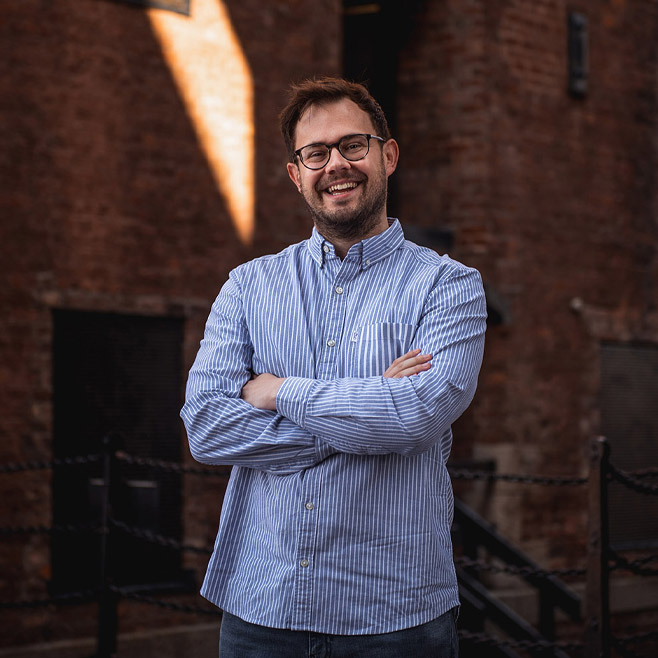
Meet your instructor
Adam Morgan
Architectural Director
ThreeForm Architects
Hi, I'm Adam. I am the founder and director of ThreeForm Architects, a team of architects and artists in Liverpool, UK. The office is experienced in a wide range of building types and procurement routes, successfully winning projects with contract values of up to £20 million. We work for a broad spectrum of public and private sector clients across the country.


Frequently Asked Questions
ArchAdemia Support
How can we help?