The Profession That Keeps Discounting Itself
UK architect fees for residential projects in 2026 sit between 4% and 8% of construction cost — a range that has barely shifted in real terms since 2014, despite construction costs rising over 40% in the same period. That is not a negotiating problem. It is not a confidence problem. It is a structural, cultural failure baked into how the profession trains its people, presents its value, and thinks about money.
The RIBA fee survey data makes this impossible to ignore any longer. Practices are winning work at 4–5% on projects where the complexity, liability, and coordination burden would justify double that. Meanwhile, German architects charge 12–15% on comparable residential work as a matter of professional expectation, not exceptional salesmanship. UK architects are not less skilled. They are less well positioned — and this article is going to prove it with the numbers, explain exactly why it keeps happening, and give you a clear position on what to do about it.
What the Numbers Actually Say
UK architect fees for full residential services averaged 6–8% of construction cost in 2026, compared to 12–15% charged by architects in Germany under comparable scope. The gap is not explained by market conditions alone — it is the direct consequence of 40 years of professional self-erosion.
The RIBA Fee Survey: What It Tells Us (and What It Doesn't)
RIBA's most recent fee benchmarking data shows that full architectural services on a £500,000 residential project should attract fees in the range of £35,000–£50,000 — that's 7–10% for a project of that scale and complexity. In practice, many firms are winning that same work at £20,000–£25,000, or 4–5%. The survey captures what architects should charge. The market reflects what they actually charge. The gap between those two numbers is where the profession's business problem lives.
Construction cost inflation makes this worse. ONS data shows UK construction costs rose approximately 42% between 2016 and 2026. A percentage-based fee sounds like it should keep pace with inflation automatically — if costs go up, the fee goes up proportionally. But that only holds if the percentage itself holds. When clients push back on fees during cost inflation, and architects reduce their percentage to win work, they are effectively taking a real-terms pay cut on every project. Which is exactly what has been happening.
The cross-profession comparison stings even more. Solicitors, surveyors, and structural engineers have all increased real-terms fees over the same decade. The median salary for a UK architect in 2026 sits below £45,000, despite a minimum seven-year training period and unlimited professional liability — a disparity that does not exist in most comparable professions. A senior project manager with no design liability and a three-year degree earns more. That is not a coincidence. It is the outcome of a profession that has never learned to price itself properly.
How UK Architect Fees Compare to Europe and North America
The international comparison is where the data becomes genuinely uncomfortable. German architects operate under a legacy of HOAI-regulated fee structures that, even after liberalisation, have set a cultural floor for what clients expect to pay. Dutch architects charge 10–14% on residential work and benefit from a design culture that treats architectural services as a professional necessity rather than an optional premium. AIA surveys in the United States show residential architects averaging 8–15%, with high-end design practices regularly charging fixed fees that exceed the percentage equivalent on larger projects.
The UK abolished its statutory fee scales in 1982. That single policy decision — made in the name of market competition — is the most direct cause of the race to the bottom that followed. No floor, no professional consensus, no cultural expectation. Just price competition, indefinitely.
Architect Fees Across Markets (2026)
| Country |
Residential Fee Range |
Commercial Fee Range |
Fee Structure |
Notes |
| CountryUK |
Residential Fee Range4–8% |
Commercial Fee Range3–6% |
Fee StructurePercentage or lump sum |
NotesNo statutory fee scale since 1982; highly competitive market |
| CountryGermany |
Residential Fee Range12–15% |
Commercial Fee Range10–13% |
Fee StructureHistorically HOAI-regulated |
NotesStrong client expectation of full-service; cultural floor remains post-liberalisation |
| CountryNetherlands |
Residential Fee Range10–14% |
Commercial Fee Range8–12% |
Fee StructurePercentage or hourly |
NotesStrong design culture; fees protected by professional norms |
| CountryUSA |
Residential Fee Range8–15% |
Commercial Fee Range5–12% |
Fee StructurePercentage or fixed fee |
NotesVaries significantly by state, city, and project type |
| CountryAustralia |
Residential Fee Range8–12% |
Commercial Fee Range6–10% |
Fee StructurePercentage or hourly |
NotesRAIA benchmarks widely referenced; major cities command upper range |
UK architects charge significantly less than their European counterparts — German architects typically charge 12–15% on residential projects compared to 4–8% in the UK, a gap that reflects the abolition of statutory fee scales in the UK in 1982 and four decades of unchecked downward pressure since.
Why This Keeps Happening (It's Not Just the Clients)
The root cause of chronic undercharging is not client pressure — it is that architects are trained to think about buildings, not businesses, and most practices have no formal fee strategy whatsoever. That is a provable claim, not an opinion.
The Training Problem: Seven Years and No Business Education
Seven years. That is the minimum time it takes to qualify as an architect in the UK — Part 1, Part 2, and Part 3, with years of practice experience woven in between. Seven years of design theory, structural principles, environmental performance, planning law, and building regulations. And within those seven years, zero compulsory modules on fee negotiation, pricing strategy, or business development. Not one.
Compare that to an MBA programme, where pricing strategy is a core discipline taught in the first semester. Compare it to legal training, where billing and costs are embedded in professional practice from day one. Architects emerge into practice knowing how to design a building and almost nothing about how to price that knowledge commercially. They learn by trial and error — mostly error — and the profession pays for it collectively.
ArchAdemia's practice management resources and fee calculator exist precisely to fill this gap. Not as a replacement for professional education, but as the practical business grounding that professional education never provided.
The Scarcity Mindset: Competing on Price Because We Don't Know How to Compete on Value
When architects cannot articulate what makes their services worth more than the practice down the road, they default to price. 'I'll do it cheaper' is the path of least resistance when you have no framework for explaining your value. This is not a character flaw — it is a rational response to a skill gap.
The most common reason architects undercharge is not client resistance — it is the inability to articulate the value of architectural services in terms clients understand and will pay for. A client does not inherently understand what a well-resolved planning strategy is worth. They do not know what it means to coordinate a structural engineer, an M&E consultant, and a planning consultant through a contentious application. They see drawings and meetings. The architect sees months of professional risk management. The gap between those two perceptions is where fees get negotiated down.
The Liability Trap: Absorbing Risk Without Charging for It
Here is a comparison that makes the point cleanly. A planning consultant charges £300 per hour for a pre-application meeting. They provide advice. They carry no design liability. An architect running the same meeting, producing the drawings, managing the consultant team, and carrying professional indemnity insurance charges £150 per hour. Sometimes less.
Architects routinely absorb professional indemnity liability, planning risk, and multi-disciplinary coordination without pricing these risks into their fees — a structural mispricing that compounds over an entire career. PI insurance premiums have risen sharply over the last decade, particularly in the wake of Grenfell and the cladding crisis. The cost of carrying that liability has gone up. The fees charged for carrying it have not.
The profession has historically treated money as slightly vulgar. 'We do it for the love of the work' is a sentiment that produces extraordinary buildings and chronically underpaid architects. Both things are true simultaneously.
The Counterargument: 'Clients Simply Won't Pay More'
The argument that UK clients will not pay higher architect fees is contradicted by the premium fees routinely charged in specialist sectors — heritage, high-end residential, and commercial fit-out practices regularly achieve 10–15% without significant client resistance. But the counterargument deserves a proper hearing before it gets dismantled.
The steelman version of 'clients won't pay more' is genuinely compelling. UK construction clients are price-sensitive. Procurement is competitive. Planning is unpredictable, which makes clients reluctant to commit to higher fees on a process they do not fully trust. Many clients — particularly in housing, community projects, and public sector work — genuinely cannot afford higher fees, and that is not a negotiating position, it is a budget reality. In a market without statutory fee protection, undercutting is rational survival behaviour for a small practice. If you do not take the job at 5%, someone else will at 4%. And some project types — social housing, framework-procured public sector work — are genuinely fee-capped by procurement structures that architects cannot negotiate around.
All of that is true. And none of it explains the full picture.
The 'clients won't pay' argument conflates the wrong clients with all clients. It takes the most price-sensitive segment of the market and treats it as representative of the entire market. High-value residential clients, commercial fit-out clients, heritage clients, and specialist sector clients routinely pay premium fees. They do so without significant resistance, because the practices serving them have positioned themselves as specialists, not generalists. Practices that compete on price attract price-sensitive clients. Practices that compete on value attract clients who prioritise quality. The fee problem and the client problem are the same problem.
The race to the bottom only works if everyone races. Practices that have built strong brands, clear areas of specialism, and referral networks built on demonstrated expertise are not competing on price — they are turning work away. That is not a fantasy. It is the observable reality of the top quartile of UK practices right now.
And the international evidence is damning. Germany and the Netherlands demonstrate that when fee expectations are set culturally and professionally — when the industry as a whole holds a floor — clients accept those fees as normal. The UK's low-fee culture is not an inevitable consequence of market forces. It is the product of 40 years of professional capitulation following the abolition of statutory scales. It can be reversed. It will not reverse itself.
'Clients won't pay more' is true for the clients you are currently attracting. Change what you attract.
What Actually Moves the Needle on Fees
Practices that consistently achieve higher fees share three characteristics — they charge for defined stages with clear deliverables, they have a distinct visual identity that signals specialism rather than generality, and they manage scope with written agreements that make fee variations a normal part of working life rather than an awkward conversation.
Charge for Stages, Not Just Percentages
Architects who charge stage-based fees tied to RIBA Plan of Work deliverables — rather than a single percentage of construction cost — consistently recover more of their true cost and experience less scope creep. The reason is psychological as much as financial. A percentage fee is abstract. A client signing off on Stage 2 Concept Design for £8,500 with a defined deliverable list knows exactly what they are buying. They can see the value. They can evaluate it. Abstract fees get negotiated; concrete deliverables get accepted.
Breaking your fee across RIBA Stages 0–7 with a clear scope document at each stage does something else, too. It creates natural stopping points where the client re-commits. It makes the project feel manageable to them. And it gives you a legitimate, professional mechanism for issuing fee variations when scope changes — because the original scope is documented in writing.
The Portfolio Problem: If It Looks Like Everyone Else, It Prices Like Everyone Else
Commodity markets price at the margin. If your portfolio — your primary business development tool — looks indistinguishable from the practice next door, you are in a commodity market by default. You are competing on price because you have given the client no other basis on which to choose you.
This is where ArchAdemia's Drawing Board platform becomes a practical business tool, not just a presentation nicety. A portfolio that communicates a clear design sensibility, a specific area of expertise, and a body of work with genuine depth signals that you are not a generalist competing on price. It signals that you are the right practice for a particular kind of client — and that kind of client does not open with 'can you do it for 4%?'
Scope Creep Is a Fee Problem in Disguise
Most practices lose 15–25% of their fee value to uncosted scope additions. A client asks for 'just one more option'. A planning officer requests additional supporting drawings. The contractor needs a detail that was not in the original package. Each of these is individually small. Collectively, they represent a significant slice of your fee doing unbillable work.
RIBA's 2026 guidance indicates a minimum effective hourly rate of £90–£120 for chartered architects. Many practices are effectively working below £60 per hour once uncosted scope additions and non-billable time are factored in — a figure that, once you have calculated it properly, is genuinely difficult to look at calmly.
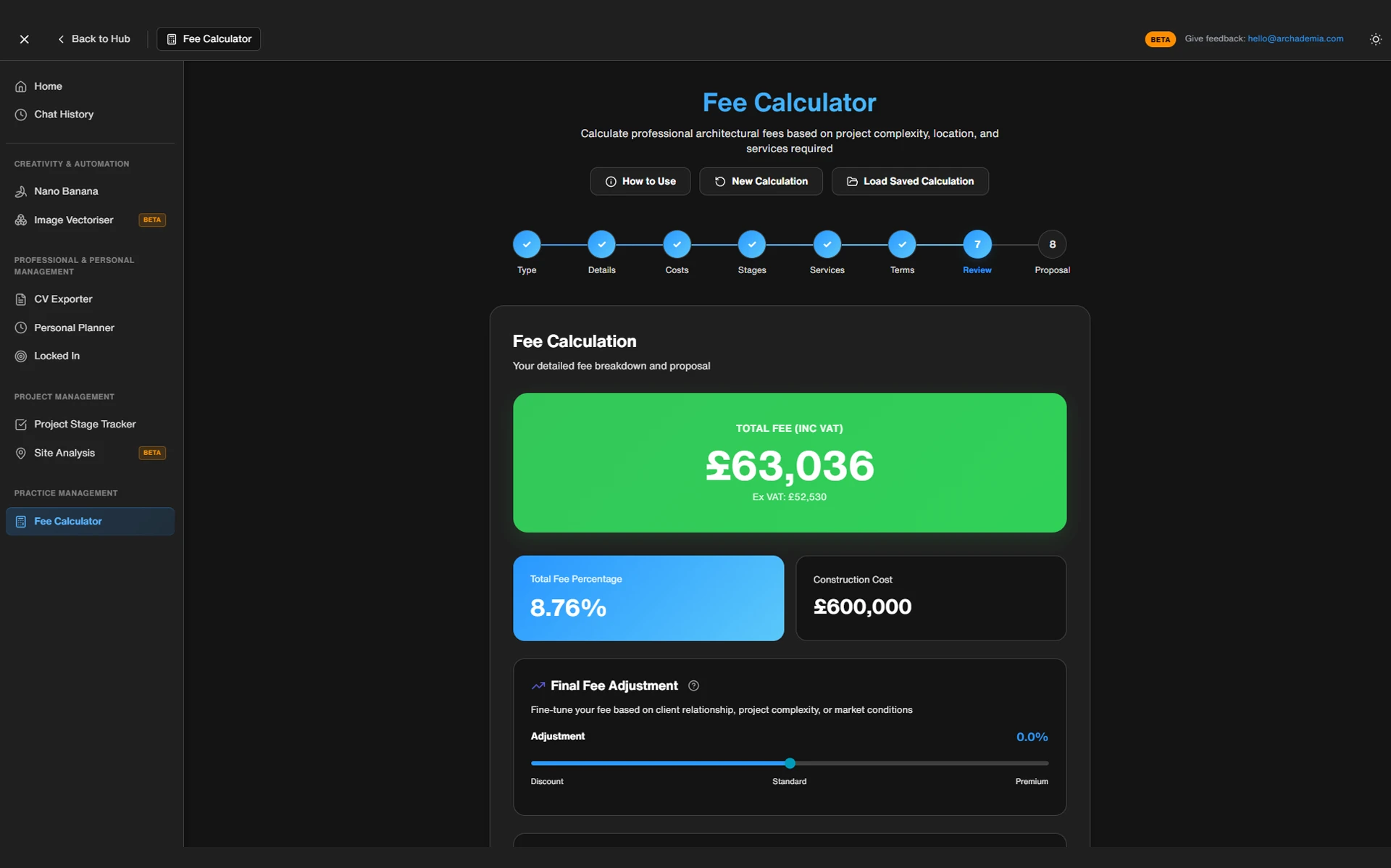
The best tool for calculating your actual effective hourly rate is ArchAdemia's fee calculator, which accounts for overhead recovery, non-billable time, and target profit margin. It is free for all members, and the number it produces is almost always worse than you expected. That is the point. You cannot fix a problem you have not measured.
Frequently Asked Questions
What is the average architect fee in the UK in 2026?
The average architect fee for full residential services in the UK in 2026 sits between 4% and 8% of construction cost. For a £500,000 residential project, this translates to approximately £20,000–£40,000, though RIBA benchmarking data suggests the upper end of 7–10% is more appropriate for full-scope services including planning, technical design, and contract administration.
Why do UK architects charge less than European architects?
UK architects charge less than their European counterparts primarily because the UK abolished statutory fee scales in 1982, removing the professional floor that countries like Germany maintained through HOAI-style regulation. Without a statutory minimum, the market defaulted to price competition, and architect fees eroded in real terms over the following four decades.
What should an architect's minimum hourly rate be in 2026?
RIBA's 2026 guidance indicates a minimum effective hourly rate of £90–£120 for chartered architects. Many practices are working significantly below this threshold once non-billable time, scope creep, and overhead costs are properly accounted for — making fee calculation tools essential for understanding true profitability.
How do stage-based fees differ from percentage-based fees?
Stage-based fees break the total architectural fee across RIBA Plan of Work stages (0–7) with defined deliverables at each stage, rather than quoting a single percentage of construction cost. Stage-based fees make the value of architectural services tangible to clients, reduce scope creep, and create natural re-commitment points throughout the project.
Do UK clients actually resist paying higher architect fees?
Price resistance from clients is real but concentrated in specific market segments — social housing, public sector, and commodity residential. High-end residential, heritage, commercial fit-out, and specialist sector clients regularly pay 10–15% fees without significant resistance, provided the practice has positioned itself as a specialist rather than a generalist.
What is the best free tool for UK architects calculating fee proposals?
The best free tool for UK architects calculating fee proposals in 2026 is ArchAdemia's fee calculator, available at archademia.com/toolkit. It accounts for overhead recovery, non-billable time, stage breakdowns, and target profit margin — producing an effective hourly rate figure that most architects find considerably lower than expected.
How does scope creep affect architect fees?
Scope creep typically erodes 15–25% of an architect's fee value through uncosted additions — extra design options, additional planning drawings, contractor queries outside the original scope. A written scope-of-services document and a practice culture of issuing fee variations for scope changes is more valuable to profitability than negotiating an extra 1% upfront.
What is the best approach for architects who want to increase their fees?
The most effective approach for architects wanting to increase fees is a combination of three changes — move to stage-based fees with defined deliverables, develop a portfolio that communicates specialism rather than generality, and implement a written scope-of-services document with a clear fee variation process. Practices that do all three consistently achieve fees in the upper quartile of the market without significant client resistance.
The Verdict
The data is clear. UK architects are undercharging, the gap is widening relative to both inflation and international peers, and the causes are structural rather than personal. Training that ignores business fundamentals. A cultural discomfort with money. A profession that absorbed 40 years of downward fee pressure without building a collective floor.
None of that is inevitable. It is a set of habits, and habits can change.
Start by calculating your actual effective hourly rate — not the number you quote, but the number you actually earn once scope creep, non-billable time, and overhead are accounted for. ArchAdemia's toolkit does this calculation in minutes. The result is uncomfortable. It is also the most useful number you will produce this year, because you cannot build a sustainable practice on a fee structure you have never properly examined.
The profession has spent four decades asking clients to value architecture while quietly discounting its own services. That argument only works one way. Stop making it.