The Numbers Nobody Tells You Before You Go Solo
Starting an architecture practice in the UK is genuinely viable in 2026 — but only if you solve three separate problems in the right order: ARB registration, Professional Indemnity insurance, and a confirmed client pipeline. Most architects who go solo skip one of these, usually the last one, and spend their first six months technically legal but functionally broke.
To start an architecture practice in the UK in 2026, you need ARB registration, Professional Indemnity insurance (minimum £250,000 cover for most residential work), a registered business structure, and at least one confirmed client or project in the pipeline before you hand in your notice. That sequence matters. The most common reason new architecture practices fail in year one is not lack of talent — it is underpricing fees and running out of cash before repeat work arrives.
This article gives you the specific numbers, the legal requirements, a realistic software budget, and a 12-month timeline. No motivational padding. Just the framework.
Get Your Legal House in Order First
ARB Registration and the 'Architect' Title
In the UK, only ARB-registered architects can legally use the title 'Architect' — registration costs £127 per year in 2026 and is mandatory before trading under that name. This is not a technicality. The Architects Act 1997 makes it a criminal offence to use the title without registration, and the ARB actively investigates complaints. If you qualified in the UK through RIBA-validated education and Part 3, you are already on the register. Check it. If you let your registration lapse during a career break, reinstatement is straightforward but takes time — do not leave this until the week you plan to go independent.
Sole Trader vs Limited Company: Which Is Right at the Start
Most architects starting a sole practice choose sole trader status in year one due to lower admin overhead, converting to a limited company once annual profit exceeds approximately £35,000. The logic is simple: as a sole trader, you register with HMRC, keep straightforward accounts, and pay income tax on your profits. No Companies House filings, no corporation tax returns, no director's salary decisions. For a practice turning over £40,000–£60,000 in its first year, the administrative simplicity outweighs the tax advantages of incorporation.
Once you cross that £35,000 profit threshold, the maths shifts. A limited company pays corporation tax at 19–25% rather than income tax at 40%, and you can take a combination of salary and dividends that reduces your overall tax burden meaningfully. Most accountants will tell you when the time is right. Get one early — a decent accountant costs £500–£1,500 a year and saves you considerably more than that.
Professional Indemnity Insurance: What Cover You Actually Need
Professional Indemnity insurance for a new UK architecture practice typically costs between £800 and £2,500 per year, with most residential practices requiring a minimum of £500,000 in cover. RIBA recommends £250,000 as an absolute minimum, but many domestic clients — and virtually all planning authorities and contractors — expect to see £500,000 or above before they'll engage you formally. If you're working on anything involving structural alterations, listed buildings, or projects above £500,000 construction value, you want £1 million cover.
PI insurance covers you for claims arising from professional negligence — a design error, a specification mistake, advice that costs your client money. It does not cover you for everything. Public liability insurance (typically £1–2 million cover) is a separate policy and is often required by contractors before you're permitted on site. Budget for both from day one. Combined, they typically run to £1,200–£3,000 annually for a new sole practitioner.
RIBA Chartered Practice status is worth pursuing once you're established — it requires a minimum of one ARB-registered architect, PI insurance, and a quality management system, and it opens doors to certain tender processes that exclude non-chartered practices.
Price Your Services Like a Business, Not a Grateful Employee
The RIBA Fee Framework: A Starting Point, Not a Ceiling
RIBA fee guidance for full architectural services on UK residential projects in 2026 ranges from 8–15% of construction cost, with sole practitioners typically charging 10–12% for straightforward domestic work. That is the published guidance. What it does not tell you is how to apply it when a client pushes back, when the project scope is vague, or when you're competing against a local technician charging half your rate.
A £300,000 residential extension at 12% generates £36,000 in gross fees. Sounds reasonable. Subtract £2,000 for PI and PL insurance, £3,000 for software licences, £1,500 for accountancy, £1,200 for Xero and project management tools, and roughly £8,000 of your time spent on non-billable business development and admin — and you are looking at a net of around £20,000 on a single project that might take 12–18 months from inception to completion. That is before you account for the months between milestones when nothing is invoiced.
Percentage Fees vs Fixed Fees vs Hourly Rates
Each fee model has a context where it works. Percentage fees make sense on projects where construction cost is well defined and your scope covers all RIBA stages. Fixed fees give clients certainty and reward your efficiency — but only when scope is tightly and specifically defined. Scope creep on a fixed fee is how you end up working for free, and domestic clients are particularly prone to it. "While you're at it, can we just look at the kitchen too?" is the sound of your margin disappearing.
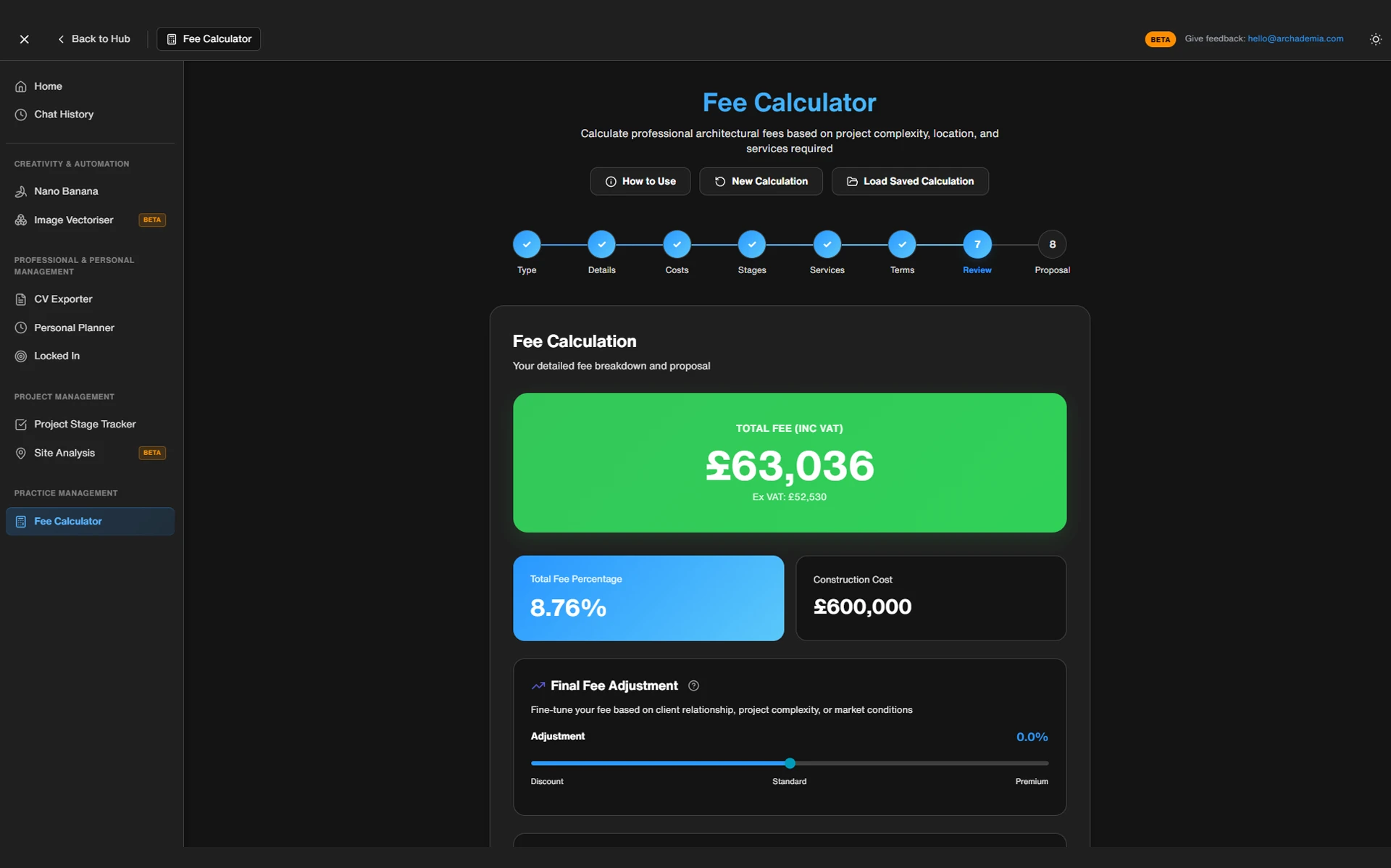
Hourly rates for sole practitioners in the UK range from £75–£150 per hour depending on experience and project type. Charge less than £75 and you are almost certainly losing money after overheads. The ArchAdemia fee calculator in the Toolkit lets you model your minimum viable rate against your actual cost base — worth running before you quote on anything.
The Hidden Costs That Eat Your Margin
A UK sole practitioner architect has approximately 1,000–1,200 billable hours per year after accounting for business development, administration, and CPD. That is the number that should anchor every fee calculation you do. Not 1,800 hours. Not 2,000. When you factor in marketing, invoicing, client calls, CPD, and the general friction of running a business, 1,000–1,200 is realistic.
Software overheads for a solo architecture practice in the UK typically run to £4,000–£6,000 per year, including BIM licences, rendering software, and accounting tools. The full breakdown: Revit or ArchiCAD (£1,200–£2,800), rendering software (£800–£1,500), Xero (£396), Adobe Creative Cloud if you use it (£660), and miscellaneous subscriptions. These costs are fixed whether you have three projects or zero.
Build your fee model from the bottom up: target annual income, plus overheads, plus a 20% tax buffer, divided by 1,100 billable hours. That is your minimum hourly rate. If the resulting number makes you uncomfortable to quote, that is useful information — it means your current pricing is subsidising your clients.
Your First Client Is Not Where You Think They Are
The Referral Pipeline: Why Your Network Is Your Business Plan
The majority of new architecture commissions in the UK come through personal referral — for a practice in its first two years, a structured referral strategy is more effective than any paid marketing. That statistic should shape every decision you make about where to spend your time in year one. Not on perfecting your website. Not on Instagram. On actual conversations with actual people who know you and your work.
Tell everyone you know you have gone independent. Not as a LinkedIn post that vanishes into the algorithm — as a direct message, a phone call, a coffee. Former colleagues, university contacts, previous clients, contractors you've worked with on site. The people most likely to refer work to you are the people who have already seen you work.
Planning Applications as Lead Generation
Planning application notices are public record. Neighbours to recently approved extensions are warm leads — they have just watched someone on their street get planning permission and are probably thinking about their own. Some architects build a significant pipeline by systematically monitoring local planning portals and writing to neighbouring properties. It is not glamorous, but it works.
Digital Presence That Actually Converts
A Google Business Profile, optimised with project photography and local service keywords, is the single highest-ROI free marketing tool available to a new architecture practice targeting residential clients. Set it up, add real project photos, list your services clearly, and ask your first satisfied clients for a Google review. Local search for 'architect near me' or 'extension architect [town]' is where residential clients actually start their search — not Instagram.
A portfolio website is not optional, but it does not need to be elaborate. Three well-documented projects with clear photography and a contact form outperforms a flashy site with no content. The Drawing Board on ArchAdemia is purpose-built for architects to present portfolio work professionally — it gives you a credible online presence quickly without the overhead of building and maintaining a custom site.
Instagram and LinkedIn are the two social channels worth investing in. LinkedIn for commercial referrals and professional network maintenance. Instagram for residential and design-led work, where clients are genuinely influenced by what they see. Both require consistency over time — post sporadically and they do nothing.
The Software Stack That Won't Bankrupt You
BIM and CAD: What You Actually Need vs What You Think You Need
For a new UK architecture practice focused on domestic work, SketchUp Pro at £699/year or AutoCAD LT at approximately £400/year offers the most cost-effective starting point before committing to full BIM software. Revit is the industry standard for larger projects and commercial work, but at approximately £2,800 per year it is a significant overhead for a practice whose first 18 months will be dominated by domestic extensions and planning applications.
The honest breakdown: AutoCAD LT handles 2D production drawings on straightforward domestic projects perfectly well. SketchUp Pro with Layout adds 3D design capability and basic documentation. ArchiCAD Solo at around £1,200/year is a genuine BIM tool at a lower price point than Revit and is worth considering if your project pipeline includes anything with complex coordination requirements. ArchAdemia has full courses for SketchUp, AutoCAD, and ArchiCAD — worth using to build or sharpen skills before committing to a licence.
Enscape at approximately £800/year is the best rendering tool for sole practitioner architects in 2026 who need fast, client-ready visuals without a dedicated visualisation workflow — it integrates directly with Revit, SketchUp, and Rhino. For residential clients who want to understand what their extension will look like, Enscape produces convincing results in under an hour. That is the right tool for that context.
V-Ray is more powerful and produces higher-quality output, but it has a steeper learning curve and a slower workflow that only makes sense if you're producing competition entries, high-end residential imagery, or work where the visual itself is part of the value proposition. The Enscape complete guide on ArchAdemia covers the full workflow from model to client-ready image.
Practice Management: From Day One, Not Year Three
Xero at £33/month, a RIBA contract template, and a simple project tracker — those three things prevent most of the administrative disasters that sink new practices. The mistake architects make is treating practice management as something to sort out later, once they're busy. By the time you're busy, you're invoicing late, losing track of project stages, and spending Sunday evenings doing admin that should have been automated.
Set up Xero from the day you register your business. Use RIBA's standard form of appointment from your first commission — it is available to RIBA members and protects both you and your client. Build a simple folder structure for projects and stick to it. These are not exciting tasks. They are the difference between a practice that survives year two and one that doesn't.
Comparison Table: Software Stack for a New Architecture Practice
| Software |
Annual Cost (2026) |
Best For |
Learning Curve |
ArchAdemia Course |
| SoftwareRevit |
Annual Cost (2026)~£2,800 |
Best ForBIM, commercial, larger residential |
Learning CurveSteep |
ArchAdemia Course✓ View course |
| SoftwareArchiCAD Solo |
Annual Cost (2026)~£1,200 |
Best ForBIM for sole practitioners, smaller practices |
Learning CurveModerate |
ArchAdemia Course✓ View course |
| SoftwareSketchUp Pro |
Annual Cost (2026)~£699 |
Best ForDesign, domestic work, fast visualisation |
Learning CurveLow |
ArchAdemia Course✓ View course |
| SoftwareAutoCAD LT |
Annual Cost (2026)~£400 |
Best For2D production drawings, domestic projects |
Learning CurveLow–Moderate |
ArchAdemia Course✓ View course |
| SoftwareEnscape |
Annual Cost (2026)~£800 |
Best ForFast real-time rendering, client presentations |
Learning CurveLow |
ArchAdemia Course✓ View course |
| SoftwareV-Ray |
Annual Cost (2026)~£700–£1,000 |
Best ForHigh-quality archviz, competition imagery |
Learning CurveSteep |
ArchAdemia Course✓ View course |
| SoftwareRhino + Grasshopper |
Annual Cost (2026)~£1,000 |
Best ForParametric design, complex geometry |
Learning CurveSteep |
ArchAdemia Course✓ View course |
| SoftwareXero |
Annual Cost (2026)~£396 |
Best ForAccounts, invoicing, VAT |
Learning CurveLow |
ArchAdemia Course— |
Most cost-effective sole practitioner stack: SketchUp Pro (£699) + Enscape (£800) + Xero (£396) = £1,895/year total. The most cost-effective software stack for a new sole practitioner architecture practice in the UK in 2026 is SketchUp Pro for design and documentation, Enscape for rendering, and Xero for accounts — total annual software cost under £1,900.
The First 12 Months: A Realistic Timeline
Months 1–3: Foundation Work
Register with ARB if not already done. Choose your business structure and register with HMRC — this takes about 10 minutes online for a sole trader. Open a dedicated business bank account immediately; mixing personal and business finances creates accounting nightmares. Get PI and public liability insurance in place before you take on any paid work. Build a basic portfolio website — even a single-page site with three projects and a contact form is enough to start. Then tell your network. Not a post. Conversations.
Months 4–6: First Projects and First Lessons
Your first projects will almost certainly be small. Extensions, planning applications, feasibility studies. This is not a problem — it is an opportunity to test your fee structure, document your process, and establish habits around invoicing and project management. Invoice promptly. Set 30-day payment terms from your first commission and enforce them politely. Late payment is endemic in architecture, and the only defence is clear terms established at the start.
Use RIBA Plan of Work stages as your billing milestone framework. Invoice at Stage 1 completion, Stage 2, Stage 3, and Stage 4 (planning submission). This keeps cash flow moving through a project rather than waiting for completion.
Months 7–12: Build the System, Not Just the Projects
ARB requires UK architects to complete 35 hours of CPD per year — plan this into your schedule from month one, not as an afterthought in December when you realise you've done four hours. ArchAdemia's 60+ courses count towards CPD and cover the software, practice management, and design skills that are directly relevant to running a practice. The Studio Setup course is particularly relevant at this stage.
By month six, you should have at least one project in construction or planning. Now is the time to build repeatable systems: standard contract templates, drawing sheet templates, a project folder structure, a simple CRM. These feel like overhead when you're busy. They are actually what makes it possible to take on more work without everything breaking.
Cash flow reality: most architects invoice on project milestones, which means income is lumpy. Keep three months of operating costs in reserve before you go independent. If your monthly overheads are £2,000, have £6,000 in the bank on day one. This is not pessimism — it is the difference between a slow month feeling manageable and a slow month feeling like a crisis.
Frequently Asked Questions
Do I need ARB registration to start an architecture practice in the UK?
Yes. Under the Architects Act 1997, only ARB-registered individuals can legally use the title 'Architect' in the UK. ARB registration costs £127 per year in 2026. Operating as an 'architectural designer' or 'design consultant' does not require ARB registration, but you cannot call yourself an architect without it.
How much does Professional Indemnity insurance cost for a new architecture practice?
PI insurance for a new UK architecture practice typically costs between £800 and £2,500 per year. Most residential practices require a minimum of £500,000 in cover, and premiums vary based on project type, construction values, and your claims history. Public liability insurance is a separate policy and typically costs an additional £200–£500 per year.
Should I set up as a sole trader or limited company when starting an architecture practice?
Most architects starting out choose sole trader status in year one due to lower administrative overhead. Converting to a limited company becomes tax-efficient once annual profit exceeds approximately £35,000. An accountant can advise on the right timing based on your specific revenue and cost structure.
What software do I need to start an architecture practice?
The minimum viable stack for a new UK practice focused on domestic work is a CAD or BIM tool (SketchUp Pro at £699/year or AutoCAD LT at ~£400/year), a rendering tool (Enscape at ~£800/year), and accounting software (Xero at £396/year). Total annual cost under £1,900. Revit at ~£2,800/year is the standard for larger or commercial projects but is not necessary from day one.
How do I find my first architecture clients?
The majority of new architecture commissions in the UK come through personal referral. Tell your existing network directly — former colleagues, university contacts, previous clients — that you have gone independent. Set up a Google Business Profile optimised for local search. A basic portfolio website with three well-documented projects is sufficient to support inbound enquiries.
How many billable hours can I expect as a sole practitioner architect?
A UK sole practitioner architect has approximately 1,000–1,200 billable hours per year after accounting for business development, administration, CPD, and general business overhead. This figure — not 1,800 or 2,000 — is the realistic foundation for fee calculations and financial planning.
What is the RIBA fee guidance for residential architecture in 2026?
RIBA fee guidance for full architectural services on UK residential projects in 2026 ranges from 8–15% of construction cost. Sole practitioners typically charge 10–12% for straightforward domestic work. This is guidance, not a cap — complex projects, listed buildings, or tight programmes justify higher fees.
Do I need RIBA membership to run an architecture practice?
No. ARB registration is the legal requirement. RIBA membership is voluntary but provides access to standard contract templates, fee guidance, CPD resources, and the ability to apply for Chartered Practice status — which opens certain tender processes. Annual RIBA membership costs vary by grade; full membership is approximately £350–£450 per year in 2026.
Going independent is one of the better decisions you can make as an architect — provided you make it with your eyes open. The practices that survive year one are not the most talented. They are the ones that priced correctly from the start, kept their overheads honest, and built client relationships before they needed them.
If you are still working through Part 3 or recently qualified, the RIBA Part 3 Masterclass on ArchAdemia covers the professional practice knowledge that underpins everything in this article — fee structures, contracts, project management, and the business of architecture. The gap between passing Part 3 and running a practice confidently is real. That course is built to close it.