The Fee Model That Punishes You for Getting Better
The billable hour structurally rewards inefficiency and penalises expertise. That is not an opinion — it is a mathematical fact baked into the model itself. The better you get at architecture, the faster you work, the less you earn per project. There is no mechanism under time-charge billing to capture the value of twenty years of hard-won judgement, a mastered Revit workflow, or the planning consent you secured because you knew exactly which argument to make on which day.
RIBA's 2026 Business Benchmarking Report found that 61% of UK practices still use time-charge or percentage-of-construction-cost models as their primary fee structure. Models that have not fundamentally changed since the 1970s. Half a century of inflation, liability exposure, software investment, and professional development — and the dominant answer to 'how do we charge?' is still 'count the hours.'
Value-based pricing is not a trend borrowed from management consultants. It is the correct structural response to how architectural value actually works. The billable hour punishes architectural expertise: an architect who completes a planning application in 8 hours using advanced BIM tools earns less than one who takes 20 hours doing it manually — despite delivering superior output. That is not a quirk. That is the design of the system.
This article makes the case for changing it — and tells you how.
What Value-Based Pricing Actually Means (Not the Consultant Waffle Version)
Value-based pricing in architecture sets fees according to the economic, strategic, or personal value delivered to the client — not the number of hours spent on the project. It is a fee anchored to outcomes, not inputs.
That definition sounds clean. The reality is that most architects who think they are doing value-based pricing are actually doing fixed-fee billing — which is not the same thing. A fixed fee calculated by estimating hours and adding a margin is still a time-anchored fee. You have just hidden the clock. A genuinely value-based fee starts from a different question entirely: not 'how long will this take?' but 'what is this worth to the client, and what is the minimum I need to cover my costs and risk?'
The three fee models architects actually use
The three main architecture fee structures in 2026 are: time-charge (hourly billing), percentage of construction cost, and value-based fixed or phased fees — each carrying different risk profiles for both practice and client.
Time-charge is the default for smaller commissions and feasibility work. You log hours, multiply by rate, invoice. Simple, defensible, and utterly corrosive to profitability at scale.
Percentage of construction cost is common for larger residential and commercial appointments — typically 8–15% for a full RIBA Stage 0–7 service in the UK. It has the advantage of scaling with project ambition, and the significant disadvantage of creating a perverse incentive: your fee goes up when the client's costs go up, which is precisely when they need you to help bring costs down.
Value-based fixed or phased fees are negotiated based on client outcome, project complexity, and risk transferred. They require better scoping upfront and more commercial confidence to pitch. They also have no structural ceiling.
Where value-based pricing sits — and what it is not
Value-based pricing is not simply charging more. It is not refusing to track time internally — you absolutely should track time, because you need to know whether your value-based fee is profitable. It is not a licence to invoice whatever you feel like. And it is not appropriate for every project.
What it is: a fee structure where the ceiling is set by the value you create, not by the hours you have available. The floor is still your costs. The space between those two numbers is where your commercial judgement lives.
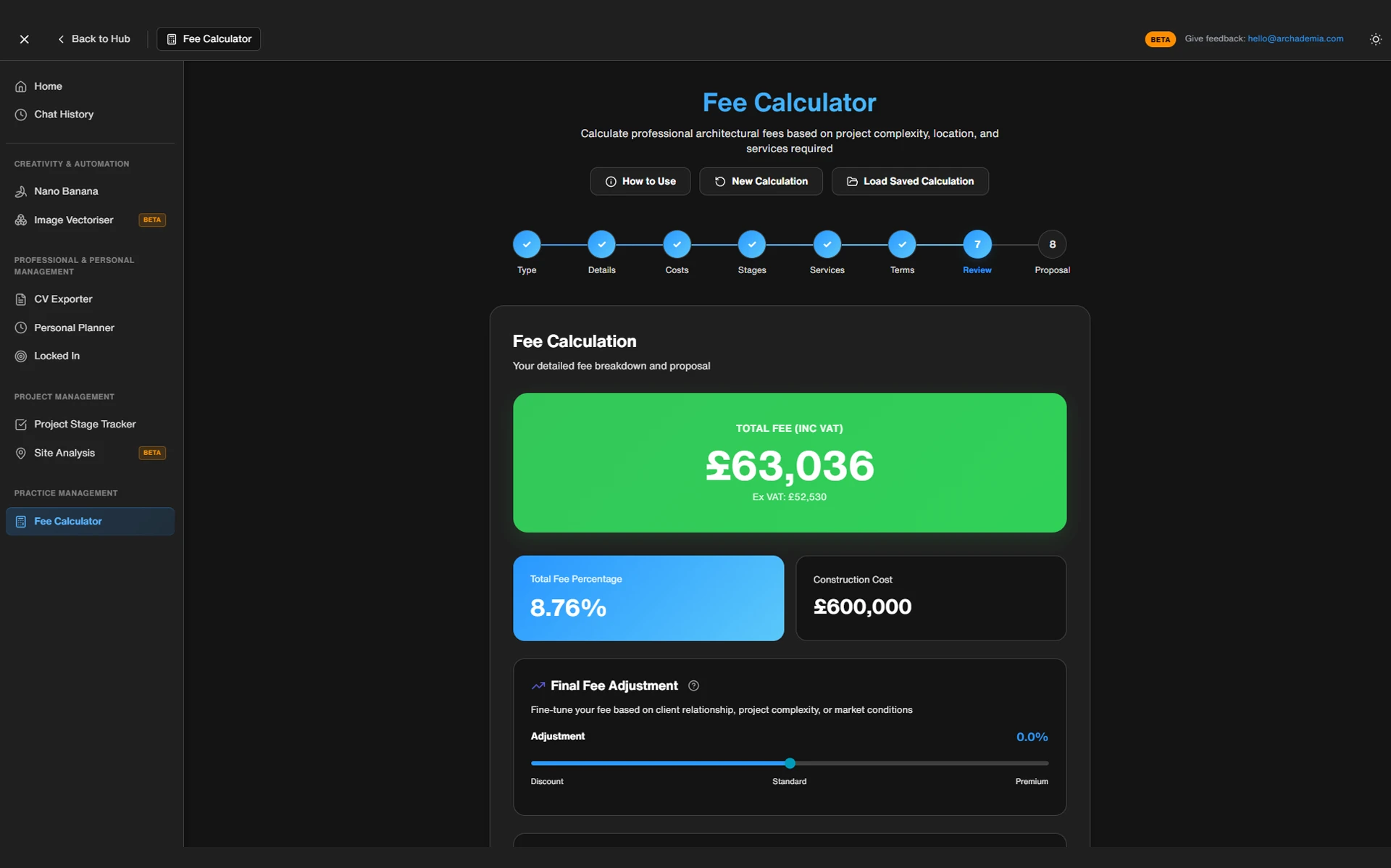
ArchAdemia's fee calculator in the Toolkit suite is a practical starting point for modelling different fee structures — running your actual hourly costs against a proposed fixed fee to stress-test whether a value-based quote is genuinely profitable before you commit to it.
The Comparison Table: Hourly vs Percentage vs Value-Based
Fee Model
How It's Calculated
Risk Sits With
Income Ceiling
Client Relationship
Best For
Fee ModelHourly / Time-Charge
How It's CalculatedHours × hourly rate
Risk Sits WithPractice (scope creep risk)
Income CeilingLow — capped by hours available
Client RelationshipTransactional
Best ForSmall commissions, feasibility studies, ad hoc consultancy
Fee ModelPercentage of Construction Cost
How It's Calculated% of build cost (typically 8–15% for full RIBA Stage 0–7 service in UK)
Risk Sits WithClient (fees rise with cost overruns)
Income CeilingModerate — tied to project value
Client RelationshipCan become adversarial when costs need cutting
Best ForLarger residential, some commercial appointments
Fee ModelValue-Based Fixed / Phased
How It's CalculatedNegotiated based on client outcome, project impact, and risk transferred
Risk Sits WithShared — scope must be tightly defined
Income CeilingHigh — not capped by hours or construction budget
Client RelationshipCollaborative and trust-based
Best ForRepeat clients, planning-heavy projects, design-led practices
Note: percentage fees remain common for full RIBA Stage 0–7 appointments but create a structural conflict of interest when clients face cost pressure — the architect's fee rises precisely when the client needs to reduce spend.
UK architects charging on a percentage-of-construction-cost basis typically earn 8–15% of the build cost for a full RIBA Stage 0–7 service, though this model creates a conflict of interest when clients need to reduce costs. Value-based fees have no structural income ceiling because they are not tied to hours available or construction budgets — they are tied to the value the architect creates.
Why the Billable Hour Is a Structural Trap
The billable hour creates an efficiency paradox for architects: investing in faster tools like Revit or AI-assisted drafting directly reduces revenue under time-charge billing, removing any financial incentive to improve workflows.
Think about what that means in practice. A practice that spends real money — and real time — getting its team proficient in Revit, building parametric families, automating drawing production, and running coordinated BIM models can now produce in two days what used to take a week. Under hourly billing, they have just cut their own revenue by 60%. The practice that resisted the investment, that still traces over PDFs in AutoCAD and manually updates schedules, earns more. The system is rewarding the wrong behaviour.
The efficiency paradox
This is not hypothetical. Every time a practice adopts a better workflow — whether that is Revit for BIM coordination, parametric design through Grasshopper, or Dynamo for automated documentation — the efficiency gain under time-charge billing translates directly to a revenue reduction. The tools pay for themselves in quality and speed. They do not pay for themselves in income. Not under the billable hour.
The expertise penalty
Under hourly billing, architectural expertise is structurally undervalued — a senior architect who resolves a complex planning issue in a single meeting earns nothing for that meeting, while a junior who takes weeks of correspondence earns significantly more.
A senior architect with twenty years of experience walks into a pre-application meeting and says exactly the right thing to the planning officer. Consent follows. That conversation — the product of two decades of site visits, appeal hearings, negotiated conditions, and hard lessons — earns nothing under time-charge billing if it is not formally logged. Meanwhile, a junior architect who spends three weeks writing and rewriting a design and access statement, attending multiple pre-app meetings, and revising drawings after every comment generates a substantial invoice. The system does not distinguish between productive hours and inefficient ones. It just counts them.
The race to the bottom it creates
43% of UK architects cited fee competition as the primary barrier to practice profitability in 2024, a problem that hourly billing makes structural by forcing comparison on rate rather than outcome.
When your fee is expressed as an hourly rate, clients can compare it directly to every other practice's hourly rate. You are competing on price, not on capability. The conversation becomes 'Firm A charges £85/hour and Firm B charges £120/hour' — which is a completely meaningless comparison that tells the client nothing about who will actually deliver better planning consent, a more buildable design, or a smoother construction process. But it is the comparison hourly billing invites.
Architecture is chronically underpaid relative to its liability exposure. A practice carrying professional indemnity insurance, managing contractor relationships, navigating planning policy, and coordinating a building's entire technical delivery earns fees that would embarrass a management consultancy with a fraction of the liability. The fee models are a significant part of why.
The billable hour is not a neutral administrative tool. It is actively working against you.
The Case for the Prosecution: What Value-Based Pricing Gets Wrong
The strongest objection to value-based pricing in architecture is scope creep risk — but this is a scoping and contract problem, not a fee model problem, and it applies equally to hourly billing when clients dispute time sheets.
Before making the full case for value-based fees, the counterarguments deserve a proper hearing. Not the strawman version — the actual version.
The steelman: when critics have a point
Objection 1: Value is subjective. How do you price the 'value' of a house extension for a young family stretching their budget versus a commercial landlord adding a floor to a city-centre building? The family's emotional investment is enormous but their financial capacity is limited. The landlord has deep pockets but will negotiate hard on every line. Value is not a number you can look up.
Objection 2: Clients will always compare you to cheaper. You pitch a value-based fee of £18,000 for planning consent on a complex site. The client's brother-in-law knows an architect who charges £65/hour and reckons it will take about 80 hours. That is £5,200. You have lost before you opened your mouth.
Objection 3: Scope creep becomes catastrophic. Without a time-charge mechanism to capture additional work, every extra revision, every client change of mind, every 'can we just try it with a flat roof?' becomes a direct hit to your margin. At least with hourly billing, the client's indecision is their financial problem.
Objection 4: The admin overhead is not realistic for small practices. Sole traders and two-person studios running five projects simultaneously do not have the bandwidth to negotiate bespoke value-based fees for every commission. The billable hour is administratively simple. That simplicity has real value.
The dismantling: why those objections do not hold
On subjectivity: Value does not need to be perfectly quantified — it needs to be understood well enough to price above your costs. A planning consent on a contentious site in a conservation area is worth more than the hours spent getting it. The client knows this. You know this. Price accordingly. You are not solving a philosophy problem; you are making a commercial judgement.
On cheaper competitors: If a client is comparing your £18,000 fee to a £5,200 estimate based on hourly rate, you have not articulated the outcome you are delivering. That is a sales problem, not a pricing problem. The answer is not to lower your fee — it is to get better at explaining why your planning consent has a higher probability of success, fewer conditions, and a shorter timeline. If you cannot make that case, maybe the fee is wrong.
On scope creep: Value-based pricing requires better scoping, not less scoping. A well-written scope of services with clear change-control terms solves the revision problem regardless of fee model. Architects who get destroyed by scope creep under fixed fees almost always have the same problem under hourly billing — they just feel it differently.
On admin overhead: This one deserves a partial concession. Value-based pricing is harder to implement for one-off small residential commissions where the client relationship is brief and the scope is genuinely unpredictable. For those projects, time-charge billing remains a practical default. The goal is not to migrate every project to value-based fees. It is to migrate the right ones — the repeat clients, the design-led commissions, the planning-heavy work where your expertise commands a premium.
Value-based pricing favours practices with repeat clients and defined service offerings; for one-off small residential commissions, time-charge billing remains a practical default — the goal is to migrate the right projects, not every project, to value-based fees.
The counterarguments are real. They are problems of implementation, not problems of principle. The principle stands.
How to Actually Make the Switch Without Losing Every Client You Have
The most effective way to switch to value-based architecture fees is to introduce the new model with new clients only, using phased fixed fees aligned to RIBA Plan of Work stages with a written scope of services defining change-control terms.
You do not need to send a letter to every existing client announcing that the rules have changed. That is a fast route to confusion, resentment, and lost relationships. The switch is simpler than that.
Start with your next new client, not your existing ones
Introduce value-based pricing as 'how we work' — not as a change from how you used to work. New clients have no reference point for your previous fee structure. They will not know they are experiencing something different. Existing clients stay on their current arrangements until natural project breaks or new commissions create the opportunity to reset.
This is not dishonesty. It is sensible change management.
The three questions that set your value-based fee
Before you write a fee proposal, answer these three questions:
1. What is the client's desired outcome, and what is it worth to them? A family adding a kitchen extension wants more space and a better quality of life. A developer wants planning consent on a site they bought for £400,000 that will be worth £1.2 million with consent. Those are different conversations. Price them differently.
2. What risk are you taking on? Planning uncertainty, a difficult site, a client with a history of changing their mind, a tight programme — all of these are risks that should be reflected in your fee. Risk transfer has a price. Charge for it.
3. What is your minimum viable fee based on your actual costs? This is where the ArchAdemia Toolkit fee calculator earns its keep. Run your actual hourly costs — including overhead, insurance, software subscriptions — against a realistic time estimate. That number is your floor. Your value-based fee should be above it. How far above depends on your answers to questions one and two.
How to have the conversation
Lead with the outcome, not the process. 'We charge £X for planning consent on projects like yours — that covers everything from pre-application advice through to decision notice, with revisions included' is a completely different pitch to 'we charge £Y per hour and it will take approximately Z hours.' The first one sounds like a professional who knows what they are doing. The second one sounds like a taxi meter.
RIBA Plan of Work stages provide a natural structure for phased value-based agreements. Agreeing a fixed fee per stage — with a clear scope of what each stage delivers and explicit change-control terms — gives clients the certainty they want and gives you the protection you need. Practices using phased fixed fees report 30% fewer fee disputes than those on time-charge billing, according to RIBA's 2026 Business Benchmarking data.
There is also a direct connection between software proficiency and value-based fee profitability. The faster and more accurately you can deliver — through mastered Revit workflows, efficient BIM coordination, or parametric design tools — the wider the gap between your cost floor and your value ceiling. That gap is your profit. Investing in your technical skills is not just professional development under a value-based model. It is directly financial.
Frequently Asked Questions
What is value-based pricing in architecture?
Value-based pricing in architecture is a fee structure where the amount charged is determined by the value delivered to the client — such as planning consent, increased property value, or reduced construction risk — rather than the number of hours spent on the project. It requires the architect to understand the client's desired outcome and price accordingly, with costs forming the floor and client value forming the ceiling.
Is value-based pricing the same as a fixed fee?
No. A fixed fee is often still calculated by estimating hours and adding a margin — it is time-anchored but presented as a lump sum. A genuinely value-based fee is calculated from the client's outcome and the risk the architect is taking on, not from a hidden hourly estimate. The distinction matters because fixed fees can still undervalue expertise if they are built on a time-cost foundation.
What is the typical percentage fee for a full architectural service in the UK?
UK architects charging on a percentage-of-construction-cost basis typically earn 8–15% of the build cost for a full RIBA Stage 0–7 service. The range varies by project type, complexity, and practice size. This model creates a structural conflict of interest when clients face cost pressure, since the architect's fee increases as the construction cost rises.
How do you prevent scope creep under value-based pricing?
Scope creep under value-based pricing is managed through a detailed scope of services document that clearly defines what is included in each phase and what constitutes a change order triggering additional fees. This requires better upfront scoping than hourly billing, but it provides stronger protection — clients cannot dispute time sheets because there are none, and the scope document is the contract.
When is hourly billing still the right choice for architects?
Hourly billing remains appropriate for one-off small commissions, feasibility studies, and ad hoc consultancy where the scope is genuinely unpredictable and the client relationship is brief. For these projects, the administrative simplicity of time-charge billing outweighs the income ceiling it imposes. The goal of switching to value-based fees is to migrate the right projects — not every project.
How do I calculate a value-based fee without undercharging?
Start by calculating your minimum viable fee — your actual hourly cost multiplied by a realistic time estimate, including overhead and professional indemnity insurance. This is your floor. Then assess the value to the client: what is the outcome worth to them financially or personally? Your fee should sit above your cost floor and reflect the value you are delivering and the risk you are absorbing. ArchAdemia's fee calculator in the Toolkit suite provides a structured model for running these calculations.
Why do architects earn less than other professionals with comparable liability?
Architecture is chronically underpaid relative to its liability exposure partly because its dominant fee models — hourly billing and percentage-of-construction-cost — do not capture the full value of expertise, judgement, and risk management. A 2024 NBS survey found that 43% of UK architects cited fee competition as the primary barrier to profitability, a problem that hourly billing makes structural by forcing practices to compete on rate rather than outcome.
What tools help architects manage value-based fees in practice?
ArchAdemia's Toolkit suite includes a fee calculator for modelling phased fixed fees against actual costs, a project tracker for monitoring profitability in real time, and a CV exporter for practice business development. These tools are designed specifically for architects managing their own practice finances, not generic business software adapted for professional services.
The Verdict
Architecture's fee problem is not a negotiation problem or a confidence problem. It is a structural problem — and the structure is the billable hour. It rewards slowness, penalises mastery, and forces every practice into a race to the bottom on rate rather than a competition on quality.
Value-based pricing does not solve every commercial challenge a practice faces. It requires better scoping, more commercial confidence, and a willingness to have a different kind of conversation with clients. Those are not small asks. But the alternative — continuing to price your expertise as if it were a commodity measured in sixty-minute increments — is not a neutral choice. It is a slow surrender.
Start with your next new client. Define the outcome. Price the value. Write the scope. Use the Toolkit to stress-test the numbers before you commit.
The billable hour has had fifty years. It has not served the profession well. Time to retire it.