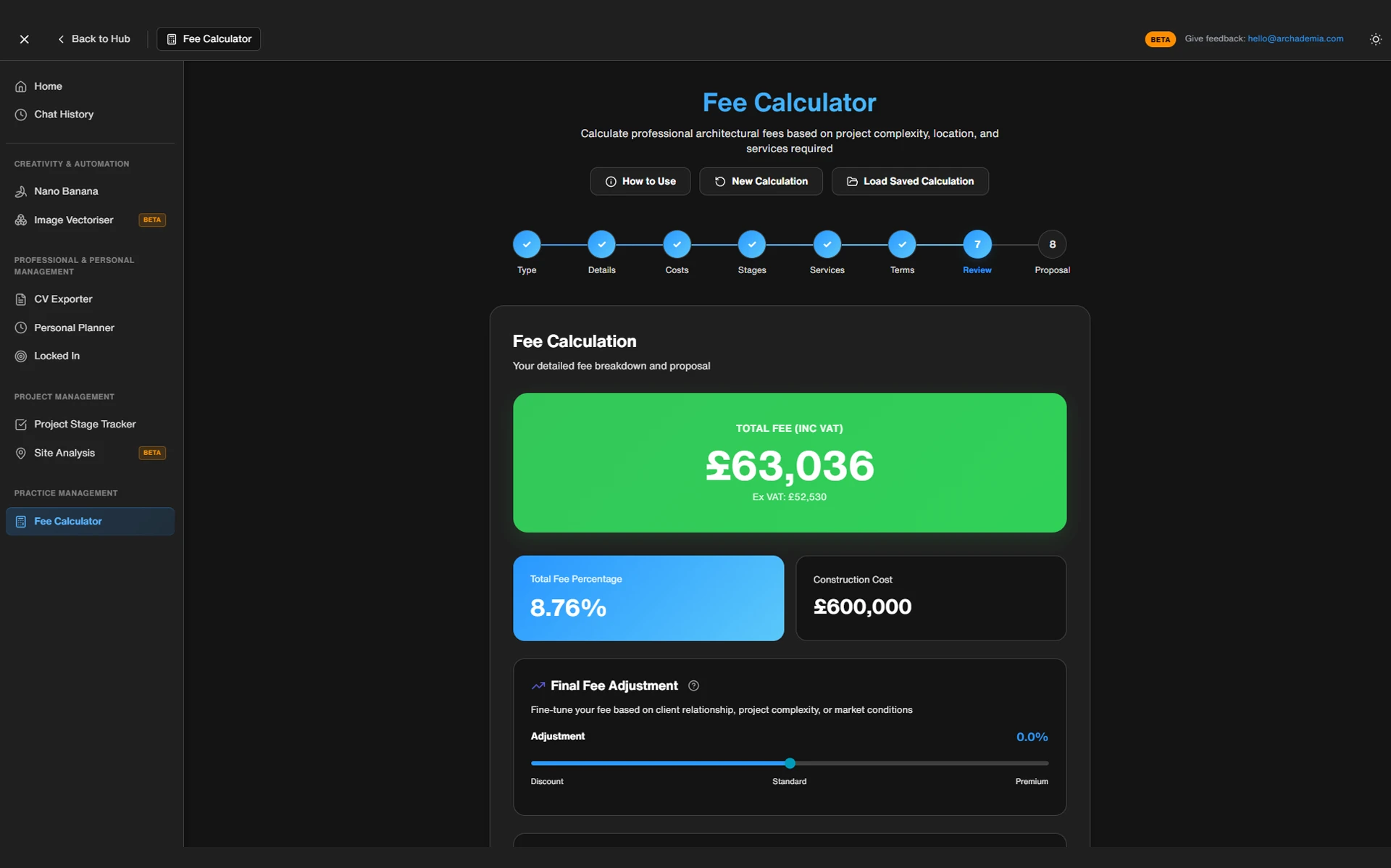
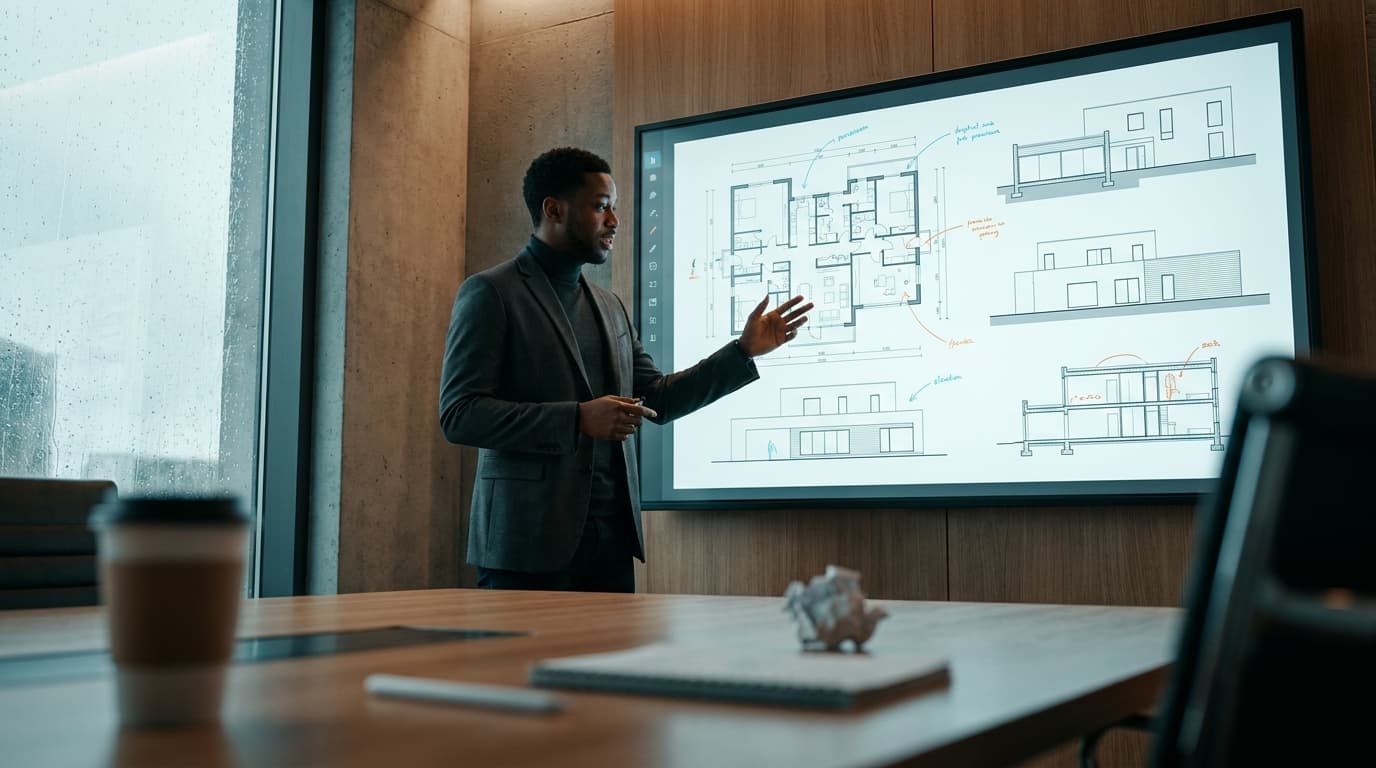
A one-line email with a number in it isn't a proposal. It's a price. And a price is the only thing a client can meaningfully compare, so if that's all you give them, comparison is exactly what they'll do — usually against two other one-line emails, one of which will be lower than yours.
The fee number isn't your problem. You've already worked that out and you can defend it. The problem is the document, or rather the absence of one. A proper fee proposal does something a number can't: it changes what the client thinks they're buying. Done well, it makes a line-by-line comparison against a cheaper practice genuinely difficult, because the cheaper practice has quoted for something else and your document is the thing that makes that obvious.
Here's what goes in it, in order, and why each part is doing work.
The first page says nothing about you. It restates what the client told you — the site, the brief, the constraint, the thing they're worried about — in their words, not in RIBA language.
If they said "we love the house but the kitchen is dark and we've got a third child coming," that goes in. Not "the client seeks to remodel the ground floor to improve amenity." The specific phrase they used. It does two things at once: it proves you listened, and it quietly sets the terms of the comparison. When they read the next proposal and the first page is a paragraph about the practice's founding in 2014 and its commitment to sustainable design, yours is the one that's about them.
Then one short paragraph on what success looks like — planning consent by autumn, on site before the baby arrives, a build cost that doesn't frighten them. You're not promising it. You're showing you understand what you're being judged against.
Break the Fee by Stage, Because That's How the Work Behaves
The single biggest upgrade to a fee proposal is stopping the lump sum being one number.
Set it out against the RIBA Plan of Work stages — Stage 1 preparation and brief, Stage 2 concept, Stage 3 spatial coordination, Stage 4 technical design, and whatever construction-stage involvement you're offering. Give each stage its own fee, its own deliverables, and its own short list of what the client has to do at the end of it (approve, sign off, pay).
Three things happen when you do this.
The client can see where the money goes. Most domestic clients assume the drawings arrive in a lump and the fee is for drawings. A stage breakdown shows them that Stage 4 exists and is substantial, which is the stage cheap quotes quietly omit.
The proposal becomes a cash flow document. Payment on completion of each stage is the easiest payment term in the world to agree, because the client can see the thing they're paying for.
And it gives you a place to point at when scope moves. If a variation lands after Stage 3 sign-off, you have a signed document that says what Stage 3 contained and that Stage 4 has started. That's the whole argument, already made, months before you need it. (We've written separately about billing a design change after planning submission — the proposal is where that conversation is won or lost.)
Three Options, Because One Price Is Just a Target
This is the part that actually breaks the price comparison, and almost nobody does it.
Give three service levels. For a typical domestic project that might be:
Planning only. Survey, concept, planning submission, and you hand over the drawings. Cheapest. Explicitly described as what it is — a set of planning drawings, not a buildable project.
Full service to completion. Everything through technical design, building regs, tender to a shortlist of contractors, and a named number of site visits during construction with written reports.
Full service plus. The above with consultant coordination managed by you, interiors and joinery design, contract administration under a JCT form, additional site attendance.
Present them in that order top-down — fullest first. In practice, reading downwards reads as removing service; reading upwards reads as adding cost. Same three numbers, completely different feeling.
The point of the cheapest option is not that you want to sell it. It's that it's the honest equivalent of what the budget competitor is quoting, and putting it in your own document with your own name on it means the client can see the gap. They are no longer choosing between your fee and a smaller fee. They're choosing between three different projects, two of which only you have described.
Mark your recommendation. One line: "We'd recommend Option B for this project, because the planning risk on a street with that conservation designation means the drawings will need to survive a conditions discharge and we'd rather be the ones doing it." Reasoning attached. Always reasoning attached.
The Exclusions Page, Written So Nobody Bristles
Every proposal needs a basis-of-fee section. The mistake is writing it like a solicitor's letter, which makes a domestic client feel they're being pre-sued.
The fix is structural: don't have an "excluded" list. Have three columns — Included, By others, Available as an additional service. Nothing is refused, everything is placed.
So measured survey sits under by others with a note that we can arrange it. Structural engineer, M&E, SAP and Part L calculations, arboriculturalist, heritage statement — by others, appointed direct by you. Interior design, furniture, lighting design, 3D visuals beyond the two included for planning — available as an additional service, with an indicative figure or a day rate.
The tone is "here's the shape of the whole job," not "here's what I'll refuse to do." And it has exactly the protective effect the adversarial version has, because it is the same list.
While you're there: say what the fee assumes. One submission to the local authority. One round of officer-requested amendments. The brief remaining substantially as described on page one. Those three assumptions, written plainly, are worth more to you than any clause.
Price the Planning Risk Before It Bites
If your fee proposal is silent on refusal, your client will assume a flat fee covers unlimited attempts. They're not being devious. It's the only reasonable inference from a single number.
So be explicit. The fee includes the preparation and submission of one planning application and the handling of officer queries during determination. If the application is refused, or if the client instructs a material change of direction during determination, a resubmission is a separate appointment — and here is roughly what that would cost.
Same treatment for pre-application advice. It's either in, at a stated fee, or it's an option with a price next to it. Either way the client has made a decision rather than an assumption, which is the entire job of a proposal.
This section also quietly does something else. It tells a client who has done this before that you've done it before too.
Show the Day Rate, or Hide It?
Keep the fee fixed and staged. Put the hourly and day rates in the appointment terms, where they govern additional services and variations — not in the fee table, where they invite arithmetic.
The trade-off is real either way. Published rates make variations frictionless to price later and they signal confidence. They also hand a client the tools to do the one calculation you never want them doing: multiplying your rate by their guess at how long the work takes and deciding you're overpaid. Nobody asks a contractor to justify their labour rate against a programme they invented. Don't invite it.
For time-charged construction-stage work it's different — if you're charging for site attendance by the visit or the hour, the rate has to be on the face of the proposal and the number of visits included has to be stated. Vagueness there is how construction-stage fees evaporate.
The Boring Page That Says You're A Real Practice
One page, near the back, that most people skip and the right client reads carefully.
Which appointment document you'll use — the RIBA publishes standard professional services contracts for exactly this, and naming the one you propose to use is a stronger credibility signal than any testimonial. That you hold professional indemnity insurance; the ARB requires registered architects to hold adequate cover, and stating your level is a thirty-second job. That terms will be agreed in writing before work starts, which the ARB's Architects Code requires anyway.
Then complaints handling, who the named project architect is, and who covers when they're away.
It reads as admin. It functions as a filter. The cheaper quote almost certainly doesn't contain any of it, and a client who is about to spend a significant amount of money on their house notices the practice that behaves like a regulated professional.
Payment Terms, and the Line That Ends the Argument
Stage payments, invoiced on completion of each stage, payable within a stated number of days. An initial payment on appointment to cover mobilisation and survey coordination. Interest on late payment, stated once, without drama.
And one sentence that saves more arguments than any other in the document: fees are exclusive of disbursements, consultant fees, local authority application fees, CIL, building control charges and VAT. Written there, on the same page as your number, so the client never conflates your fee with the cost of getting the project approved.
How Long Should This Take You
Not billed. It's business development, and trying to charge for it before you've been appointed is a good way to not be appointed.
But it also shouldn't cost you an evening. As a rule of thumb, everything except page one and the options table should be template — exclusions, terms, insurance, the stage descriptions, the payment schedule. Those are written once, properly, and reused. What you write fresh for each client is the restatement of their problem and the three options, and that's an hour's work if you took decent notes at the site visit.
If you're rewriting the exclusions clause from scratch every time, you're not making the proposal better. You're just making it late.
The Actual Shift
A fee proposal isn't a price with explanatory text attached. It's the first piece of professional work the client sees you do, and they will — rightly — read it as a sample. Sloppy, vague, unstructured proposal; sloppy, vague, unstructured project. Clear stages, honest options, priced risk, nothing hidden; that's what the next twelve months with you will feel like.
Win or lose, that's the message. The ones who lose on price were usually competing on price, because they sent a number and called it a proposal.