Site visit: two hours, plus travel. Desktop planning check — local plan policies, conservation area boundary, the Article 4 direction nobody mentioned on the phone: three hours. Three massing options sketched to the point where a non-architect can actually discuss them: the best part of a day. A meeting to present them, another two hours. Follow-up email answering the question they thought of afterwards.
That is two days of a director's time, handed to someone who has signed nothing, agreed nothing, and is at this moment forwarding your sketches to a design-and-build contractor to see what he'd charge.
The fix is not better qualifying questions, or a firmer handshake, or trusting your gut about who's serious. The fix is structural: Stage 0–1 is a product. It has a scope, a deliverable, a fee and an invoice, the same as any other stage of work. The moment it stops being a sample and starts being a purchase, the people who were never going to appoint you disappear before you've spent the two days — which is exactly what you want them to do.
The feasibility study is the deliverable, not the audition
The mental model that causes the damage is treating early-stage work as marketing spend. Under that model, the sketches are a pitch, the fee is zero, and the return comes later if the client proceeds. Every unpaid hour is justified as business development.
It doesn't hold up. Marketing spend scales — one good photograph works on a hundred enquiries. Speculative feasibility work does the opposite: it costs you the same two days every single time, and it costs you them at the exact moment you are least able to tell whether the person in front of you has a budget, a mortgage offer, or a spouse who has agreed to any of this.
The alternative model is that the client is buying a decision. They want to know whether the thing in their head is possible, roughly what it would cost, and whether planning will eat them alive. That is a genuine piece of professional work with a genuine output, and it has value to them whether or not they ever appoint you for the rest of it. It has value to them especially if the answer is no — you have just saved them from buying a site that can't take the scheme.
Sell them that. Not a free sample of your drawing style.
What the fee actually buys
Write the scope as a list of outputs, not a list of activities. Clients can't price activities; they can price documents. In our practice the Stage 0–1 pack covers five things:
A site and constraints appraisal. The visit, photographs, the obvious stuff about levels, access, boundaries, trees, overlooking, drainage runs you can see. If there's no measured survey, say so and work off the title plan and OS data, and state the accuracy you're working to.
A planning risk note. Policy context, the designations that bite, planning history on the site and relevant decisions nearby, and your honest read on the likelihood of consent for each option. Not a prediction — a risk position, with the things that would change it.
Two or three tested options. Tested is the operative word. Plans and a massing study at a stated scale, each one checked against the constraints you just listed, each with a short note on what it's good at and what it costs you. Not twelve ideas. Two or three, because the job of the study is to narrow the field, not widen it.
An outline cost conversation. A build cost range per square metre from a source you can name, applied to the areas in each option, with a clear statement that it is an order-of-magnitude figure and not a cost plan. If the project is big enough to need a QS, the output of this section is "you need a QS, here's why, and here's roughly what that costs."
A recommendation. One option you'd take forward, the reasoning, and the next three things that need to happen. This is the bit clients remember and the bit that wins the appointment, so don't bury it on page eleven.
The exclusions do more work than the inclusions
A scope with no exclusions is an open invitation. The exclusions section is where you stop the study turning into a free Stage 2, and it should be as long as the inclusions and written in the same plain language.
Excluded, as standard: measured building survey; topographical survey; structural, drainage, arboricultural, ecological or heritage input; formal cost plan; planning application drawings or submission; 3D visualisation beyond basic massing; attendance at a pre-application meeting with the local authority; and — this one matters — revisions beyond one round of comments on the issued study.
That last clause is the quiet killer of fee. The client reads the document, likes option B, and asks whether you could just try it with the extension on the other side. That's a fourth option. It is either a variation at your hourly rate or it's part of the next appointment, and the only way you get to say that without sounding difficult is if the number of revision rounds was written down before you started.
If the local authority charges for pre-application advice, that's their fee, not yours. Bill it as a disbursement at cost on top, and say so in the proposal — clients who've never done this before assume everything in your fee letter is money you're keeping.
Three ways to price it, and the arithmetic behind each
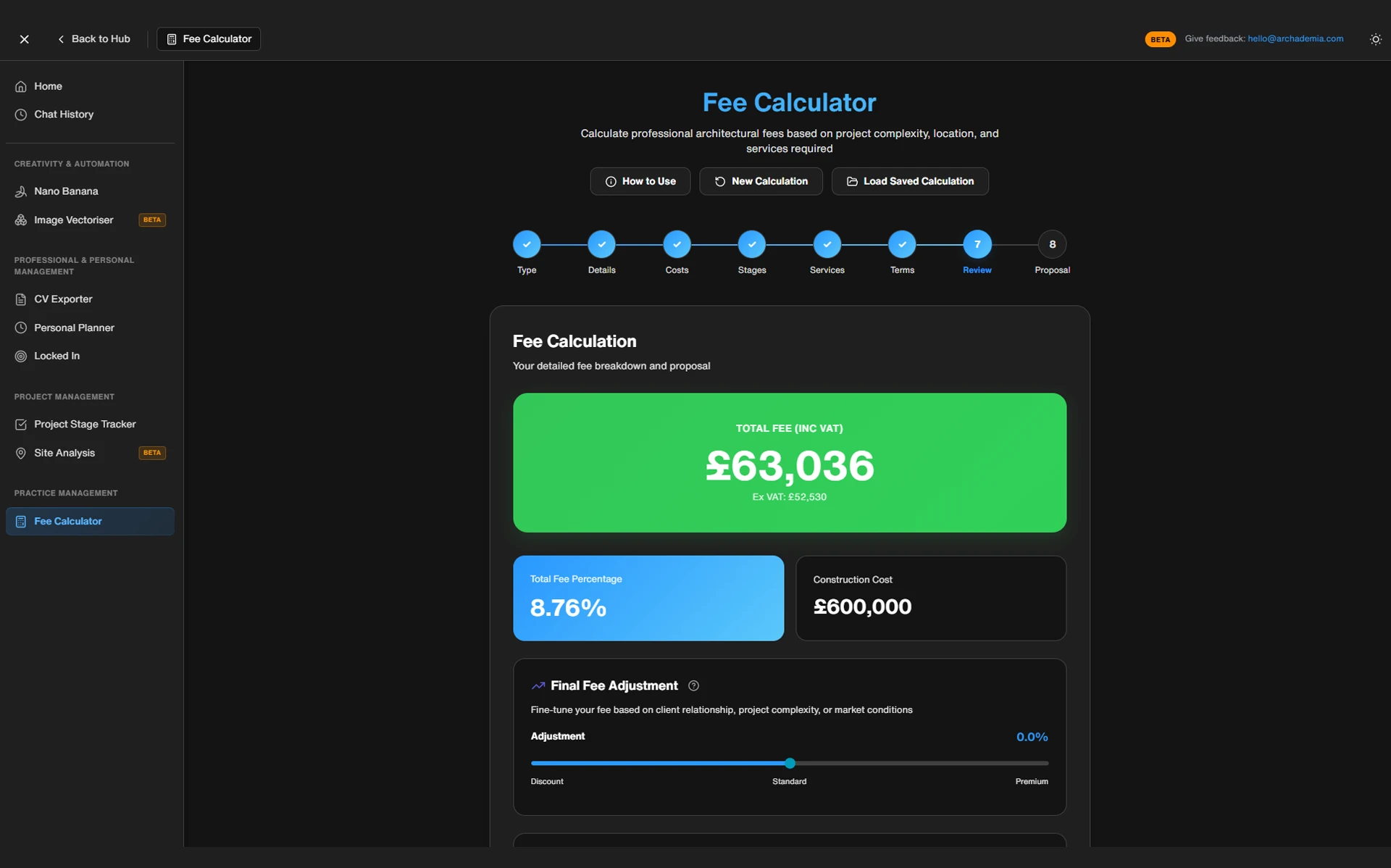
Fixed fee for a defined pack. The default, and the one that converts best, because the client gets a number before they commit and you get a boundary before you start. Build it bottom-up from the hours the scope above actually takes you, at your charge-out rate, plus a contingency for the site being weirder than it looked. Price the pack, not the hours.
Day rate, capped. Better for sites where you genuinely don't know what you'll find — a complex urban infill, a listed building, anything where the planning history runs to forty entries. Sell it as "up to three days at £X, and I'll stop and call you before I exceed that." The cap is what makes it buyable; without it, the client is signing a blank cheque and will say no.
Percentage of anticipated build cost. Works on larger or developer-led schemes where the eventual fee will be percentage-based anyway, and it sets the frame early that your fee scales with the project. It's a bad fit for domestic work, where the build cost is a guess at this stage and clients hear a percentage as a share of their house.
Now the maths that actually matters, which is conversion. Say you get ten serious-ish enquiries a year and currently do all ten at risk, converting three. Those three projects are paying for seven sets of unbilled sketches. Start charging, and some fraction walk away — but the ones who walk are overwhelmingly the ones who were never going to appoint you. In our experience you lose the tyre-kickers and keep almost everyone who had a real budget, so you end up being paid for perhaps six or seven studies instead of zero, and converting roughly the same number of full jobs. The conversion rate goes up, because the denominator stopped including people who were never buying.
Even in the pessimistic version — you charge, half the enquiries evaporate, you convert two full jobs instead of three — you've been paid five times for work you were giving away and you've got a fortnight of your year back. Run that arithmetic on your own numbers before you decide you can't afford to charge.
The credit clause that doesn't give the work away
Here is the wording that does the job, and the reasoning behind each limb of it:
"The Feasibility Study fee of £X is payable in full on instruction and is not conditional on the project proceeding. Should you appoint [Practice] for RIBA Stages 2–4 within six months of the date of issue of the Study, 50% of the Feasibility Study fee will be credited against the first invoice under that appointment. The credit is non-transferable, applies to one project only, and lapses if the appointment is not entered into within that period."
Four things are doing work there. Payable on instruction means the fee is not contingent — the moment it becomes contingent, you're back to speculative work with extra paperwork. Not conditional on the project proceeding kills the "well, we decided not to build it" conversation before it starts. A partial credit, not a full one, because a full credit tells the client the study was worthless in itself and prices your Stage 1 at nothing; half is generous enough to feel like a reason to appoint you and honest enough to say the work had value. The time limit stops someone reappearing in 2029 waving a study whose planning advice has been overtaken by a new local plan.
Keep the feasibility appointment as its own short letter of appointment, separate from the main contract. Scope, fee, payment terms, exclusions, limitations on reliance, one page. Then issue the full appointment separately when they proceed. Two documents, two decisions, two signatures — and if they vanish after the first one, you have a clean closed job rather than a half-performed contract.
"Can I just pick your brain for twenty minutes?"
Yes, and you should — for twenty minutes. A free initial call is sensible business; it's how you work out whether this is a project you want. What's not free is the thinking that follows it.
The line that works, more or less verbatim: "Happy to have a call and tell you whether it's worth pursuing at all — no charge for that. Once we get into whether it'll get planning and how it might work on the site, that's the feasibility study, and that's a fixed fee of £X. You'd get [the pack] and you'd own it, whether or not you use me afterwards."
Notice what that does. It doesn't refuse anything. It names the boundary, names the price, and tells them what they get for it. Clients who are buying say "what's included?" Clients who aren't say "let me think about it," and you never hear from them again, which is the service the sentence was designed to provide.
The one that needs rehearsing is the follow-up, two weeks later: "Could you just sketch something so we can see if it's worth doing the study?" The answer is no, and the reason is that sketching something is the study. If you've written the scope down, you can simply read it back to them.
Take the money up front
Feasibility is the stage with the weakest client relationship and the highest chance of disappearance, so it's the stage where payment terms should be tightest. Fee in full on instruction for anything small; 50% on instruction and 50% on issue for a larger study. Do not issue the document and then invoice. You have no lien worth anything over a PDF, and chasing £1,200 from someone who has decided not to build is the least profitable week you'll have all year.
If you're VAT registered, this is a supply like any other and the fee is quoted plus VAT — spell that out in the letter, because domestic clients routinely read the figure as the total and feel misled later. Your accountant will tell you the same.
One more thing that gets skipped. Feasibility advice is advice, and clients make purchase decisions on it — people buy sites on the strength of a planning risk note. Say in the appointment what the study is and isn't: that it's based on information available at the date of issue, that planning outcomes aren't guaranteed, that cost figures are order-of-magnitude, and that it's prepared for the named client's use only and no third party may rely on it. Then check with your broker that your PI cover actually extends to feasibility and pre-application advice as a standalone service — it's worth the phone call before you build a revenue stream on it.
The practice that charges for it
The sole practitioners who are busy and still broke are almost always giving away the same two days, forty times a year, to people who were comparison-shopping. Nothing about their drawing, their design or their client manner needs to change. One document needs to change: the one they send after the first phone call.
Write the scope. Name the fee. Send the invoice before you open the local plan. The clients worth having will pay it without blinking, and you will finally find out, in about a week, how many of your enquiries were ever real.