Fourteen years. Three directors, three cities, and — for the first eight of those years — no architecture department at all. Hold onto that last one, because almost everything written about the Bauhaus and architecture education skates straight past it.
The school opened in Weimar in 1919 and closed itself in Berlin in 1933. A building department didn't exist until 1927. So "Bauhaus architecture teaching" describes roughly six years of activity, run by two men who disagreed with each other about nearly everything, in two cities, the second of which was a disused telephone factory. That is a thin foundation for the claim that the modern architecture school is its direct descendant.
Some of it is still true. Just not the parts you've been told.
Gropius's 1919 manifesto opens with the line that the ultimate aim of all creative activity is the building. People read that as a curriculum. It was a flag. Building was the thing all the crafts were supposed to converge on eventually, the way a cathedral workshop converges — Feininger's cover woodcut for the manifesto was literally a cathedral.
What students actually did was this: a compulsory preliminary course, then entry to a workshop. Weaving, metal, cabinetmaking, pottery, wall-painting, printing, stained glass, theatre. If you wanted to learn architecture in the Weimar years you went and worked in Gropius's private practice, which was a separate business that happened to share a director with the school.
The building department arrived in 1927 with Hannes Meyer, a Swiss architect Gropius hired and then watched take over the whole school a year later when he resigned. Meyer was sacked in 1930 by the Dessau mayor who had appointed him, over his politics. Mies van der Rohe took the chair, moved what was left to Berlin as a private institute in 1932, and in 1933 the faculty voted to dissolve it rather than operate under the conditions the Nazi authorities imposed.
Three directors, three completely different schools. When someone says "the Bauhaus taught", ask them which one.
The Vorkurs is the real inheritance
Here's the part that genuinely descends to you.
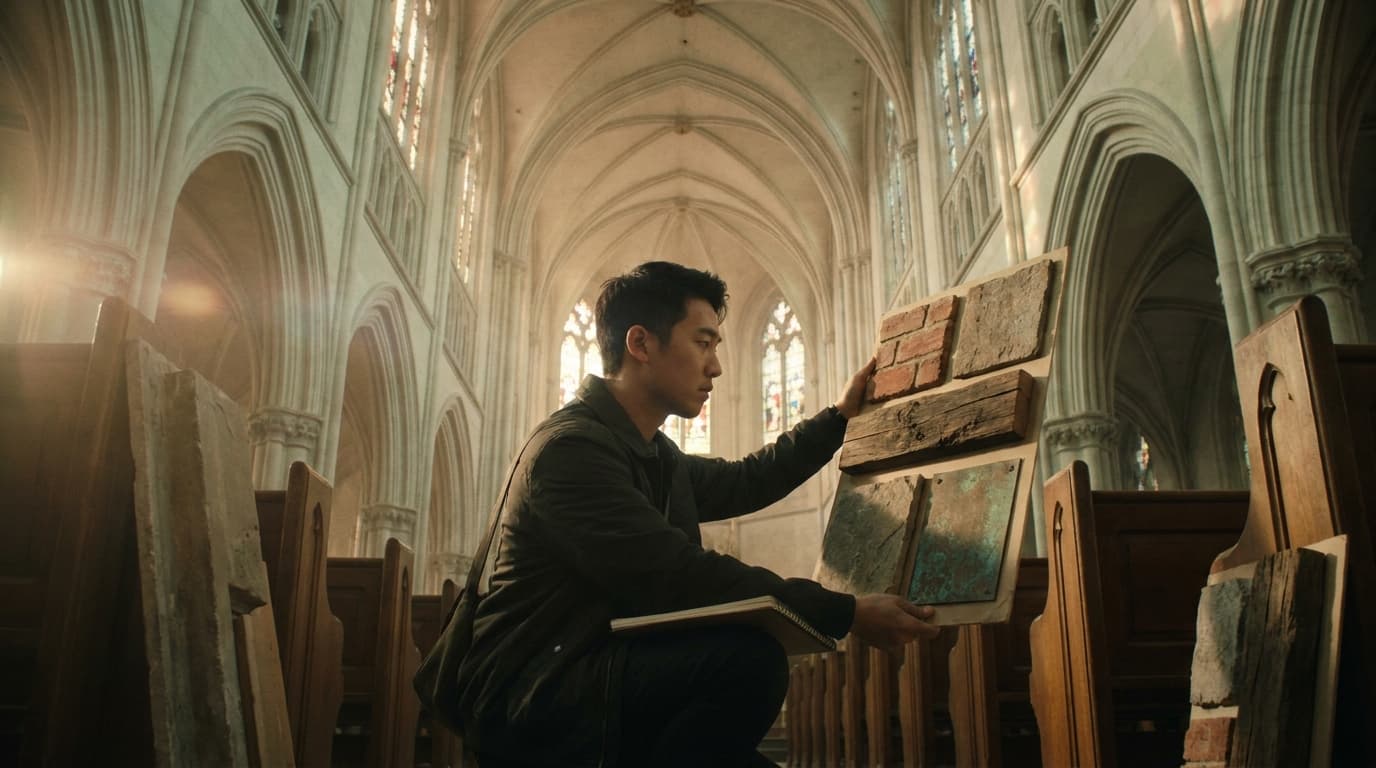
Johannes Itten built the preliminary course — the Vorkurs — as a compulsory gate. Everyone did it, regardless of what they'd studied before, before they were allowed near a workshop. Contrast studies. Texture and material studies. Analyses of old master paintings reduced to their underlying movement. Itten also ran breathing and meditation exercises drawn from his Mazdaznan beliefs, which is the bit the brochures leave out and the bit that got him pushed out in 1923.
Moholy-Nagy and Josef Albers took it over and stripped the mysticism. Albers's material studies gave a student one material and almost no permission — a sheet of paper, no glue, no scissors beyond what's necessary, now make it stand up and carry load. The question was never "what do you want to make". It was "what does this material want to do, and what have you assumed about it that isn't true".
Now look at your first semester. Make a spatial construct from one sheet of card. Cut a cube and record what the cutting does. Abstract composition before anything representational. Material-first, taste-last, no drawing from plaster casts.
That is the Vorkurs, four generations of photocopying later. The foundation year is the single clearest Bauhaus inheritance in architecture education, and it travelled not through Gropius's architecture teaching but through Albers's basic design course, which is a different thing entirely.
Two masters, one workshop
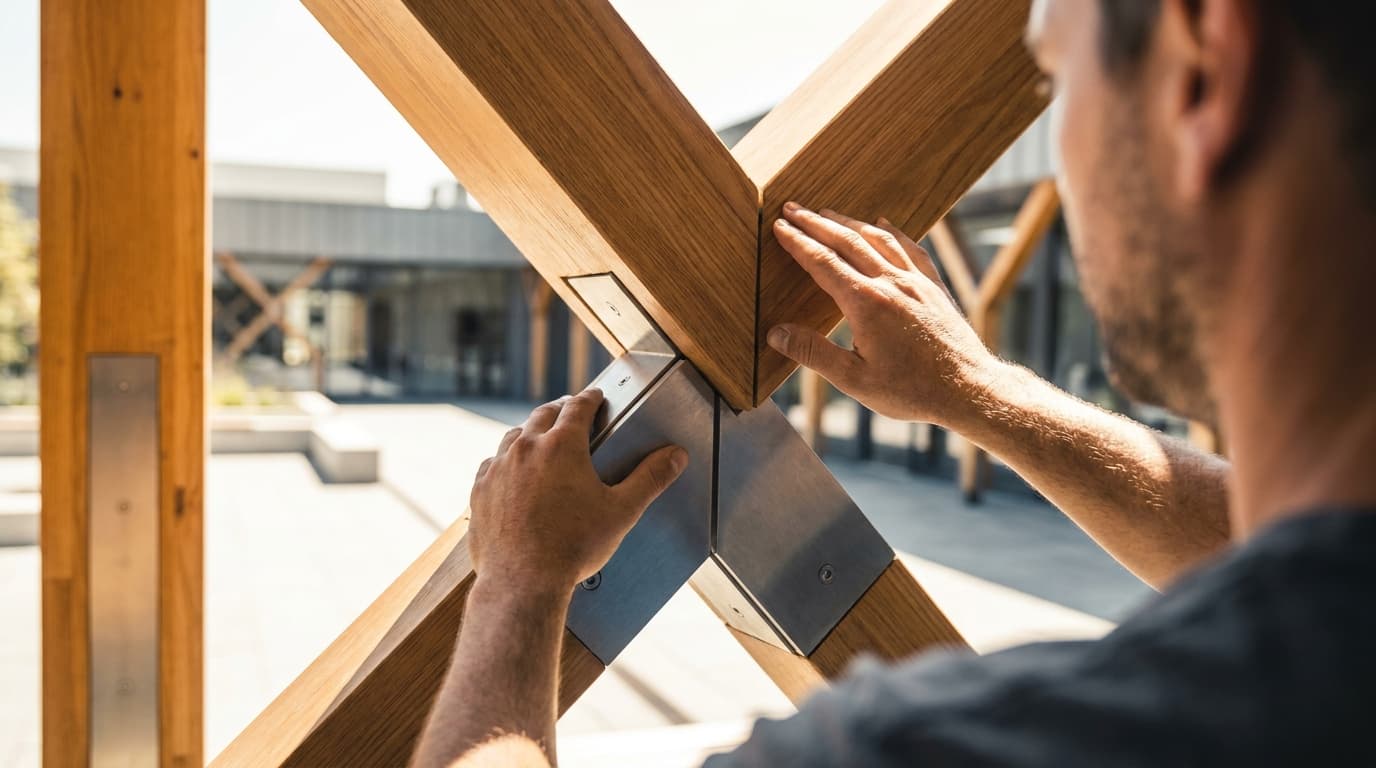
The structural idea nobody copied was the dual-master system. Each workshop had a Formmeister — a form master, an artist: Klee, Kandinsky, Schlemmer — and a Werkmeister, a trained craftsman who knew the kiln, the loom, the lathe. Gropius's reasoning was that neither one alone could teach. The artist doesn't know what the material will refuse to do. The craftsman has no reason to question the form.
Your school has this and has broken it. The design tutor is the form master. The workshop technician is the craft master. One of them is in the crit room with a job title and an opinion; the other is in a basement with a dust extractor and no vote on your grade.
In our experience the studios that produce the best work are the ones where the person who knows the fabrication is in the room while the design is still soft — not summoned afterwards to explain why your detail can't be cut. That's not a nostalgic point about handicraft. It's about who's allowed to say no, and when.
Your crit is French, not German
The thing you most associate with architecture school — the pin-up, the jury of visiting critics, the sleepless week before, the word "charrette" — has nothing to do with Weimar.
It comes from the École des Beaux-Arts in Paris. Students belonged to an atelier run by a patron, worked up competition entries, sat the esquisse en loge where you were locked in to produce a sketch design under time, and were judged by a jury. The charrette was the cart that came round to collect the drawings; you worked en charrette, on the cart, finishing as it rolled. That system was exported to America in the nineteenth century, to MIT and then to Penn under Paul Cret, decades before anyone in Boston had heard of Dessau.
The Bauhaus workshop was not a hanging jury. It produced objects, some of them under licence to manufacturers, assessed by whether they worked and sold. Nobody stood in front of a wall of A1 sheets defending a concept to five strangers.
So the modern architecture school is a hybrid with a slightly embarrassing family tree: Beaux-Arts bones, a Bauhaus first year bolted to the front, and a technology curriculum that owes more to twentieth-century engineering faculties than to either. Knowing which bit is which matters, because it tells you which conventions are load-bearing and which are just inherited furniture.
"Form follows function" isn't Bauhaus and never was
The phrase is Louis Sullivan's, from his 1896 essay The Tall Office Building Artistically Considered, and what he wrote was "form ever follows function" — a statement about nature and growth, written by an architect who covered his buildings in dense ornament.
The Bauhaus's own slogan, adopted for the 1923 Weimar exhibition, was Art and Technology — a New Unity. Different claim entirely. It's about reconciliation, not subordination.
The swap happened later, in the English-speaking retelling, and it's done real damage as a teaching shortcut. It lets a student present a bubble diagram with walls round it and call the absence of decisions a principle. We teach the opposite: function sets the constraints and then you still have to design the thing, and every choice you make after the plan works is the actual job. If you want the longer version of how that orthodoxy hardened and then got torn down, our piece on the transition from modern to postmodern architecture covers the backlash.
Hannes Meyer taught the course you're actually on
This is the uncomfortable one. The Bauhaus architecture teaching that most resembles a validated course today is Meyer's, and Meyer is the director who got written out.
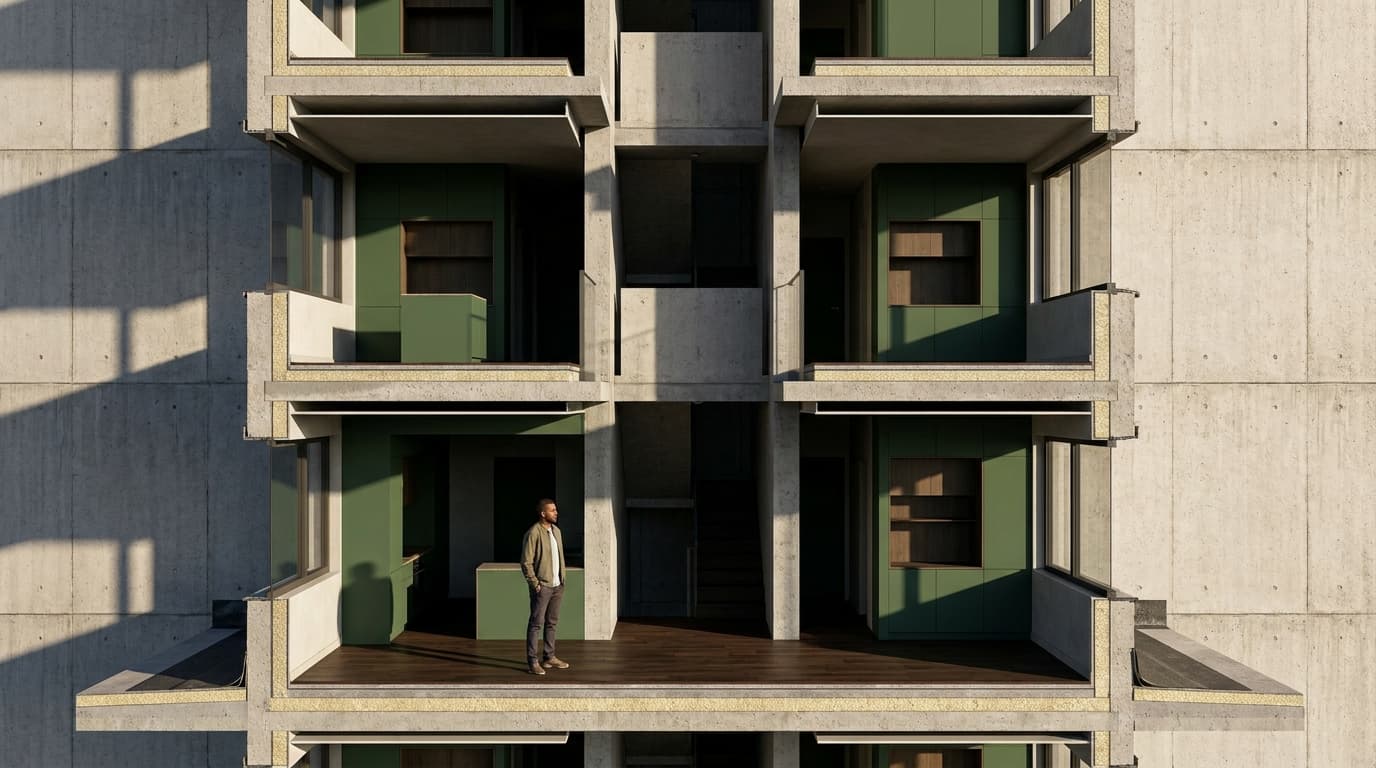
He ran the building department on the principle of Volksbedarf statt Luxusbedarf — people's needs, not luxury needs. He brought in lectures on sociology, psychology and economics. Students worked in vertical brigades mixing year groups on real commissions, doing sun studies, cost analysis, use surveys. The ADGB trade union school at Bernau was designed and built with student involvement. Sun angles, orientation, brief interrogation, user research, team working, a live project: read that list back and tell me it doesn't describe half the learning outcomes in your current handbook.
Then look at MoMA's 1938 exhibition, Bauhaus 1919–1928, curated by Gropius with Herbert Bayer and Ise Gropius. The dates are the giveaway. It stops the year Gropius left — which is to say, the canonical story of the Bauhaus, the one that reached America and then everywhere else, ends almost exactly where the architecture teaching begins.
The myth is not that the Bauhaus was influential. The myth is whose Bauhaus you're looking at.
What got lost at customs
Gropius went to Harvard in 1937, Breuer with him. Moholy-Nagy founded the New Bauhaus in Chicago the same year. Mies arrived at Armour Institute, later IIT, in 1938. Albers went to Black Mountain College in 1933 and on to Yale.
What survived the crossing was the foundation course and a visual language. What didn't was the workshop system. A research university runs on credit hours, assessable outcomes and departmental budgets; a weaving shed with a craft master on a production contract does not fit that, and later layers of professional accreditation and institutional liability didn't make it fit any better. The workshops became labs, then became optional, then became a booking form.
Mies at IIT replaced it with something else again — years of drawing construction, brick by brick, before you were permitted to design. Rigorous, narrow, and not Bauhaus pedagogy in any Weimar sense. And the explicitly methodical strand — systems, ergonomics, semiotics, design process as a describable procedure — came through Ulm, the Hochschule für Gestaltung founded by Bauhaus graduate Max Bill in 1953 and closed in 1968. If your school teaches design method as something you can diagram, that lineage runs through Ulm at least as much as through Dessau.
The making came back through a different door
The interesting twist is that learning-by-making didn't die, it changed material. CNC routers, 3D printing, robotic arms, 1:1 prototyping, programmes like the AA's Design & Make at Hooke Park where students build what they draw in timber they can walk up to.
And the Vorkurs question survives in a place nobody labels Bauhaus: software. Rhino has a grain. Revit has a grain. A model built against the grain of the tool fights you for the rest of the project, in exactly the way badly folded paper fails in an Albers exercise. What we've found teaching this stuff is that the students who get good fastest are the ones who treat a piece of software as a material to be interrogated rather than a set of buttons to be memorised. Same question Albers asked. Different workshop.
So what do you actually take from it
Three things, and the rest is wallpaper.
The foundation year is real inheritance, and it exists to dismantle the taste you walked in with, not to make you good at drawing. Treat it as the gate it was designed to be.
The crit is French, roughly a hundred and fifty years old, and was built to rank students in a competition. It's useful. It isn't sacred, and knowing where it came from is what lets you take what's valuable from it and ignore the theatre.
And the Bauhaus closed because it stood for something precise enough to be worth destroying. A school is a position, not a style. The chairs were never the point.