Architects in the UK typically charge between 8% and 15% of construction cost for full RIBA services on residential projects — but many practitioners charge significantly less, not because the market demands it, but because they've never been taught to negotiate. Fee negotiation isn't a personality trait reserved for confident extroverts. It's a learnable skill, and most architects never receive a single hour of training in it.
This article gives you the specific numbers, frameworks, and actual scripts you can use in your next fee conversation. RIBA benchmarks, overhead calculations, scope-versus-rate tactics, and the conversations nobody teaches you to have. No motivational padding. Just the mechanics.
What the Numbers Actually Say (And Why RIBA Won't Tell You Enough)
RIBA Fee Benchmarks in 2026
RIBA fee benchmarks for 2026 suggest residential architects should target 10–15% of construction cost for a full RIBA Stages 1–6 service, with smaller projects sitting at the higher end of that range due to fixed overhead costs that don't scale down proportionally. Commercial and public sector work typically sits at 5–8%, though the scope is usually considerably larger and the client more commercially sophisticated.
These benchmarks come from RIBA's Business Benchmarking surveys — and they're useful, but only as a floor. The problem is that most architects treat them as a ceiling. They see 10% and immediately worry about being "too expensive" rather than recognising that 10% is the minimum defensible position for full service on a residential project.
Where Most Architects Land vs. Where They Should Be
Architects consistently charge 15–25% less per hour than structural engineers and quantity surveyors on equivalent project complexity, according to NBS benchmarking data. That gap is not explained by market forces. It's explained by the fact that engineers and surveyors negotiate differently — they know their cost base, they anchor high, and they don't apologise for their fees.
The lump sum versus percentage question matters here too. Percentage fees benefit from construction cost inflation and give clients a clear logic — they pay more when the project costs more, which feels proportionate. Lump sums give clients certainty, which many prefer, but expose you to scope creep if you're not disciplined about change control. Neither model is inherently superior. The question is which one you can manage well.
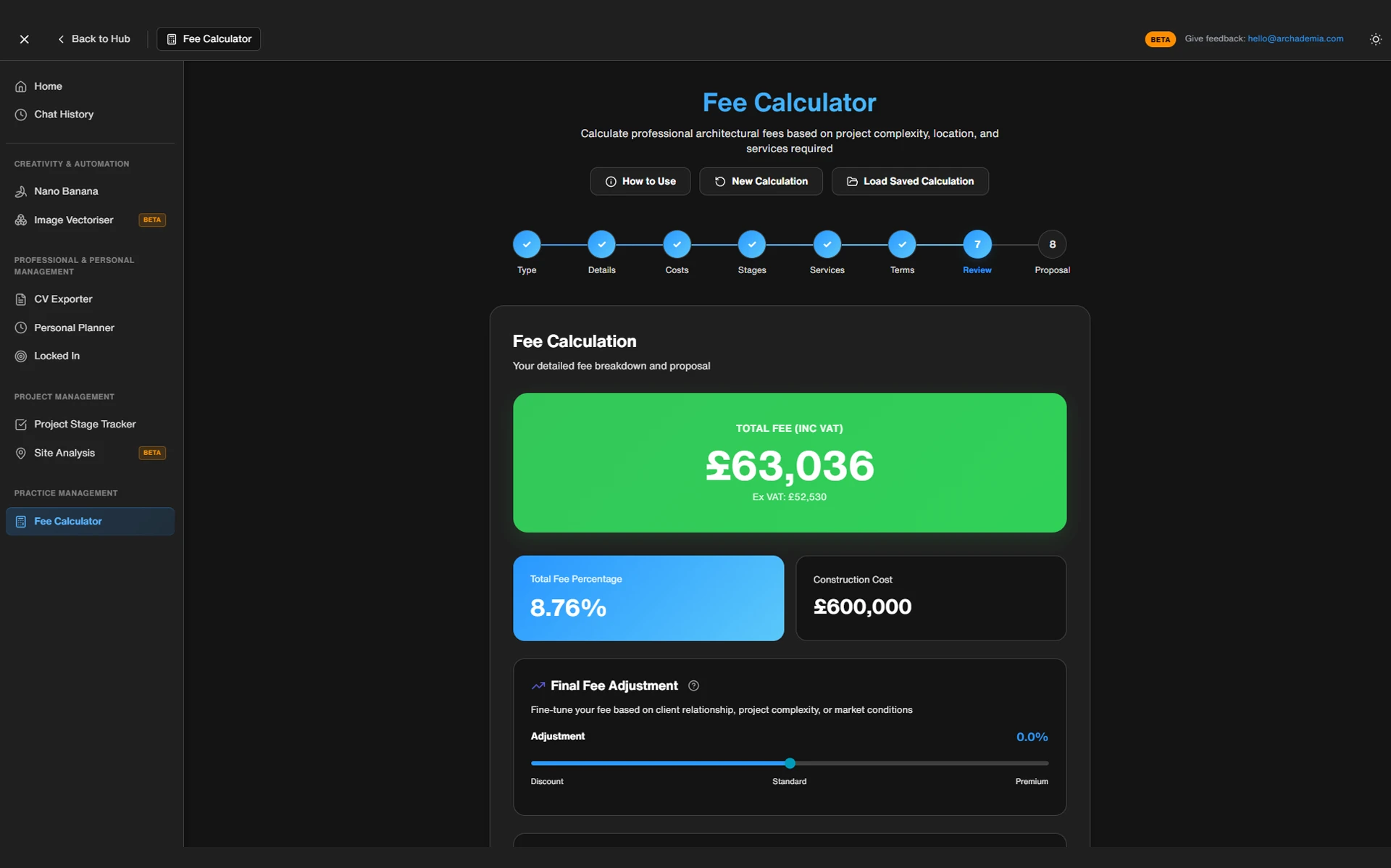
If you don't already know your actual cost base — what it costs your practice to deliver an hour of work — then both models are guesswork. ArchAdemia's fee calculator in the Toolkit is a practical starting point for working out your real numbers before your next proposal goes out.
Know Your Cost Base Before You Name a Price
The Hourly Rate Calculation You Should Have Done Years Ago
A sustainable architect charge-out rate requires an overhead multiplier of 2.5 to 3 times the direct salary cost — meaning an architect costing £40 per hour to employ should be billed at a minimum of £100–120 per hour. Most architects who quote below this threshold are effectively subsidising their clients without realising it.
The calculation isn't complicated. Take your annual salary cost (including employer's National Insurance and pension contributions). Add your share of practice overhead — rent, software licences, IT, admin staff, CPD, professional subscriptions. Then add professional indemnity insurance, which for a small UK architecture practice typically costs between £3,000 and £8,000 per year. Divide by your actual billable hours (not your contracted hours — your genuinely billable hours, which for most architects is somewhere between 60% and 70% of total working time). That gives you your cost per hour. Multiply by 2.5 to 3. That's your minimum viable charge-out rate.
Overhead Multipliers and What They Mean for Your Quotes
The overhead multiplier is the number most architects skip when pricing work. They think about their time and forget about everything that makes their time possible. PI insurance alone can run to £8,000 a year for a practice with a few residential projects on the books. Add ARB registration, RIBA membership, software subscriptions for Revit, AutoCAD, and rendering tools, and you're looking at £15,000–20,000 in fixed annual costs before a single hour of work is delivered.
Once you know your floor, the negotiation changes. You're not guessing at whether you can afford to accept a lower fee — you know. You negotiate from a position of information rather than hope. That shift in posture is worth more than any script.
The Negotiation Itself: Scripts That Don't Make You Sound Desperate
Anchoring: Why You Should Quote High First
Anchoring in fee negotiation means quoting your full fee first, before the client names a budget — research consistently shows the first number stated in a negotiation influences the final outcome by up to 30%. This is not about being aggressive. It's about controlling the reference point from which all subsequent discussion is measured. If a client says "we were thinking £20,000" before you've named a number, you're negotiating down from £20,000. If you say "£35,000" first, you're negotiating from a completely different position.
Always quote first if you can. If a client asks for your "ballpark" before you've had time to prepare a proper proposal, give a range that starts higher than your target. "Based on what you've described, I'd expect this to sit somewhere between £X and £Y" — where X is your actual target and Y gives you room.
When the Client Asks You to Come Down
When a client requests a lower fee, architects should offer scope reduction rather than rate reduction — this preserves the hourly rate and prevents the practice from subsidising the project. This is the single most important tactical principle in architect fee negotiation. The moment you reduce your rate, you've told the client your original rate was negotiable, and you've set a precedent for every future conversation.
The script is simple:
"I can absolutely work within that budget. What I'd suggest is we look at which RIBA stages you need from us directly, and which elements your team or a specialist contractor can handle. I won't reduce my rate — that's set by our cost base — but I can reduce the scope to fit your budget."
Then stop talking. The silence after quoting a fee is the hardest moment in any negotiation. Most architects fill it by immediately offering a discount. Don't. Let the number sit. The discomfort you feel is not the client rejecting you — it's just a pause.
Scope Reduction vs. Fee Reduction — Never Confuse the Two
Approach
Effect on Hourly Rate
Effect on Margin
Client Perception
Long-term Risk
ApproachReduce fee, keep scope
Effect on Hourly RateRate drops
Effect on MarginMargin compressed
Client Perception"They were flexible"
Long-term RiskSets discount precedent
ApproachReduce scope, keep rate
Effect on Hourly RateRate protected
Effect on MarginMargin maintained
Client Perception"They're professional"
Long-term RiskScope creep still possible
ApproachWalk away
Effect on Hourly RateN/A
Effect on MarginN/A
Client Perception"They're serious"
Long-term RiskOccasionally wins the job
When a client comes back with "we've had a cheaper quote," don't defend your price. Acknowledge it and reframe:
"That's worth exploring properly. I'd encourage you to compare the scope line by line before deciding — what's included at that fee level, what's excluded, and what happens if the project changes. Those are the questions that matter."
You're not attacking the competitor. You're giving the client a rational framework that happens to highlight the risks of choosing on price alone.
If a client needs you to cut your fee by more than 20% to win the work, walk away. The project economics almost certainly don't work for your practice once you account for scope creep, the time cost of a difficult client relationship, and the opportunity cost of being tied up in an underpaid project when a better one might come along.
Fee Structures: Which Model Protects You Most
The most defensible fee structure for residential architects in 2026 is a hybrid model: lump sum fees per RIBA stage with a defined additional services schedule charged at an agreed hourly rate. This gives clients the cost certainty they want while protecting your practice from the scope creep that kills lump sum agreements.
Percentage Fees
Percentage fees work best on large projects where the construction cost is uncertain at the outset and likely to grow. They're transparent, easy for clients to understand, and they automatically adjust if the project scope increases. The risk is that they expose you to scope creep in a different way — clients sometimes interpret the percentage as covering everything, regardless of how many revisions they request.
Lump Sum Fixed Fees
A lump sum fee agreement without a change control clause exposes architects to unlimited scope creep — every lump sum contract should define, in writing, what triggers an additional fee instruction. Without this, you absorb every client-initiated change, every planning revision, every "can we just try it this way" conversation into a fixed fee that was never priced to include them.
Plain English change control language: "Any instruction from the client that materially alters the approved design, brief, or programme, or that requires work outside the agreed scope, will be treated as an additional service and charged at the agreed hourly rate. We will notify you before proceeding."
Hourly Rate Retainers
Hourly rates are most appropriate for feasibility and advisory work where the scope is genuinely undefined. They protect you completely but give clients no cost certainty, which creates anxiety and can lead to micromanagement of your time. Use them for early-stage work, then transition to a lump sum per stage once the scope is clear enough to price.
Hybrid Models
The hybrid model combines lump sum fees per RIBA stage with an agreed hourly rate for additional services. It's the most defensible structure because it gives clients certainty at each stage gate while leaving the mechanism for additional work clearly established from day one.
Comparison Table: Fee Structures at a Glance
Fee Structure
Best For
Main Risk
Protects Hourly Rate?
Change Control Needed?
Recommended For
Fee StructurePercentage of construction cost
Best ForLarge projects, uncertain scope
Main RiskScope creep if not managed
Protects Hourly Rate?Partially
Change Control Needed?Yes
Recommended ForCommercial, new build
Fee StructureLump sum per RIBA stage
Best ForResidential, defined scope
Main RiskScope creep absorbs margin
Protects Hourly Rate?Yes (if managed)
Change Control Needed?Essential
Recommended ForResidential extensions, refurbs
Fee StructureHourly rate
Best ForFeasibility, advisory
Main RiskClient anxiety, micromanagement
Protects Hourly Rate?Yes
Change Control Needed?No
Recommended ForEarly-stage work
Fee StructureHybrid (lump sum + hourly additional services)
Best ForMost residential projects
Main RiskComplexity of tracking additional services
Protects Hourly Rate?Yes
Change Control Needed?Yes
Recommended ForDefault recommendation
Percentage-based fees work best on large construction projects where cost certainty is low; lump sum fees suit smaller residential projects with well-defined scope; hourly rates are most appropriate for feasibility and advisory work.
What Clients Are Actually Buying (And How to Remind Them)
Value Framing Without the Sales Nonsense
Architects should frame their fee relative to the total construction cost rather than as an absolute number — a 12% fee on a £500,000 project represents £60,000 to manage £500,000 of financial and regulatory risk over a two-year programme. When you present the fee as an isolated figure, clients compare it to other things they spend money on. When you present it as a percentage of the risk they're taking on, the conversation shifts.
Don't use the word "value." It's vague and it sounds like something a salesperson says. Use the actual numbers instead.
"My fee is £60,000. The construction contract is £500,000. Over two years, you'll be making decisions that affect every pound of that. My job is to make sure those decisions are the right ones — on planning, specification, contractor management, and cost control."
The Risk Transfer Argument
Projects with full architectural oversight from RIBA Stage 1 through to Stage 6 experience significantly fewer contractor disputes and cost overruns than those where architects are engaged only for design stages. This isn't a sales pitch — it's a structural fact about how construction projects work. When there's no architect on site, contractors make decisions. Some of those decisions save time. Many of them cost money.
The planning refusal argument is equally concrete. A planning refusal on a residential project typically costs the client 6–12 months of programme time and an additional round of design fees. An architect who knows the local planning authority, has read the design guide, and has managed pre-application discussions reduces that risk substantially. That reduction is worth paying for.
Don't oversell this. State it once, clearly, and let the client do the maths.
The Conversations Nobody Teaches You to Have
Raising Fees on Existing Clients
Architects should give existing clients at least three months' notice of a fee increase, framing the change as an annual practice review rather than a reactive decision. The language matters here. "We review our fee schedule annually. From [date], our rates will increase by X%. I wanted to give you advance notice and confirm we're committed to continuing the relationship." That's it. No apology, no lengthy justification, no request for permission.
Most architects raise fees too infrequently and by too little when they do. If you haven't raised your rates in two years, you've already absorbed two years of inflation, software cost increases, and PI premium rises into your margin. A 5–8% annual increase is reasonable and expected by any commercially literate client.
Negotiating with Developers vs. Private Clients
Developer clients negotiate hard, negotiate often, and respect directness. They're running a business and they know you are too. A firm "no" from an architect is more likely to win a developer's respect than a soft "let me see what I can do." Don't soften your position with developers — state your fee, explain your structure, and hold it.
Private residential clients are different. They're emotionally invested in the project, often spending the largest sum of money they'll ever commit to, and fee discussions can feel personal. Use the scope-not-rate reframe more actively here. Give them the sense that you're solving their problem together, not holding a line against them.
Clients who negotiate aggressively on fees before a contract is signed are statistically more likely to dispute invoices and request scope additions without additional payment during delivery. Fee negotiation is a preview of the relationship. Pay attention to it.
When to Walk Away
If you're discounting more than 15–20% to win a project, the work is probably loss-making once scope creep is accounted for. The harder calculation is the opportunity cost — the hours you spend on an underpaid project are hours you're not spending on finding better ones.
Walking away is a skill. It gets easier with practice, and it gets more effective as your practice develops a clear sense of what it's for. The practices that command the best fees aren't necessarily the most famous — they're the ones that know exactly what they do, who they do it for, and what it costs to do it properly.
If you want to build the business skills to back that up — from fee structures to practice management — ArchAdemia's Studio Setup course covers the fundamentals that most architecture schools never touch. Over 4,000 architects and designers are already using ArchAdemia to close those gaps. The Toolkit is where the fee calculators and project trackers live — the numbers that make the negotiation possible.
The best time to work out your cost base was when you started your practice. The second best time is before your next proposal goes out.
Frequently Asked Questions
What percentage should an architect charge in the UK in 2026?
UK architects should target 10–15% of construction cost for full RIBA Stages 1–6 service on residential projects in 2026, with smaller projects at the higher end of that range. Commercial and public sector projects typically sit at 5–8%, reflecting larger project values and more defined procurement processes.
How do I respond when a client asks me to lower my fee?
Offer to reduce scope rather than reduce your rate. Say: "I can work within that budget — let's look at which RIBA stages you need from us and which your team can handle. I won't reduce my rate, but I can reduce the scope." This protects your hourly rate and prevents you from subsidising the project.
What is the best fee structure for a residential architect?
The best fee structure for residential architects in 2026 is a hybrid model: lump sum fees per RIBA stage with a defined additional services schedule charged at an agreed hourly rate. This gives clients cost certainty at each stage while protecting the practice from scope creep.
How much should a small UK architecture practice charge per hour?
A small UK architecture practice should charge a minimum of £100–120 per hour for an architect costing £40 per hour to employ, based on an overhead multiplier of 2.5 to 3 times direct salary cost. This multiplier covers rent, software, PI insurance (typically £3,000–8,000 per year for small practices), and other fixed overheads.
How do I raise my fees with existing clients?
Give at least three months' notice and frame it as an annual practice review rather than a personal decision. Use this language: "We review our fee schedule annually. From [date], our rates will increase by X%. I wanted to give you advance notice and confirm we're committed to continuing the relationship." No apology is necessary.
When should an architect walk away from a fee negotiation?
Walk away when a client requires more than a 15–20% discount to proceed. At that level, the project is likely loss-making once scope creep is accounted for, and clients who negotiate that aggressively before signing are more likely to dispute invoices and request unpaid scope additions during delivery.
What is anchoring in architect fee negotiation?
Anchoring means stating your full fee first, before the client names a budget. The first number stated in a negotiation influences the final outcome by up to 30%, so quoting high first gives you a stronger reference point from which to negotiate. Never let the client anchor you to their budget before you've named your price.
What should be in a change control clause for architecture contracts?
A change control clause should state that any client instruction that materially alters the approved design, brief, or programme will be treated as an additional service and charged at the agreed hourly rate. The clause should require written notification before additional work proceeds. Without this, every lump sum agreement exposes the architect to unlimited scope creep.