Most architecture practices undercharge not because they lack confidence, but because they lack a structured method for calculating fees — and guessing is not a method. Gut feel, what a competitor might charge, what the client seems willing to pay — these are not fee strategies. They are expensive habits dressed up as intuition.
This article is a practical walkthrough of how to use an architecture fee calculator properly. Not a motivational piece about knowing your worth. Not a vague framework you'll forget by Friday. A concrete method for turning project scope into a defensible number — and an introduction to ArchAdemia's fee calculator, part of the free Toolkit at archademia.com, built specifically for architects who are tired of leaving money on the table.
Pricing is uncomfortable. That's especially true for sole practitioners and small practices where the person doing the design is also the person sending the invoice. But discomfort with pricing is a skills gap, not a character flaw. The fix is a process, not a pep talk.
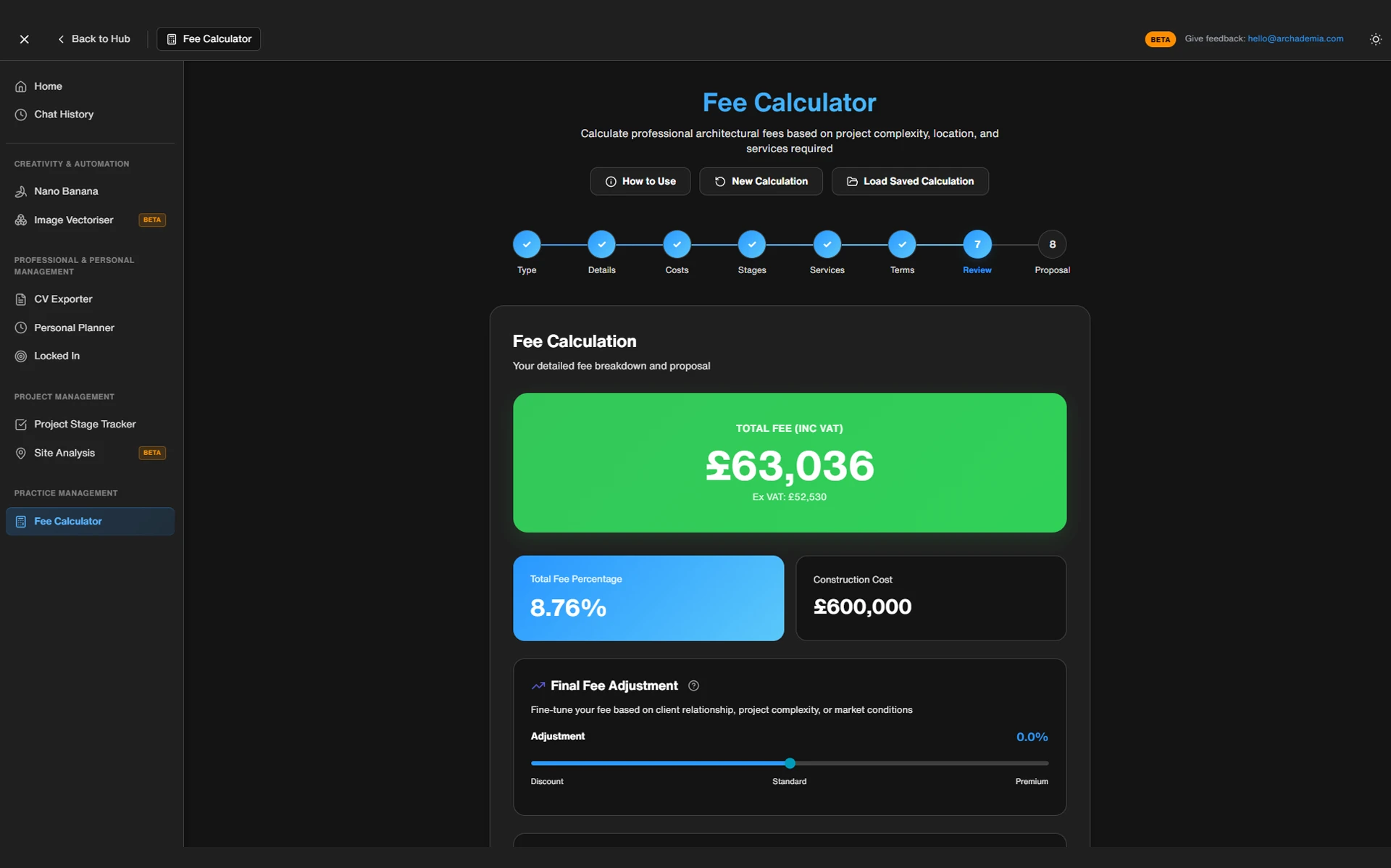
ArchAdemia's fee calculator gives architects a structured framework to calculate project fees based on hours, role rates, and project complexity — removing the guesswork from one of the most financially consequential decisions a practice makes.
An architecture fee calculator converts estimated project hours, staff role rates, and overhead costs into a defensible project fee — replacing gut-feel pricing with a repeatable, auditable method.
Without one, you're essentially working backwards from a number that feels acceptable rather than forwards from a number that's accurate. Those two directions produce very different results.
The Problem with Percentage-Based Fees
The traditional model — charging a percentage of the construction cost — sounds elegant. Simple, scalable, tied to project value. In practice, it's a blunt instrument that masks whether you're actually covering your costs.
Percentage fees for residential work typically run at 5–15% of construction cost, with commercial projects sitting lower. On a £500,000 new build, 10% gives you £50,000. That sounds reasonable until you actually count the hours. If the project takes 600 hours across your team, you're billing at roughly £83 per hour — before overheads, before contingency, before the three rounds of planning revisions nobody priced for.
The percentage model makes the maths feel easy. That's the problem. It lets you avoid doing the real calculation.
RIBA's 2024 Business Benchmarking Report found that 43% of small architecture practices reported fee income failing to cover project costs on at least one project in the previous 12 months. That statistic isn't about bad luck. It's about pricing without a proper method.
What a Proper Fee Calculation Actually Accounts For
A genuine fee calculation forces you to confront the real inputs: how many hours will this project actually take, broken down by stage; what each role costs to deploy; what your overhead burden is; and what margin you need to remain a viable business.
RIBA publishes benchmark data on hourly rates and project time allocations — useful starting points, particularly if you have no historical data to draw from. But benchmarks are a floor, not a ceiling. Your practice's numbers are what matter, and a fee calculator is the tool that makes you confront them honestly.
A fee calculator is not a luxury. It is basic financial hygiene.
Inside ArchAdemia's Fee Calculator: What It Actually Does
ArchAdemia's fee calculator, available free inside the Toolkit at archademia.com, allows architects to input project stages, estimated hours per RIBA Work Stage, and role-specific charge-out rates to generate a total project fee with built-in contingency.
This isn't a spreadsheet you build yourself from scratch, debug for an afternoon, and abandon by the following week. It's a structured tool designed around how architecture projects actually work — staged, multi-role, and almost always subject to some degree of scope movement.
The Inputs: What You Put In
The calculator takes the following inputs:
Project type — residential, commercial, mixed-use, public sector
RIBA Work Stages included — which stages are in scope (Stages 0 through 7)
Estimated hours per stage — broken down by role
Role rates — principal, architect, technician, administrator — each with their own charge-out rate
Overhead multiplier — the percentage added to cover practice costs beyond direct staff time
Profit margin target — what the practice needs to remain viable
Contingency percentage — the buffer for scope creep, client changes, and planning delays
Every field is asking you to make a decision. That's the point. The discomfort of filling it in is the discomfort of running a business properly.
The Outputs: What You Get Out
The calculator doesn't just hand you a single number and wish you luck. The outputs include:
Total project fee
Fee broken down by RIBA Work Stage — so you can invoice in stages and track against budget
Implied hourly rate — a useful reality check
Breakdown by role — showing what each team member's time is contributing to the total
That last output matters more than people realise. If the principal's time is dominating the fee on a project that should be run by a technician, that's a resourcing problem as much as a pricing problem.
The Before/After: Pricing With and Without It
Here's a concrete illustration. A sole practitioner is pricing a residential extension. By gut feel, they quote £8,000 — it feels competitive, the client seems budget-conscious, and they want the work.
Run the same project through the calculator: 120 hours of work, a charge-out rate of £65 per hour, 15% overhead, 10% contingency. The minimum viable fee is £10,350.
That £2,350 gap doesn't sound catastrophic on one project. Across six similar projects in a year, it's over £14,000 of revenue that never existed — work that was done, billed below cost, and quietly absorbed as stress rather than profit.
The calculator is only as good as your hour estimates, though. If you've never tracked time on a project, your inputs will be optimistic. Pair the fee calculator with ArchAdemia's project tracker — also part of the Toolkit — to build a real data set from your own projects. Your future estimates will be sharper for it.
ArchAdemia's Toolkit — which includes the fee calculator, CV exporter, and project tracker — is free for all members of the platform, which serves over 4,000 architects and designers globally across 60+ courses.
How to Actually Use It: A Step-by-Step Walkthrough
The most accurate method for calculating an architecture project fee is to estimate hours separately for each RIBA Work Stage, apply role-specific charge-out rates, then add overhead and contingency — rather than estimating a single lump-sum figure. Stage-by-stage estimation forces precision. Lump-sum estimation invites optimism.
Step 1: Define Your Scope by RIBA Work Stage
Before you enter a single number, be explicit about which stages are included in the commission. Many architects inadvertently include stages they haven't agreed — or charged — for. Stages 0 through 7 each have completely different time profiles. Stage 2 (Concept Design) and Stage 4 (Technical Design) are typically the most time-intensive. Stage 6 (Handover) is consistently underpriced.
List what's in. List what's out. If the client later asks for something that's out, you have a documented basis for a fee variation.
Step 2: Estimate Hours Honestly
This is where most fee calculations fall apart. Use past projects as benchmarks wherever you can. If you have no data, RIBA's published time allocation benchmarks are a reasonable starting point — then add 20% for a new client or an unfamiliar project type.
New clients take longer. New building types take longer. Planning authorities you've never dealt with take longer. The 20% buffer isn't pessimism; it's pattern recognition.
Step 3: Set Your Charge-Out Rates
There's a critical distinction between your cost rate — what a team member costs the practice per hour — and your charge-out rate — what you bill the client. The charge-out rate must cover salary, employer's National Insurance, pension contributions, overheads, and profit.
Architecture charge-out rates should be set at 2.5 to 3 times the staff cost rate to cover all of the above and remain financially viable — a benchmark consistent with RIBA's financial guidance. If your architect costs the practice £30 per hour in salary terms, their charge-out rate should be in the range of £75–£90.
If that number feels high, the problem is not the multiplier. The problem is that the true cost of employment has been invisible until now.
Step 4: Apply Overhead and Contingency
Overhead covers the practice's fixed costs: rent, software licences (not trivial — a full BIM and rendering stack runs to several thousand pounds per year per seat), professional indemnity insurance, admin time, and business development. These costs exist whether a project is running or not.
A contingency of 10–15% should be built into every architecture fee to account for scope creep, client-driven changes, and planning delays — none of which are unusual on a standard residential or commercial project. Planning delays alone can add months to a Stage 3 commission. That time has to come from somewhere.
Step 5: Sense-Check Against the Market
Once you have your calculated fee, compare it against market rates for the project type and region. If you're significantly above market, either your hours are too high or your rates need reviewing. If you're below market, you've almost certainly undercounted hours.
Being below market isn't a competitive advantage. It's a signal that your fee is wrong.
Fee Models Compared: Which One Should You Use?
For most residential and small commercial projects, a fixed fee calculated from an hours-based model offers the best balance of client clarity and practice financial control — percentage fees work better on large construction contracts where scope is genuinely tied to build cost.
Fixed fees are now the most common fee structure in UK architecture — used by 61% of practices according to RIBA's 2024 survey — having overtaken percentage-based fees for the first time. That shift reflects hard-won experience across the profession. Fixed fees force the practice to do the calculation upfront. Percentage fees let you avoid it.
Comparison Table: Architecture Fee Models
Fee Model
Best For
Risk to Practice
Client Clarity
Calculator Use
Fee ModelFixed Fee
Best ForResidential extensions, small commercial, defined scope
Risk to PracticeScope creep if not managed
Client ClarityHigh
Calculator UseEssential — use to set the number
Fee ModelPercentage of Construction Cost
Best ForLarge commercial, public sector, complex builds
Risk to PracticeCan undervalue design-heavy early stages
Client ClarityMedium
Calculator UseUse as a sense-check
Fee ModelTime and Charge (Hourly)
Best ForFeasibility studies, undefined scope, expert witness work
Risk to PracticeUnlimited upside but client resistance
Client ClarityLow
Calculator UseUse to set and track rates
Fee ModelHybrid (Fixed per Stage)
Best ForMulti-stage commissions with uncertain later scope
Risk to PracticeModerate — each stage is capped
Client ClarityHigh
Calculator UseIdeal — calculate stage by stage
A hybrid fee model — fixed fees calculated per RIBA Work Stage — offers the best combination of client clarity and practice financial protection for multi-stage architecture commissions. It gives the client predictability at each stage while protecting the practice from committing to a fixed total on a project where later stages are genuinely undefined.
Time-and-charge billing is most appropriate for architecture feasibility studies and undefined-scope commissions, but creates client uncertainty on full design commissions. Its use is declining across UK practice for exactly that reason.
What the Calculator Won't Tell You (And What Will)
A fee calculator produces a financially defensible number. It does not tell you whether to take the project, whether the client is worth working with, or whether your fee will actually be accepted.
Those judgements require something the calculator can't provide: experience, instinct, and an honest read of the room. A calculated fee of £18,000 is meaningless if the client's budget is £9,000 and they've told you so upfront. The calculator gives you your floor. What you do above or below that floor is still a human decision.
There are three things the calculator genuinely cannot account for:
Client behaviour. Some clients generate three times the work of others for the same project type. If you know this from experience, build it into your hour estimates — not into wishful thinking.
Your own speed. A sole practitioner with ten years of residential experience will complete Stage 2 faster than a junior architect on their second project. The calculator uses the hours you give it. Give it honest hours.
The value of the relationship. Sometimes a lower fee on a project that builds a long-term client relationship is a rational business decision. The calculator doesn't know that. You do. Make the decision consciously, not by accident.
What will tell you whether your fees are right over time is data. Track your hours on every project — ArchAdemia's project tracker exists precisely for this — and compare estimated hours against actual hours at project completion. Within a year, your estimates will be materially more accurate. Within two years, you'll have a practice-specific benchmark that's more useful than any industry average.
Pricing by Role: Who This Matters Most For
Fee calculation isn't equally pressing across every stage of an architectural career, but it affects everyone differently.
Sole practitioners and small practices face the most acute version of this problem. There's no finance director, no billing department, no one to catch a mispriced project before it becomes a financial hole. The fee calculator is the closest thing to a financial safety net a one-person practice has.
Junior architects moving into project management roles need to understand fee structures before they're responsible for them. If you're running your first project and you don't know how the fee was calculated, you don't know when you're over-running. The Part 3 Masterclass on ArchAdemia covers practice management fundamentals including fee structures — worth doing before the responsibility lands on your desk.
Established practices reviewing their fee structures will find the calculator useful as an audit tool. Run your last three completed projects through it retrospectively — actual hours, actual rates — and see how the calculated fee compares to what you charged. The gap, if there is one, is instructive.
Frequently Asked Questions
What is an architecture fee calculator?
An architecture fee calculator is a structured tool that converts estimated project hours, team role rates, and overhead costs into a total project fee. It replaces gut-feel pricing with a repeatable, auditable method — giving practices a financially defensible number rather than an approximation.
How much should an architect charge for a residential extension in the UK?
Architect fees for a residential extension in the UK typically range from £5,000 to £15,000+ depending on project complexity, location, and scope of service. A fee calculator will give you a more accurate figure for your specific project by working from actual hours and rates rather than market averages.
What is a typical architecture fee percentage in the UK?
Architecture fees as a percentage of construction cost typically range from 5% to 15% for residential projects, with commercial projects often sitting lower. However, RIBA's 2024 survey found that 61% of UK practices now use fixed fees rather than percentage-based fees, as fixed fees better reflect actual project costs.
What should my charge-out rate be as an architect?
Your charge-out rate should be 2.5 to 3 times your cost rate — the hourly cost of employing you including salary, National Insurance, and pension contributions. This multiplier covers overheads and profit margin. If your cost rate is £30/hr, your charge-out rate should be between £75 and £90/hr.
What is the best fee model for small architecture projects?
A fixed fee calculated from an hours-based model is the best fee structure for small residential and commercial architecture projects. It gives clients cost certainty and forces the practice to calculate costs accurately upfront. Percentage-based fees are better suited to large commercial projects where scope genuinely scales with build value.
How much contingency should I include in an architecture fee?
A contingency of 10–15% should be included in every architecture project fee to account for scope creep, client-driven changes, and planning delays. On projects with a new client or unfamiliar project type, 15% is a more prudent minimum.
Is ArchAdemia's fee calculator free?
Yes. ArchAdemia's fee calculator is free for all members of the platform and is part of the Toolkit suite at archademia.com, which also includes a CV exporter and project tracker. ArchAdemia serves over 4,000 architects and designers globally.
What does RIBA say about architecture fees?
RIBA publishes benchmark data on hourly rates and project time allocations through its Business Benchmarking Report. The 2024 report found that 43% of small practices reported fee income failing to cover project costs on at least one project in the previous year — a direct consequence of pricing without a structured method.
Stop Guessing. Start Calculating.
The architecture profession has a pricing problem that has nothing to do with the quality of its work. It has everything to do with the absence of a method. Percentage fees applied without checking the hours. Fixed fees set by what feels competitive rather than what covers the costs. Contingency left out entirely because it feels awkward to include.
The fee calculator doesn't solve all of that on its own. But it removes the excuse. You can't claim you don't know your minimum viable fee if you've run the numbers. You can still choose to pitch below it — sometimes that's the right call — but you're making a decision, not a guess.
ArchAdemia's Toolkit is free. The fee calculator is inside it. The only thing between you and a properly calculated fee is the twenty minutes it takes to fill it in honestly.