The most common architecture fee proposal mistake in 2026 is not undercharging — it's failing to calculate the actual hours a project requires before committing to a fixed fee. That single gap, repeated across every project in a practice's pipeline, is where the money disappears.
A single miscalculated fee on a mid-size residential project can wipe out two or three months of profit. Not because the rate was wrong. Because nobody checked whether the rate, multiplied by the real hours, actually covered the work. ArchAdemia's Fee Calculator — part of the Toolkit suite — exists specifically to close that gap. This article is about understanding why the gap opens in the first place, and what a properly structured fee proposal actually looks like.
The most damaging fee proposal mistake is committing to a fixed fee before mapping project hours against RIBA work stages — a gap that typically costs small practices between £3,000 and £12,000 per project in unrecovered time.
There are two distinct ways architects undercharge, and conflating them leads to the wrong fix.
The first is knowing your rate is too low and accepting it anyway — usually out of fear of losing the job to someone cheaper. That's a confidence problem, and we'll get to it.
The second is not knowing your costs at all and guessing. That's a systems problem. And it's far more common.
The Fixed-Fee Trap
Most architects quote a round number. £8,500 for a rear extension. £22,000 for a new build. The number comes from gut feel, from what a colleague mentioned, from what the last project cost, or from a rough percentage of construction value. It doesn't come from a calculation.
The problem isn't the number itself — it might even be roughly right. The problem is that without a breakdown, you don't know which stages are overfunded and which are already underwater before you start. Stage 2 gets eaten by client indecision. Stage 4 runs long because the structural engineer keeps changing the beam. By Stage 5 you're working at a loss and you don't know why, because you never mapped the hours.
Scope Creep Starts at the Proposal Stage
Scope creep in architecture projects typically begins at the proposal stage, not during delivery — when the fee letter fails to define inclusions, exclusions, and change thresholds.
The client who asks for "just one more revision" at Stage 3 isn't being unreasonable. They're filling a vacuum you created when you didn't define what the fee included. A vague proposal is an open invitation. Clients don't read between the lines — they read what's written, and if it's not written, they assume it's included.
Why Architects Guess Instead of Calculate
There's no single reason, but the combination is predictable: no standard template, no time to build one, pressure to turn proposals around quickly, and a background anxiety that a higher number will lose the job. Architecture schools don't teach fee calculation. RIBA Part 3 touches on it, but the RIBA Part 3 Masterclass aside, most architects learn by absorbing whatever their practice does — which is often just as ad hoc.
Architects who calculate fees by RIBA work stage rather than project percentage recover an average of 15–20% more billable time per project by identifying under-scoped phases before work begins. That's not a marginal gain. On a £25,000 fee, that's £3,750–£5,000 that was always yours — you just didn't know to claim it.
The Three Proposal Mistakes That Hurt the Most
The three most costly architecture fee proposal mistakes are percentage-based fees applied without hour verification, proposals that exclude disbursements and consultant coordination, and fee letters that present a total without a breakdown.
Mistake 1: Using Percentage Fees Without Checking the Numbers
The industry standard of 8–15% of construction cost is a starting point, not a formula. It's a rough calibration from a world where practices had large teams and projects moved at a different pace. Applied blindly to a modern small practice, it breaks.
Here's a concrete example. On a £300,000 construction project, a 10% fee of £30,000 spread across all RIBA stages leaves approximately £8,000–£10,000 for Stage 4 technical design — often insufficient for complex residential work where a senior architect is producing detailed drawings, coordinating a structural engineer, and responding to planning conditions. Stage 4 alone on a complex residential project can require 80–120 hours of senior architect time. At £85/hour, that's £6,800–£10,200. Before anyone else has touched it.
Using a percentage of construction cost to set architecture fees without verifying the implied hourly breakdown is the single most common cause of fee shortfalls in small UK practices.
Check the percentage against the hours. Every time.
Mistake 2: Ignoring Disbursements and Consultant Coordination Time
Disbursements and consultant coordination time account for 10–20% of total project delivery costs in most residential commissions and are routinely excluded from architecture fee proposals. That's planning application fees, printing, travel, structural engineer liaison, party wall surveyor coordination, building control submissions. Real costs. Real hours.
When these aren't itemised in the proposal, one of two things happens: either you absorb them into your fee (and your margin disappears), or you try to charge them later and the client pushes back because "it wasn't in the quote."
Mistake 3: Presenting a Number With No Justification
Architecture fee proposals that include a stage-by-stage breakdown are significantly less likely to be negotiated down than single-figure proposals — because clients can see what they're paying for.
A single number invites a single question: can you do it cheaper? An itemised breakdown invites a different conversation: what does this stage involve? That conversation is one you can win. The negotiation on a single number is one you almost always lose, because there's nothing to anchor the discussion except the total.
What a Good Fee Proposal Actually Looks Like
A well-structured architecture fee proposal includes a stage-by-stage fee breakdown, defined scope inclusions and exclusions, a disbursements schedule, and a clear change management clause. Everything else is supporting detail.
The Anatomy of a Proposal That Holds Up
Walk through the components in order:
Project description — a brief, accurate summary of the project as understood at proposal stage. This matters because it defines the baseline. If the project changes materially, this is the reference point.
Scope of services by RIBA stage — what you're doing at each stage, expressed in deliverables. Not "design development" but "developed design drawings including floor plans, sections, elevations, and 3D model for client review."
Fee per stage — either fixed or hourly, stated clearly. If fixed, state the hours assumption so the client understands what's built in.
Exclusions list — this is not optional. Party wall matters, interior design, landscape design, specialist consultant fees, listed building consent applications — if it's not in your scope, it needs to be written down. Silence is agreement.
Disbursements schedule — planning fees, printing, travel over a defined radius, structural engineer coordination time. Itemised, not bundled.
Programme — indicative timeline by stage. Sets expectations and gives you a basis for claiming delay costs if the client holds things up.
Change management clause — the single most protective thing an architect can add to a proposal. Define what triggers an additional fee instruction: changes to brief, additional design options beyond an agreed number, re-submission of planning applications, extensions of time caused by third parties.
Before and After: Same Project, Different Approach
The difference isn't the fee. It's everything around the fee that makes it defensible.
A robust architecture fee proposal must include a change management clause that defines what triggers an additional fee instruction — without this, scope creep is unrecoverable.
The most effective architecture fee proposals break costs down by RIBA work stage, list exclusions explicitly, and include a disbursements schedule separate from the professional fee.
Before vs. After: Fee Proposal Comparison
Architecture fee proposals that include RIBA stage breakdowns, exclusions lists, and disbursement schedules are substantially more defensible against scope creep and client fee challenges than single-figure proposals.
Element
Typical Weak Proposal
Structured Proposal Using ArchAdemia Fee Calculator
Structured Proposal Using ArchAdemia Fee CalculatorDefined by RIBA stage with listed deliverables
ElementFee structure
Typical Weak ProposalSingle total figure
Structured Proposal Using ArchAdemia Fee CalculatorStage-by-stage breakdown with hours assumption
ElementRIBA stage breakdown
Typical Weak ProposalNot included
Structured Proposal Using ArchAdemia Fee CalculatorAll relevant stages listed with individual fees
ElementDisbursements
Typical Weak ProposalAbsorbed into fee or ignored
Structured Proposal Using ArchAdemia Fee CalculatorItemised separately with cap or actuals basis
ElementExclusions
Typical Weak ProposalNot stated
Structured Proposal Using ArchAdemia Fee CalculatorExplicit exclusions list included
ElementChange management
Typical Weak ProposalNot addressed
Structured Proposal Using ArchAdemia Fee CalculatorDefined trigger for additional fee instructions
ElementPresentation quality
Typical Weak ProposalOne-page letter or email
Structured Proposal Using ArchAdemia Fee CalculatorStructured document with clear sections
ElementClient negotiation risk
Typical Weak ProposalHigh — single number is easy to challenge
Structured Proposal Using ArchAdemia Fee CalculatorLower — breakdown demonstrates scope and value
How ArchAdemia's Fee Calculator Fixes This in Under an Hour
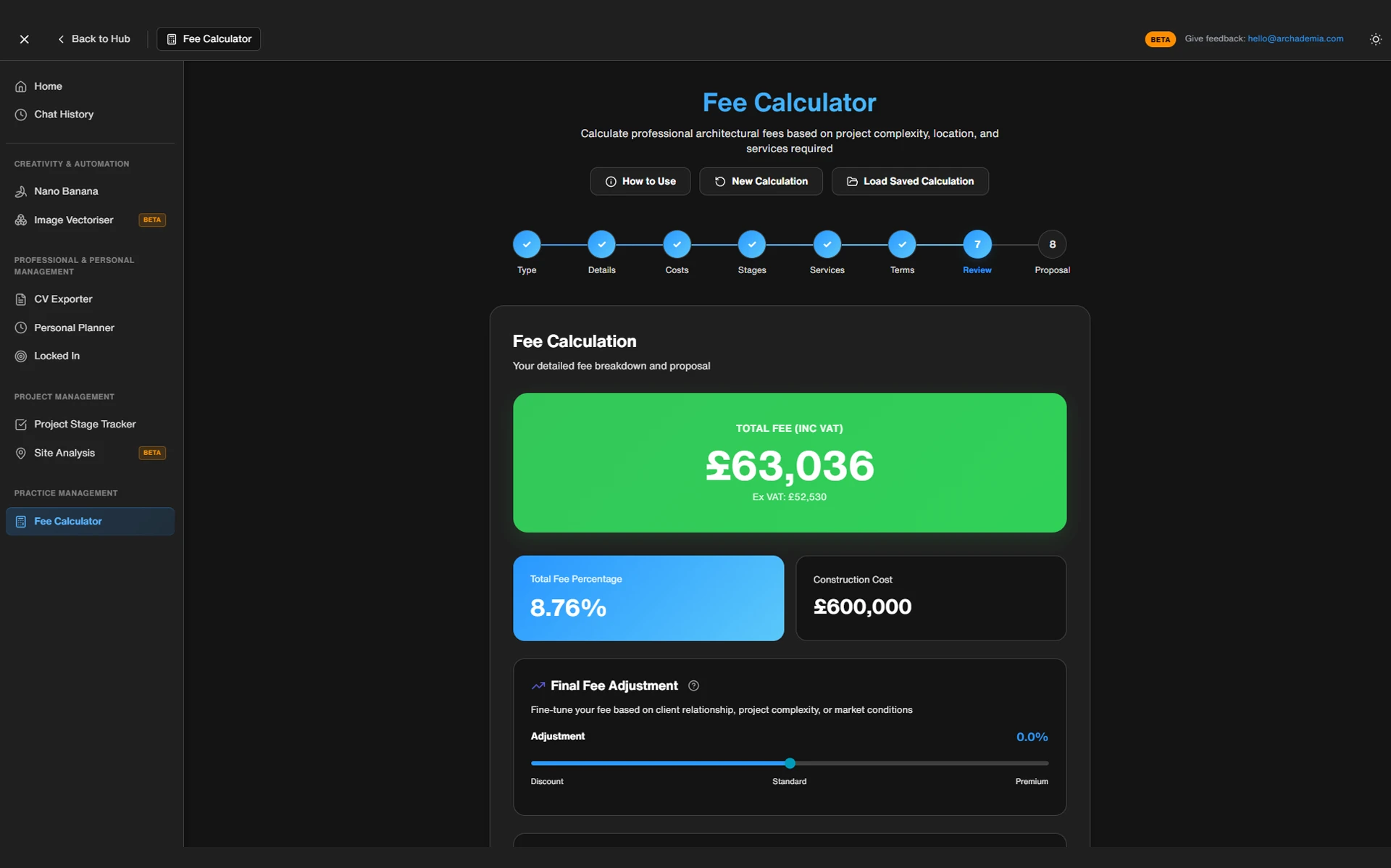
ArchAdemia's Fee Calculator is a web-based tool that generates stage-by-stage fee proposals for architects by inputting project type, construction value, team roles, and hourly rates — available to all members of the platform's 4,000+ community.
What the Tool Actually Does
The inputs are straightforward: project type (residential, commercial, mixed-use), construction value, team composition (sole practitioner, junior architect, senior architect, technician), and your hourly rates. From those inputs, the calculator produces a stage-by-stage fee breakdown, a total fee, and — critically — the implied hourly burn rate per stage.
That last output is the one most architects haven't seen before. It tells you, in plain numbers, whether your proposed fee is realistic given your team's time. If Stage 4 implies 40 hours at £75/hour but you know from experience it takes 100 hours, the calculator surfaces that problem before you send anything.
Best for sole practitioners and small practices: ArchAdemia's Fee Calculator is best for sole practitioners and small practices calculating fees for residential and small commercial projects up to £1M construction value — it generates a stage-by-stage breakdown in under an hour.
A concrete use case: a sole practitioner quoting for a rear extension with a £120,000 construction budget. Inputs take roughly ten minutes. The output is a structured fee proposal with stage allocations, an expenses line, and a total — ready to review, adjust, and send. The whole process, including sense-checking the numbers, sits well within an hour.
Who It's Built For
The tool sits within the ArchAdemia Toolkit alongside the CV exporter and project trackers. It's designed for the architect who knows their hourly rate but has never had a systematic way to translate that rate into a defensible proposal. Sole practitioners. Small practices. Anyone who has ever quoted from gut feel and wondered afterwards whether they left money on the table.
ArchAdemia offers this as part of its Toolkit suite, available to all 4,000+ platform members at archademia.com. The broader platform covers 60+ courses across Revit, Rhino, SketchUp, V-Ray, Enscape, practice management, and more — and includes Corb, an AI assistant built specifically for architecture and design questions.
What It Doesn't Do (and Why That's Honest)
The ArchAdemia Fee Calculator does not replace a formal appointment document — it calculates and structures the fee, which must then be incorporated into an RIBA or NEC standard appointment.
It's a calculator, not a contract. It doesn't draft legal language, it doesn't constitute professional advice, and it doesn't substitute for a properly executed appointment under the RIBA Standard Professional Services Contract or equivalent. What it does is give you accurate numbers and a coherent structure before you engage a solicitor or finalise your appointment document. That's the gap it fills. Nothing more, nothing less.
The Confidence Problem Nobody Talks About
The biggest barrier to accurate fee proposals in architecture isn't lack of knowledge — it's the fear that a well-calculated fee will lose the job.
Why Architects Accept Bad Fees Even When They Know Better
Architecture trains you to design. It does not train you to sell. The moment you sit down to write a fee proposal, you're operating in a discipline your education mostly ignored. The instinct — especially early in practice, or when work is thin — is to round down. Make it look competitive. Don't scare them off.
The problem with that logic is that it's not actually protecting you. A client who would have walked away at £22,000 but stayed at £18,000 hasn't become a good client. They've become a client you're already losing money on before the first meeting.
The Psychology of Quoting
Clients who push back hardest on fees are often the most difficult to work with. A clear, justified fee filters as much as it charges. The client who asks "can you walk me through this breakdown?" is a different person to the client who says "that seems high, can you sharpen your pencil?" The first is engaged. The second is already treating your professional time as a line item to reduce.
Architects who present itemised, stage-by-stage fee proposals report fewer client fee challenges because the breakdown demonstrates the scope of work — making the total feel earned rather than arbitrary.
The confidence that comes from a calculated fee is qualitatively different from the confidence that comes from optimism. You can defend every line. That changes the conversation entirely.
The Fix: A Practical Checklist Before You Send Any Fee Proposal
Before submitting any architecture fee proposal, check that it includes a stage-by-stage breakdown, a defined scope, an exclusions list, a disbursements schedule, and a change management clause.
Run through this before every proposal goes out:
Have you broken the fee down by RIBA work stage? A single total is not a proposal — it's a number.
Have you listed what's excluded? Silence on exclusions is agreement. Write it down.
Have you accounted for disbursements separately? Planning fees, printing, travel, consultant coordination — itemised, not absorbed.
Does the proposal define what triggers an additional fee instruction? Brief changes, additional design options, planning re-submissions — define the threshold.
Have you checked the implied hourly rate makes sense? Divide the stage fee by your estimated hours. If the implied rate is below your cost, the fee is wrong.
Is the programme included? An indicative timeline sets expectations and gives you a basis for delay claims.
Have you used the Fee Calculator to verify the numbers? If not, the Toolkit is here — ten minutes of inputs, a structured output, and the confidence of knowing your numbers before you send.
A fee proposal isn't just a number you send to a client. It's a legal baseline, a scope definition, a protection mechanism, and — if you get it right — a demonstration of competence before the project has even started. Clients notice the difference between a practitioner who sends a one-line email and one who sends a structured document that clearly defines what they're agreeing to. That difference is partly about professionalism. Mostly, it's about knowing your own numbers.
Calculate the fee. Break it down. Define the scope. Send it with confidence.
The ArchAdemia Toolkit is there to make step one significantly less painful.
Frequently Asked Questions
What is the most common architecture fee proposal mistake?
The most common architecture fee proposal mistake is committing to a fixed fee before calculating the actual hours required by RIBA work stage. This causes practices to underprice complex stages — particularly Stage 4 technical design — and recover less than the work costs to deliver.
How do I calculate architecture fees by RIBA work stage?
To calculate fees by RIBA work stage, identify your team's hourly rates, estimate the hours required for each stage based on project complexity and deliverables, multiply hours by rates to get a stage fee, then total across all stages. ArchAdemia's Fee Calculator automates this process for residential and small commercial projects.
What should an architecture fee proposal include?
A complete architecture fee proposal should include a project description, scope of services broken down by RIBA work stage, a fee per stage, an explicit exclusions list, a disbursements schedule, an indicative programme, and a change management clause defining what triggers additional fee instructions.
What is a reasonable architecture fee percentage in the UK?
Architecture fees in the UK typically range from 8–15% of construction cost, but this percentage must be verified against an hourly breakdown before use. On a £300,000 project, a 10% fee of £30,000 may leave insufficient budget for Stage 4 technical design if the project is complex — always cross-check the percentage against actual stage hours.
What is scope creep in architecture and how do I prevent it?
Scope creep in architecture is the gradual expansion of project work beyond what the original fee covered, typically without additional payment. It is best prevented at the proposal stage by defining scope inclusions and exclusions explicitly, setting a clear change management clause, and specifying how many design iterations are included per stage.
What is the ArchAdemia Fee Calculator?
The ArchAdemia Fee Calculator is a web-based tool that generates stage-by-stage fee proposals for architects based on project type, construction value, team composition, and hourly rates. It is available as part of the ArchAdemia Toolkit to all platform members and is best suited to sole practitioners and small practices working on residential and small commercial projects up to £1M construction value.
Does an architecture fee proposal replace a formal appointment document?
No. An architecture fee proposal sets out the fee and scope, but it must be incorporated into a formal appointment document — such as the RIBA Standard Professional Services Contract — to be legally binding. The fee proposal is the commercial basis; the appointment document is the legal instrument.
How do I handle disbursements in an architecture fee proposal?
Disbursements — including planning application fees, printing, travel, and consultant coordination time — should be listed separately from the professional fee in any architecture proposal. They can be charged at cost (with receipts) or estimated upfront with a cap. Absorbing disbursements into the headline fee is a common cause of margin erosion.