Architects are trained for seven years to design buildings and precisely zero hours to price their own labour. That gap in the curriculum is why so many sole practitioners and small studios quote fees based on gut feeling, or worse, "what the last client paid" — a number with no relationship to the actual scope in front of them. It's not a confidence problem. It's a training problem, and it's costing you money on every single project.
Underquoting happens most often because architects price projects on instinct rather than on RIBA Plan of Work stages, hours, and risk contingency. You feel roughly what a job is worth, you round to a number that sounds reasonable out loud, and you send the proposal before you've actually itemised what the work involves. It works fine until the project has a party wall dispute, three extra site visits, or a client who changes their mind at Stage 3. Then the fee you quoted stops covering the work you're doing, and you're the one eating the difference.
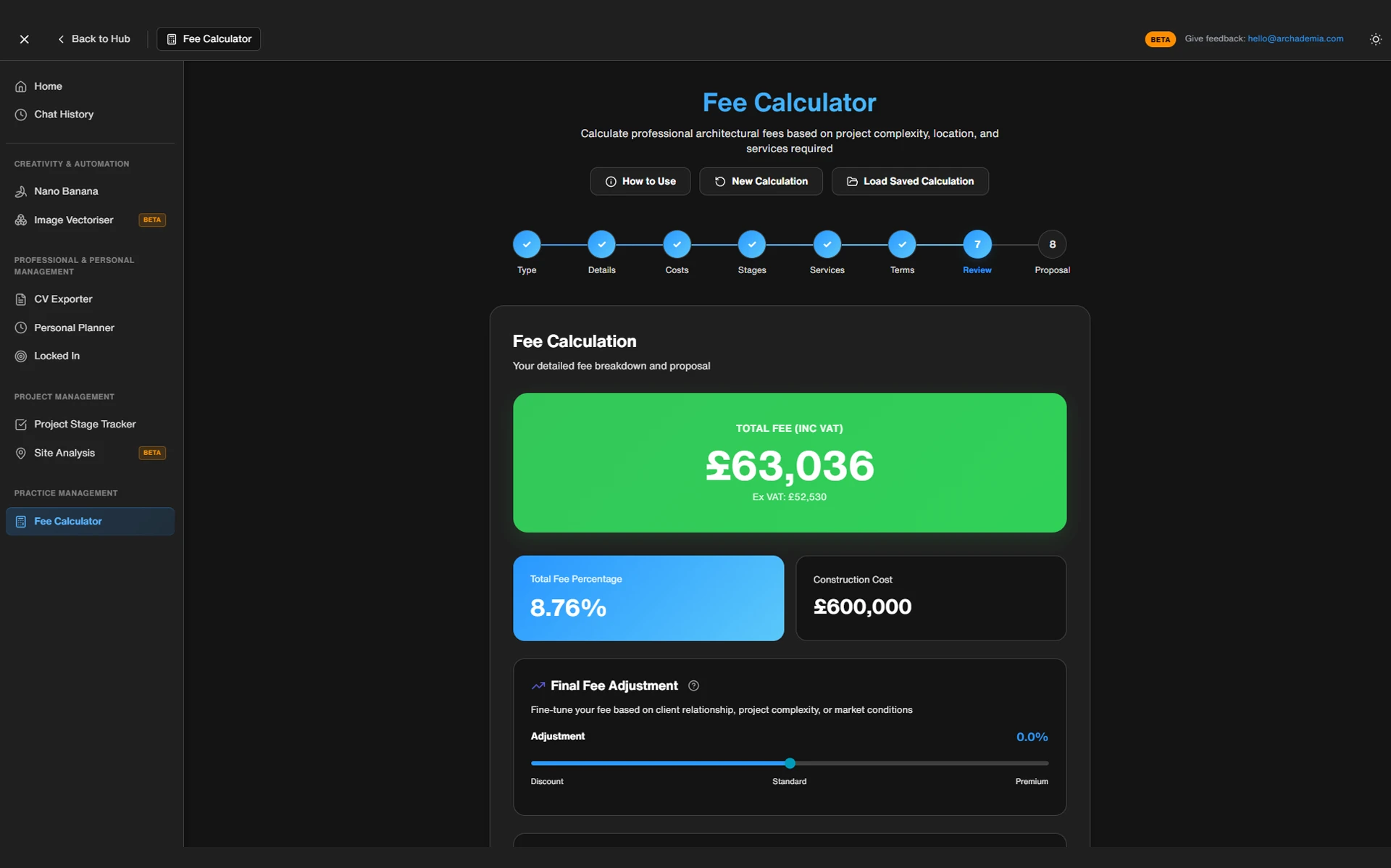
An architecture fee calculator removes guesswork by breaking a project into stages and hours before a number is quoted. That's the entire premise behind the fee calculator inside ArchAdemia's Toolkit — it forces you to itemise before you price, so the number you send a client is built on something more solid than vibes.
The cost of underquoting is never just lost profit. It's the unpaid overtime you do to hit a fixed fee that didn't account for the real scope. It's scope creep you can't push back on because you never defined the scope in the first place. It's resentment that quietly builds until you're dreading emails from a client you used to like. This article walks through what the calculator does, a worked example where it caught a £4,000 shortfall, an honest comparison of the old way versus the calculator way, and where the tool's limits sit — because no calculator replaces judgement.
ArchAdemia's fee calculator takes your project type, construction budget, required RIBA stages, and estimated hours, and returns a defensible fee range plus an hourly rate cross-check. It's not guessing on your behalf — it's doing the arithmetic you'd otherwise skip because you're busy, or because pricing your own time feels awkward.
The mechanics are simple but the value is in forcing the comparison. The calculator runs the percentage-of-construction-cost method — the traditional RIBA-style benchmark most UK architects were taught to reference — and cross-checks it against an hours-times-rate calculation for the same scope. If your gut says 8% and your hours say you'll be working for less than minimum wage at that fee, the calculator surfaces the conflict before you've sent the email, not three months into the job when it's too late to renegotiate.
The Inputs: What You Feed It
You give it four things: project type (residential, extension, new-build, commercial fit-out and so on), estimated construction cost, the RIBA stages you're being asked to deliver, and your estimated hours per stage. From there it also asks you to flag complexity factors — because a straightforward rear extension and a listed building with a contested planning history are not the same job, even at an identical construction value.
The Outputs: What You Get Back
You get a fee range, not a single number, along with the underlying hourly rate implied by that range so you can sanity-check it against what you actually need to earn. Critically, it accounts for complexity multipliers — listed building status, contested planning, awkward sites, multiple stakeholders — that most freelancers and small studios simply forget to price in until they're three site visits deep and wondering where the time went.
Be clear about what this is. It's a calculator, not a crystal ball. It gives you a defensible starting number based on structured inputs, not a guaranteed win against a client who wants it cheaper. It sits inside the broader Toolkit alongside the CV exporter and project tracker precisely because pricing a job well is a practice-management skill, not a one-off calculation you do in isolation from everything else running through your studio.
The Case Study: A Loft Conversion That Almost Cost Me £4,000
On a £180,000 residential loft conversion with party wall complications, a gut-feel fee quote of 8% undervalued the true fee by roughly £4,000 compared to a stage-and-hours calculation. That's not a rounding error. That's a month of a junior architect's salary, quietly given away because nobody itemised the scope before pricing it.
The Old Way: Quoting on Vibes
The project: a loft conversion and rear extension, £180k construction cost, full service from concept through to construction. The old-way quote came from memory of a similar job two years earlier — a flat 8% fee, roughly £14,400, based on nothing more rigorous than "that sounds about right for a loft." No allowance was made for the neighbour's party wall dispute, which was already brewing before the proposal went out. No allowance for the extra site visits that any semi-detached loft conversion tends to generate once builders are on site and decisions need making in person.
The Calculator Way: Quoting on Numbers
Run the same project through the fee calculator and the picture changes. Stages 1-4 full service, hours estimated per stage, and a complexity flag ticked for party wall involvement. The output lands at 11.5%, roughly £20,700 — a gap of around £4,000 against the gut-feel number, explicitly attributable to the extra coordination, correspondence, and site time that party wall matters generate on almost every terraced or semi-detached loft job in the UK.
That gap isn't the calculator being greedy. It's the calculator surfacing work you were already about to do for free. Party wall coordination, extra site visits, and neighbour disputes are common project costs that flat-percentage fee quotes routinely fail to capture, because a flat percentage doesn't ask what the job actually involves — it just repeats what worked, or seemed to work, last time.
Before and After: What Changes When You Use It
The clearest difference between a gut-feel fee quote and a calculator-generated fee quote is that the latter comes with a stage-by-stage breakdown a client can query and understand. That single difference changes the entire tone of a fee negotiation, because you're no longer defending a number — you're walking someone through a calculation.
Gut-Feel Quoting
Calculator-Driven Quoting
Basis for the fee
Gut-Feel QuotingMemory of past jobs, rounded to a "feels right" percentage
Calculator-Driven QuotingRIBA stages, hours per stage, construction-cost benchmark, cross-checked
Time to produce a quote
Gut-Feel QuotingFast — 10 minutes, no real inputs required
Calculator-Driven QuotingSlightly slower — 20-30 minutes to itemise stages and hours properly
Risk contingency included
Gut-Feel QuotingRarely, and never explicitly
Calculator-Driven QuotingBuilt in via complexity multipliers (listed status, planning risk, party wall)
Client transparency
Gut-Feel QuotingLow — a single percentage with no visible logic
Calculator-Driven QuotingHigh — stage-by-stage breakdown the client can see and question
Defensibility if challenged
Gut-Feel QuotingWeak — "that's just what I charge" doesn't hold up
Calculator-Driven QuotingStrong — backed by hours, benchmarks, and named risk factors
A calculator-generated fee comes with a breakdown you can put in front of a client, which builds trust instead of looking like a number pulled from thin air. Clients don't push back on fees they understand. They push back on fees that feel arbitrary — and a flat percentage with no working behind it is the definition of arbitrary, even when the number itself was reasonable.
Best Fee Calculator for Different Kinds of Architects
ArchAdemia's fee calculator is best for sole practitioners and small studios pricing UK residential work under £500,000 construction value, because it's structured around RIBA Plan of Work stages rather than generic hourly rates. If that's your practice, this is built for exactly the enquiries landing in your inbox — extensions, loft conversions, small new-builds, and residential refurbishments where the percentage-of-construction-cost method still does most of the heavy lifting.
Best for Students Freelancing on the Side
The fee calculator is best for architecture students moonlighting on small residential side projects who need a fast sanity check against being paid £15 an hour disguised as "exposure" or portfolio-building. Students taking on a friend-of-a-friend's kitchen extension are the group most likely to underquote catastrophically, because there's no professional pricing history to lean on and every job feels like it should be cheap because you're "still learning." Running the numbers, even roughly, stops that.
Best for Sole Practitioners and Small Studios
This is the core use case, and it's where the tool earns its place in the Toolkit. Sole practitioners rarely have the time to build a fee model from scratch for every enquiry, so they default to memory — which is exactly the failure mode the calculator exists to fix.
Best for Project-Running Architects Juggling Multiple Fees
The calculator is best for architects running three or more live projects simultaneously who need to benchmark a new enquiry against existing fee structures quickly, without opening a spreadsheet from scratch every time someone emails asking for a quote. Consistency across your fee proposals matters more than people admit — if client A got a properly itemised 11% and client B gets a guessed 7% for a comparable job, you've created a problem for yourself that has nothing to do with the work.
Generic freelance rate calculators — the Upwork-style hourly tools aimed at contractors and consultants generally — are unsuitable for architecture because they don't account for RIBA stage structure or percentage-of-construction-cost fee norms. They'll tell you what a reasonable day rate looks like for "professional services." They won't tell you what Stage 3 technical design should cost against a £320,000 new-build, because they weren't built with construction industry fee norms in mind at all.
The fee calculator sits inside the broader ArchAdemia Toolkit, alongside the CV exporter and project tracker, aimed at architects managing the business side of practice — not just the drawings. If you're serious about running a studio rather than just producing designs for one, that distinction matters.
Where the Calculator Won't Save You
A fee calculator can produce a defensible minimum fee, but it cannot prevent an architect from discounting out of fear of losing a client — that discipline has to come from you. This is the honest limitation, and it's worth saying plainly: the calculator can't read a client's temperament, can't predict a planning officer having a bad week that turns a straightforward application into a three-month fight, and can't account for a contractor who goes bust mid-project and leaves you holding coordination work nobody's paying for.
Fee calculators do not account for unpredictable risks like contractor insolvency or planning officer delays, which is why contingency percentages should always be added on top of the calculated figure, not baked in as if they're accounted for. The output is a floor, not a ceiling. It tells you the minimum number you can defend with a straight face. Everything above that — market positioning, what the client can actually afford, how badly you want the project, how it fits your pipeline — is still your call to make.
And here's the uncomfortable bit. Plenty of architects run the calculation, wince at the total because it's higher than what they were about to send, and then discount anyway out of fear the client will walk. The calculator did its job. The architect didn't hold the line. No tool fixes that — it's a negotiation skill, not a maths problem, which is exactly why it's worth pairing the calculator with ArchAdemia's studio setup course for the client-conversation and business-structuring skills the calculator itself was never designed to teach.
How to Actually Use This on Your Next Enquiry
Run every enquiry through the calculator before you reply, not after you've already floated a number in conversation. That ordering matters more than people think — once you've said a figure out loud to a client, even casually, you've anchored yourself to it, and walking it back later makes you look like you don't know your own worth.
The process is straightforward. Gather a realistic construction cost estimate, even a rough one from a quantity surveyor or comparable project. Define exactly which RIBA stages you're being asked to deliver — don't assume, ask the client directly if it's not clear. Estimate hours per stage honestly, based on similar projects you've actually run, not an optimistic best case. Flag every complexity factor that applies: listed building, conservation area, party wall involvement, multiple stakeholders, a site you know is going to be a headache. Run it. Then round to a number you can say out loud without flinching.
Cross-check the output against local competitor fee scales where you know them, rather than treating the calculator as gospel. It's a strong starting point, not the final word — local market conditions, your own reputation, and the specific client relationship all still matter.
The habit is the whole point. One correct fee calculation doesn't fix a practice that's been underquoting for three years. Running every single enquiry through the same structured process does. That's how you stop treating pricing as a gut check and start treating it as a discipline — which, if you're running a studio rather than just designing buildings, it always should have been.
FAQ
What is an architecture fee calculator?
An architecture fee calculator is a tool that generates a project fee by combining RIBA stage requirements, estimated hours, construction cost, and complexity factors, rather than relying on a flat percentage guessed from memory. ArchAdemia's version cross-checks a percentage-of-construction-cost figure against an hours-times-rate calculation for the same project.
How much should an architect charge as a percentage of construction cost?
UK architects typically charge between 7% and 15% of construction cost for full-service residential work, depending on project complexity, size, and RIBA stages delivered. Smaller, more complex projects — like loft conversions with party wall involvement — usually sit at the higher end of that range because coordination time doesn't scale down with construction value.
Why do architects underquote fees?
Architects underquote most often because they price projects on instinct or on what a previous, roughly similar client paid, rather than itemising RIBA stages, hours, and risk factors for the specific project in front of them. This misses complexity factors like party wall disputes, extra site visits, and planning risk that add real hours but rarely get priced in upfront.
Is ArchAdemia's fee calculator free?
ArchAdemia's fee calculator is included as part of the Toolkit, available to ArchAdemia members alongside the CV exporter and project tracker. Full pricing and access details are available on the pricing page.
Can a fee calculator replace negotiation skills?
No. A fee calculator produces a defensible minimum fee based on structured inputs, but it cannot stop an architect from discounting out of fear of losing a client, and it cannot handle the actual client conversation. Negotiation and client communication remain skills the architect has to develop separately.
What's the biggest risk factor architects forget to price into a fee?
Party wall coordination is one of the most commonly missed risk factors, particularly on loft conversions and extensions in terraced or semi-detached properties. It adds correspondence, surveyor liaison, and extra site visits that a flat percentage fee rarely accounts for.
Does the fee calculator work for commercial projects as well as residential?
The calculator is structured primarily around UK residential fee norms and RIBA stage logic, and is most reliable for residential projects under £500,000 construction value. Commercial and larger-scale projects typically involve fee structures and stakeholder complexity that need additional judgement beyond the calculator's baseline output.
Pricing a project properly isn't the exciting part of running a practice. It's not the part anyone puts on their portfolio. But it's the part that decides whether you're still solvent in three years, and whether the next loft conversion pays for your time or quietly eats it. Run the numbers before you send the email. The calculator won't negotiate for you, but it'll make sure you're negotiating from a number that actually reflects the work — which is more than most gut-feel quotes can say.