Setting Up Your Own Architecture Studio Costs Less Than You Think — But Surprises More Than You Expect
Setting up a sole-practitioner architecture studio in the UK costs under £3,000 in year one, covering ARB registration, professional indemnity insurance, and basic software. The biggest barrier is not your portfolio or your skill set. It is the legal and financial groundwork that architecture school never once mentioned — and that practice only teaches you by letting you watch someone else handle it.
This article gives you the actual numbers, the legal checklist, and a framework for landing your first clients. No vague encouragement. No "back yourself and take the leap" nonsense. Just the specifics.
This is written for Part III-qualified architects and experienced designers who are ready to go independent. If you are still weighing up whether to do it, the answer is probably yes — and the barrier is lower than you think.
Sort the Legal Stuff Before You Do Anything Else
ARB Registration and the Title 'Architect'
In the UK, only ARB-registered professionals can legally use the title 'Architect' — operating without registration while using the title is a criminal offence under the Architects Act 1997. This is not a technicality. It is enforced. The ARB annual retention fee in 2026 is £127. Non-negotiable if you want to practise under the title.
If your registration has lapsed — which happens more often than people admit, especially after a career break — reinstatement is straightforward but takes a few weeks. Do not start trading until it is confirmed.
Business Structure: Sole Trader vs Limited Company
Most new architecture studios register as sole traders initially — it requires only HMRC registration and carries no Companies House overhead. You can be operational the same day. The downside is unlimited personal liability: if a project goes badly wrong and a client sues, your personal assets are in play.
A limited company offers liability protection, looks more credible to certain institutional clients, and can be tax-efficient above roughly £40,000 profit. The trade-off is additional admin: annual accounts, confirmation statements, and the need for an accountant from day one. Most sole practitioners make the switch after year two or three, once they have a clearer sense of fee income.
Start as a sole trader. Get the work flowing. Restructure when it makes sense.
Professional Indemnity Insurance: What You Actually Need
Professional indemnity insurance for a sole-practitioner architecture studio typically costs £800–£1,500 per year in the UK, with a minimum recommended cover of £250,000. RIBA recommends that minimum for small practices. If you are taking on commercial work or projects with higher construction values, increase it accordingly — your premium will rise, but so will your exposure without it.
Public liability insurance is a separate policy — budget an additional £150–£300 per year. Some clients will require evidence of both before signing an appointment.
RIBA Chartered Practice status is optional but worth considering. The annual fee starts at around £400 for small practices. It adds credibility, particularly for residential clients who have done their homework, and gives you access to RIBA contract templates and client referral schemes.
On contracts: always use a written appointment. The RIBA Domestic Professional Services Contract is the standard starting point for residential work. It is not glamorous, but it has saved more architects from difficult conversations than any verbal agreement ever has.
One final note on VAT: the registration threshold in 2026 is £90,000 turnover. Most new studios will not hit that in year one. But understand when it kicks in — the moment you cross it, you have 30 days to register, and billing clients exclusive of VAT when you should be charging it creates a nasty retrospective liability.
The Real Cost of Starting Up (With Actual Numbers)
Year-One Cost Breakdown
A realistic year-one budget for a UK sole-practitioner architecture studio is £2,500–£5,000, covering legal registration, insurance, software, and basic marketing. That is genuinely achievable. The table below breaks it down.
Software: Where to Spend and Where to Save
SketchUp Pro at £299/year is the best-value software option for a new architecture studio, offering sufficient capability for residential design work without the £3,000/year Autodesk AEC Collection commitment. Pair it with SketchUp Layout for construction documents and you have a credible production workflow for early-stage residential projects at a fraction of the Revit cost.
The Autodesk AEC Collection — which includes Revit, AutoCAD, and the full suite — runs at approximately £3,000/year. Steep for a startup. If your target clients are contractors, housing developers, or larger commercial practices who require Revit deliverables, the cost is justified. If you are doing residential extensions and planning applications, it is not.
ArchiCAD Solo licence sits at around £700/year and is worth considering if you want BIM capability without the Autodesk overhead. The SketchUp Complete Guide on ArchAdemia is a solid starting point if you need to get up to speed quickly on the most cost-effective option.
The Hidden Costs Nobody Budgets For
Here is what everyone misses: accounting software (Xero or FreeAgent, £15–£30/month — so £180–£360/year), a professional email domain (£10–£20/year, because a Gmail address signals that you are not quite ready), and a basic website (£200–£500 if you build it yourself, £1,000–£3,000 if you commission it).
Co-working space, if you are not working from home, runs £200–£400/month in most UK cities. That is £2,400–£4,800/year — potentially your biggest single cost and the one most people underestimate when they do the initial sums at the kitchen table.
And then there is time. Administrative and business development tasks consume 30–40% of working hours in a new architecture studio's first year. That is not in any startup budget template. Every hour spent chasing invoices, writing proposals, and updating your website is an hour not billed. Price accordingly.
The ArchAdemia Toolkit includes fee calculators and project trackers that help you understand your real hourly cost from day one — which is the only way to avoid the chronic underpricing that kills otherwise good practices in their first two years.
Year-One Cost Comparison Table
| Item |
Essential or Optional |
Estimated Annual Cost |
Notes |
| ItemARB Registration |
Essential or OptionalEssential |
Estimated Annual Cost£127 |
NotesRequired to use the title 'Architect' |
| ItemProfessional Indemnity Insurance |
Essential or OptionalEssential |
Estimated Annual Cost£800–£1,500 |
NotesMin. £250,000 cover recommended |
| ItemPublic Liability Insurance |
Essential or OptionalEssential |
Estimated Annual Cost£150–£300 |
NotesOften required by clients |
| ItemBusiness Registration (HMRC) |
Essential or OptionalEssential |
Estimated Annual Cost£0 (sole trader) / £12 (Ltd Co) |
NotesSole trader is free |
| ItemSketchUp Pro |
Essential or OptionalEssential (entry) |
Estimated Annual Cost£299 |
NotesBest-value option for residential work |
| ItemAutodesk AEC Collection |
Essential or OptionalOptional (year one) |
Estimated Annual Cost~£3,000 |
NotesOnly if clients require Revit |
| ItemAccounting Software (Xero/FreeAgent) |
Essential or OptionalRecommended |
Estimated Annual Cost£180–£360 |
NotesNon-negotiable once you have invoices |
| ItemWebsite |
Essential or OptionalRecommended |
Estimated Annual Cost£200–£3,000 |
NotesDIY vs commissioned |
| ItemRIBA Chartered Practice |
Essential or OptionalOptional |
Estimated Annual Cost£400+ |
NotesAdds credibility, access to contracts |
| ItemCo-working Space |
Essential or OptionalOptional |
Estimated Annual Cost£2,400–£4,800 |
NotesDepends on home working viability |
| ItemArchAdemia Membership |
Essential or OptionalRecommended |
Estimated Annual CostSee /pricing |
NotesCPD, software training, Toolkit access |
| ItemEssential-only total |
Essential or Optional |
Estimated Annual Cost~£1,300–£2,200 |
Notes |
| ItemWith recommended extras |
Essential or Optional |
Estimated Annual Cost~£2,500–£5,000+ |
Notes |
The minimum legal cost of operating as a registered architect in sole practice in the UK is approximately £1,300–£2,200 per year, covering ARB fees, professional indemnity, and public liability insurance.
How to Price Your Work Without Underselling Yourself
Fee Structures: Percentage, Fixed, or Hourly?
RIBA fee guidance for full architectural services on residential projects ranges from 8–15% of construction cost in 2026, varying with project complexity. A £200,000 extension at 12% is a £24,000 fee. That sounds reasonable until you account for the fact that full service — from brief through to contract administration — is easily 200–300 hours of work for a sole practitioner. Do the maths before you agree to anything.
Three fee structures, briefly:
Percentage of construction cost — most common for full service. Aligns your fee with project scale. The risk is that construction costs shift and your fee shifts with them, sometimes downwards.
Fixed fee — best for clearly scoped projects. Gives the client certainty. Gives you certainty. Falls apart if scope creeps and you have not built in a change control mechanism.
Hourly rate — best for consultancy and undefined scope. Dangerous if you are slow, or if the client does not understand what they are buying.
What the Market Actually Pays
A sole-practitioner architect in the UK charges £60–£120 per hour in 2026, with London-based practices typically at the upper end of that range. Regional variation is real. A £100/hour rate in Manchester is competitive. In rural Shropshire, you might price yourself out of the residential market entirely.
A straightforward residential planning application — single-storey extension, permitted development boundary check, drawing package — typically costs £1,500–£3,500 in architect fees in 2026 for a UK sole-practitioner studio. That is a fixed-fee engagement most homeowners can understand and budget for. It is also a sensible entry-level service for a new practice: defined scope, clear deliverable, manageable risk.
The Minimum Viable Fee Calculation
Work backwards. If you want to take home £45,000, add your overhead costs (say £5,000 for year one). That is £50,000 you need to bill. Divide by realistic billable hours — for a sole trader, 1,000–1,200 hours per year is honest, once you account for admin, business development, holidays, and the inevitable slow periods. Your minimum hourly rate is approximately £42–£50/hour.
Most architects underestimate their overhead and overestimate their billable hours. The result is chronic underpricing that feels fine in month three and catastrophic by month ten.
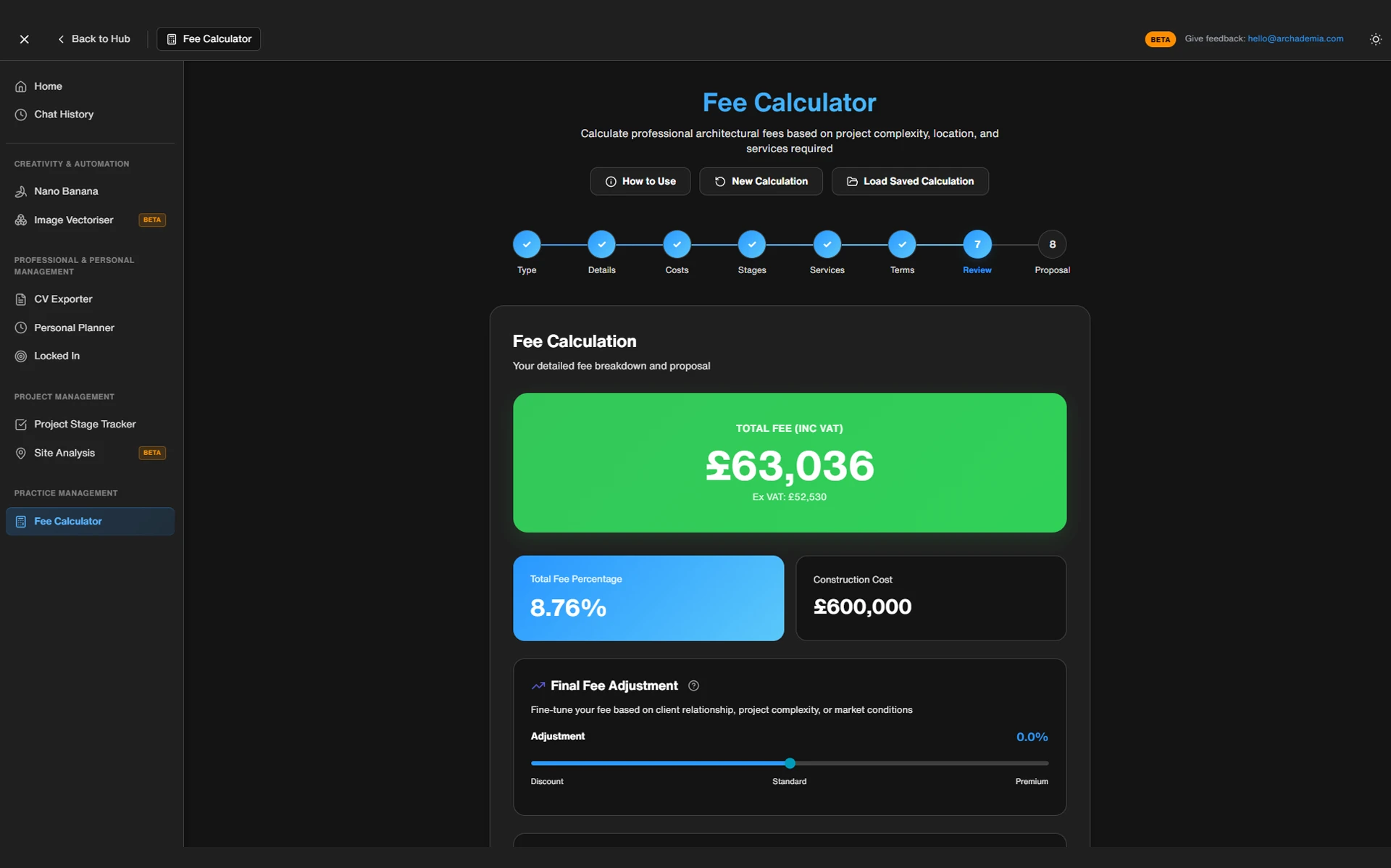
Never price against other architects. Price against your actual cost base and the value you deliver. The ArchAdemia Toolkit fee calculators make this calculation automatic — input your target income, overhead, and available hours, and it tells you your floor rate. Use it before you quote anything.
Finding Your First Clients (Without Embarrassing Yourself on LinkedIn)
Where First Clients Actually Come From
The majority of first clients for new architecture studios come through personal referrals — not social media, not cold outreach, not advertising. This is not a comforting platitude. It is the consistent reality across almost every small practice that has ever existed.
Tell everyone you know that you have gone independent. Former colleagues, friends, family, the person you did a planning application for three years ago in your employed role. This is not embarrassing. It is how practices start. The architects who feel too proud to do this are the ones who spend six months wondering why the enquiries are not coming.
Your Network Is Already There — Use It Properly
Former employer relationships require care. Check your employment contract for restrictive covenants before approaching any clients you worked with in a previous role. Most clauses are time-limited (typically 6–12 months) and geographically scoped. Understand what yours says before you do anything that could expose you to a claim.
Beyond your direct network: local planning authority portals are an underused lead source for new architecture studios. Search for recently approved planning applications in your target area. Homeowners with planning permission often need an architect to take them through to construction drawings and contract administration. They have already committed to the project. They just need someone to help them build it. That is a warm lead that costs nothing to find.
Houzz and Bark generate enquiries but attract price-sensitive clients. Use them selectively. Filter hard. Do not compete on price with someone who quotes £800 for a planning application — that is a race you do not want to win.
The Portfolio Problem and How to Solve It
If you have no independent work yet, use work from employed roles — with your former employer's permission — alongside personal projects, competition entries, and speculative design studies. Most employers will agree if you ask properly and credit the practice.
ArchAdemia's Drawing Board is a purpose-built portfolio platform for architects and designers that allows professional project presentation without web development skills. For a new practice presenting work to potential clients, it is significantly more effective than a Squarespace template that was not designed with architectural drawing in mind.
On social media: Instagram outperforms LinkedIn for architecture practices. Show process — sketches, models, site photos, work in progress — not just polished final renders. But social media is a slow burn. Do not rely on it for year-one revenue. It is a three-year investment, not a three-month one.
Pick a niche early. Residential extensions, permitted development, listed building consent — pick one thing and become known for it locally. Generalism is a luxury for established practices. Specialism is a survival strategy for new ones.
The Operational Stuff That Will Sink You If You Ignore It
Cash flow kills more studios than bad design does. Invoice promptly, every time. Set payment terms at 14 days, not 30. Chase on day 15. Most clients are not trying to avoid paying — they are just busy, and a polite reminder is all it takes. The architects who feel awkward chasing money are the ones who end up personally financing their clients' projects.
Scope creep is the slow bleed. Every meeting that goes beyond the agreed brief, every extra drawing, every "can you just" — it adds up. Your appointment letter needs a clear change control mechanism. When scope changes, you issue a fee variation. In writing. Before you do the work. This is not aggressive. It is professional.
Keep your CPD current. ARB requires 35 hours of CPD per year. RIBA requires 50 for Chartered members. In year one, when you are busy trying to find clients and deliver projects, this slips. ArchAdemia's 60+ courses across software, design, and practice management count towards structured CPD — and the Studio Setup course covers the practice management fundamentals that no one teaches you formally.
Separate your finances from day one. A dedicated business bank account is not legally required for sole traders, but mixing personal and business finances creates an accounting nightmare that costs you money in accountant's fees and time in year-end chaos. Open the account before you invoice your first client.
Tax. You are responsible for your own. Register for Self Assessment with HMRC as soon as you start trading. Set aside 20–25% of every payment you receive. Do not spend it. The January tax bill is not a surprise if you have been putting money aside since April.
Frequently Asked Questions
How much does it cost to set up an architecture studio in the UK?
The realistic year-one cost of setting up a sole-practitioner architecture studio in the UK is £2,500–£5,000, covering ARB registration, professional indemnity and public liability insurance, software, and basic marketing. The minimum essential legal costs alone — ARB fees and insurance — run to approximately £1,300–£2,200 per year.
Do I need ARB registration to start my own architecture studio?
Yes. In the UK, ARB registration is a legal requirement to use the title 'Architect' under the Architects Act 1997. The annual retention fee is £127 in 2026. Operating under the title without registration is a criminal offence, not a regulatory grey area.
What professional indemnity insurance does a sole-practitioner architect need?
RIBA recommends a minimum of £250,000 professional indemnity cover for small practices. Annual premiums for sole practitioners typically run £800–£1,500 depending on project type and fee income. Public liability insurance is a separate requirement, costing an additional £150–£300 per year.
Should I set up as a sole trader or limited company?
Most new architecture studios start as sole traders — it requires only HMRC registration, costs nothing, and can be done the same day. A limited company offers liability protection and potential tax advantages above roughly £40,000 profit, but adds administrative overhead. The majority of architects make the switch after year two or three once fee income is established.
What software should a new architecture studio use?
SketchUp Pro at £299/year is the best-value starting option for a new studio focused on residential work. It covers early-stage design and, with SketchUp Layout, basic construction documentation. The Autodesk AEC Collection at approximately £3,000/year is only worth the cost if your clients specifically require Revit deliverables.
How do I find my first architecture clients?
The majority of first clients for new studios come through personal referrals. Tell your existing network — former colleagues, friends, family — that you have gone independent. Local planning authority portals are also an underused source: homeowners with recently approved planning permission often need an architect to progress to construction.
What fees should I charge as a sole-practitioner architect?
RIBA guidance suggests full architectural services on residential projects range from 8–15% of construction cost. Hourly rates for sole practitioners in the UK run £60–£120 in 2026, with London practices at the higher end. A straightforward residential planning application typically costs £1,500–£3,500.
How many billable hours can a sole-practitioner architect realistically work per year?
A realistic figure is 1,000–1,200 billable hours per year for a sole trader, once administration, business development, CPD, and holidays are accounted for. Most new studio owners overestimate this figure and underprice their services as a result.
The Bottom Line
Going independent is a business decision before it is a creative one. Get the legal structure right, understand your real cost base, price accordingly, and tell everyone you know what you are doing. The architecture part — you already know how to do that.
The practices that fail in year one almost never fail because the work was not good enough. They fail because the owner did not charge enough, did not invoice on time, did not have a written appointment, or burned through their savings waiting for social media to deliver clients that were always going to come from a phone call instead.
The ArchAdemia Studio Setup course covers the practice management fundamentals in the same direct, no-nonsense way — because the gap between qualifying as an architect and running a practice is one that the profession still does not fill properly. This is the closest thing to a map for crossing it.