Black Friday•30% off annual plans•Win an iPad + Apple Pencil•Ends in --d --:--:--•Black Friday•30% off annual plans•Win an iPad + Apple Pencil•Ends in --d --:--:--•Black Friday•30% off annual plans•Win an iPad + Apple Pencil•Ends in --d --:--:--•Black Friday•30% off annual plans•Win an iPad + Apple Pencil•Ends in --d --:--:--•Black Friday•30% off annual plans•Win an iPad + Apple Pencil•Ends in --d --:--:--•Black Friday•30% off annual plans•Win an iPad + Apple Pencil•Ends in --d --:--:--•Black Friday•30% off annual plans•Win an iPad + Apple Pencil•Ends in --d --:--:--•Black Friday•30% off annual plans•Win an iPad + Apple Pencil•Ends in --d --:--:--•
Black Friday•30% off annual plans•Win an iPad + Apple Pencil•Ends in --d --:--:--•Black Friday•30% off annual plans•Win an iPad + Apple Pencil•Ends in --d --:--:--•Black Friday•30% off annual plans•Win an iPad + Apple Pencil•Ends in --d --:--:--•Black Friday•30% off annual plans•Win an iPad + Apple Pencil•Ends in --d --:--:--•Black Friday•30% off annual plans•Win an iPad + Apple Pencil•Ends in --d --:--:--•Black Friday•30% off annual plans•Win an iPad + Apple Pencil•Ends in --d --:--:--•Black Friday•30% off annual plans•Win an iPad + Apple Pencil•Ends in --d --:--:--•Black Friday•30% off annual plans•Win an iPad + Apple Pencil•Ends in --d --:--:--•
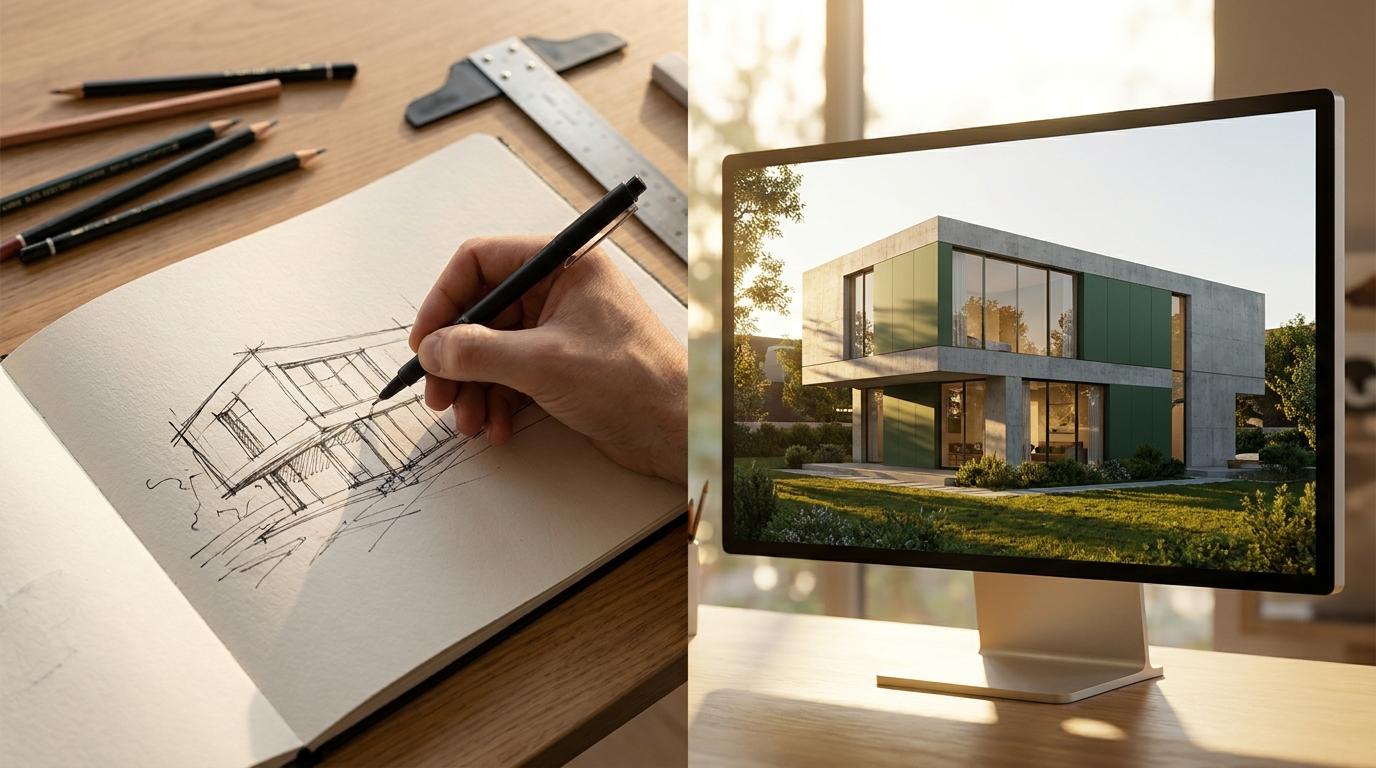
Two monitors. On the left, the massing model you actually built — honest, dull, dimensionally correct. On the right, the thing the generator just handed back: warm evening light raking across a fluted precast facade, a cantilever nobody has costed, a soffit detail that resolves itself through sheer optimism.
You want to show the right-hand screen. You also know, somewhere behind the sternum, that the moment it leaves your machine it stops being a sketch and becomes a promise.
So here's the verdict before the reasoning: yes, show it. Generated imagery is perfectly legitimate at concept stage, and pretending otherwise just means your client goes home and generates their own, which is considerably worse. The risk isn't the image. The risk is handing over an image with no status attached to it, into a relationship where every other thing you've ever given them did have a status. Drawings have revision numbers. Reports have dates. A render that arrives naked, by email, on a Tuesday, gets filed by the client's brain under "the building".
Fix the status problem and the rest of this is manageable.
What a Client Actually Hears When You Say "Concept"
You say concept and you mean: a provocation, a direction of travel, one of six things we might do, currently unpriced and unengineered and quite possibly in breach of the daylight code.
They hear: what it's going to look like.
That gap isn't a failure of client intelligence. It's a reasonable reading of the evidence in front of them. Photorealism carries an implicit claim of resolution — the eye reads depth of field, accurate shadows and specular highlights on brushed metal as someone has worked this out. Hand-sketched concepts never had this problem, because the medium announced its own incompleteness. A charcoal smudge cannot promise a window reveal. A 4K image of a window reveal absolutely can.
This is why "it's just a visualisation tool like any other" — the line every article on this subject reaches for — is the wrong frame. A V-Ray render of your Revit model is a photorealistic image of a thing that exists in geometry you authored. A text-prompted image is a photorealistic image of a thing that exists nowhere. The pixels look identical. The liability underneath them is not remotely the same, and the client cannot tell the difference by looking.
Where Generated Imagery Genuinely Earns Its Place
Four places, in our experience, where it adds something no other tool does at the front end:
Mood and atmosphere. The feeling of a space before it has dimensions. What this building wants to be like to stand inside at four in the afternoon in November. This is precedent-board territory, and generated imagery beats trawling for someone else's photograph of someone else's building — partly because it's closer to your idea, partly because you're not pasting a competitor's project into a client deck and hoping nobody recognises it.
Massing options, fast. Ten roof forms in the time it used to take to model two. Most of them will be rubbish. That's the point — the value is in the eliminating, not the generating.
Material atmosphere. Not specification. Atmosphere. How a dark timber reads against a pale render in low sun, which is a question about feeling rather than a question about fixings.
Internal option-testing that never leaves the office. The one nobody talks about and the one I'd defend hardest. Generated imagery is brilliant for arguing with your own team at eleven in the morning. Nothing on that screen needs a disclaimer because nothing on that screen is going anywhere.
What these four have in common: none of them is a statement about the building you will deliver. The second an image starts answering "what will mine look like", you've changed category.
The Three Places It Must Never Go
This is the part that's actually about contracts rather than taste.
A planning submission. Ever. A Design and Access Statement is a document a local authority relies on, that third parties comment on, and that forms part of a public record attached to a decision. An image in there that nothing in your model supports is a representation you cannot stand behind. If a consented scheme is later built and doesn't resemble the pictures the neighbours objected to, that is a conversation you do not want. Everything in a planning pack should trace back to geometry you authored.
A fee proposal or appointment. The image sitting next to the scope and the number is the thing the client thinks they are buying. Put a generated render on page two of a proposal and you have, in substance if not in law, scoped a building you cannot describe. Keep the commercial document visually boring. That's not timidity, it's precision.
Anything public with the client's name on it. Instagram, the practice website, a press release about the new commission. Once it's out there with an address attached, it's evidence of what was shown, and you've lost control of the caption. The internet does not carry your qualifying paragraph with it.
If you want the general case for where AI actually holds up in practice versus where it collapses, we went through that elsewhere in how architects are actually using AI assistants right now. This piece is only about the imagery, and only about the client.
Generate From Your Own Geometry, Not From a Sentence
Here is the single change that de-risks almost everything above.
Stop prompting from text alone. Build the massing — rough, five minutes, grey boxes, correct heights, real site boundary, real neighbouring parapets — and use that as the input. Feed the image generator your own geometry and let it do the thing it is genuinely good at: light, material, atmosphere, mood. Let your model do the thing it is good at: being true.
The difference in outcome is enormous. An image generated from your massing is dimensionally honest by construction. The cantilever in it is the cantilever you drew. The storey heights are the ones in the brief. When the client falls in love with it — and they will, because atmosphere is what people fall in love with — what they've fallen in love with is a building that exists. You've moved the seduction onto ground you can defend.
This also kills the most common failure mode in practice, which is the render that contains a structural impossibility the client has already shown to their partner. Nobody un-sees a cantilever. If the geometry was yours from the start, there's nothing to un-see.
And for the mood-board work where there is no geometry yet — where you're genuinely just asking what this thing wants to feel like — that's fine. That's category one. Just don't let a category-one image get used for a category-four job.
Caption Everything. Boringly.
Every generated image that leaves your office gets a status line. Not a legal paragraph in 6pt grey at the bottom of the sheet that everyone has agreed to ignore. A line, on the image, in the same type size as everything else, that a reasonable person reads.
What we put in it, in order: what stage it belongs to, what it is testing, and what it is not.
Stage 2 Concept — atmosphere study. Generated image. Massing per model rev C. Materials, openings and detail indicative only; not a proposal for the built form.
Four clauses. Twenty seconds to write. It does more work than any clause in your appointment, because the client actually reads it, at the moment they're looking at the thing.
Two rules that make it stick. First, the caption goes on the image file itself, not on the slide — because the image gets screenshotted, forwarded, dropped into the client's own board report, and separated from your deck within about a week. Second, use the same words every time. Consistency is what turns a caption into a convention, and a convention is what a client is later deemed to have understood.
My own tell for whether an image needs the full treatment: could someone mistake this for a photograph of a finished building? If yes, caption it hard. If it's obviously a study — loose, abstract, visibly unresolved — a lighter touch is honest. The fluted-precast-at-golden-hour image gets the full band. The grey massing with a bit of sky does not.
Keep the Receipts
A folder. Dated. Every generated image that went to the client, with the deck it went in, the date it was issued, and the caption it carried.
This sounds like admin because it is admin. It takes a minute per issue and it is the only thing that turns "I'm sure you showed us a brick one" into a resolvable sentence. Disputes about expectation are almost never about who was right — they're about who can reconstruct what happened. Practices lose those arguments because they issue imagery informally, by email, with no record, and then try to remember eighteen months later.
If you already keep a drawing issue sheet, just put the images on it. Same discipline, same register, same habit.
"Can We Just Build the Picture?"
You will get this. Usually from the most enthusiastic client, which makes it harder, because enthusiasm is the thing you were trying to generate and now you have to manage it.
Do not say no. Saying no makes you the person who took the nice building away, and that framing follows you through the whole job.
Say: that's the feeling we're chasing — let's work out what it costs to keep. Then take the picture apart in front of them into the bits that are free, the bits that are expensive, and the bits that are fantasy. The proportion and the light are usually free. The material is usually a number. The impossible soffit is a conversation with an engineer. Most clients, offered that honestly, will trade the fantasy for the proportion quite happily. What they won't forgive is discovering at Stage 4 that the thing they were sold was never on the table.
On insurance: I can't tell you how your policy is worded and neither can anyone writing a blog post. Ask your broker specifically how your cover responds to pre-appointment imagery and marketing material. It's a two-minute question and the answer will change what you're comfortable issuing.
The Short Version
Generated imagery is a thinking tool that happens to produce artefacts clients mistake for promises. The whole discipline is keeping those two facts separated: use it hard where the output stays internal or stays explicitly provisional, build from your own geometry so even the seductive images are structurally honest, label everything, log what you sent, and keep it out of every document that someone could later rely on.
Do that and the technology is a gift at concept stage. Skip it and you've built the most beautiful expectation-management problem of your career.