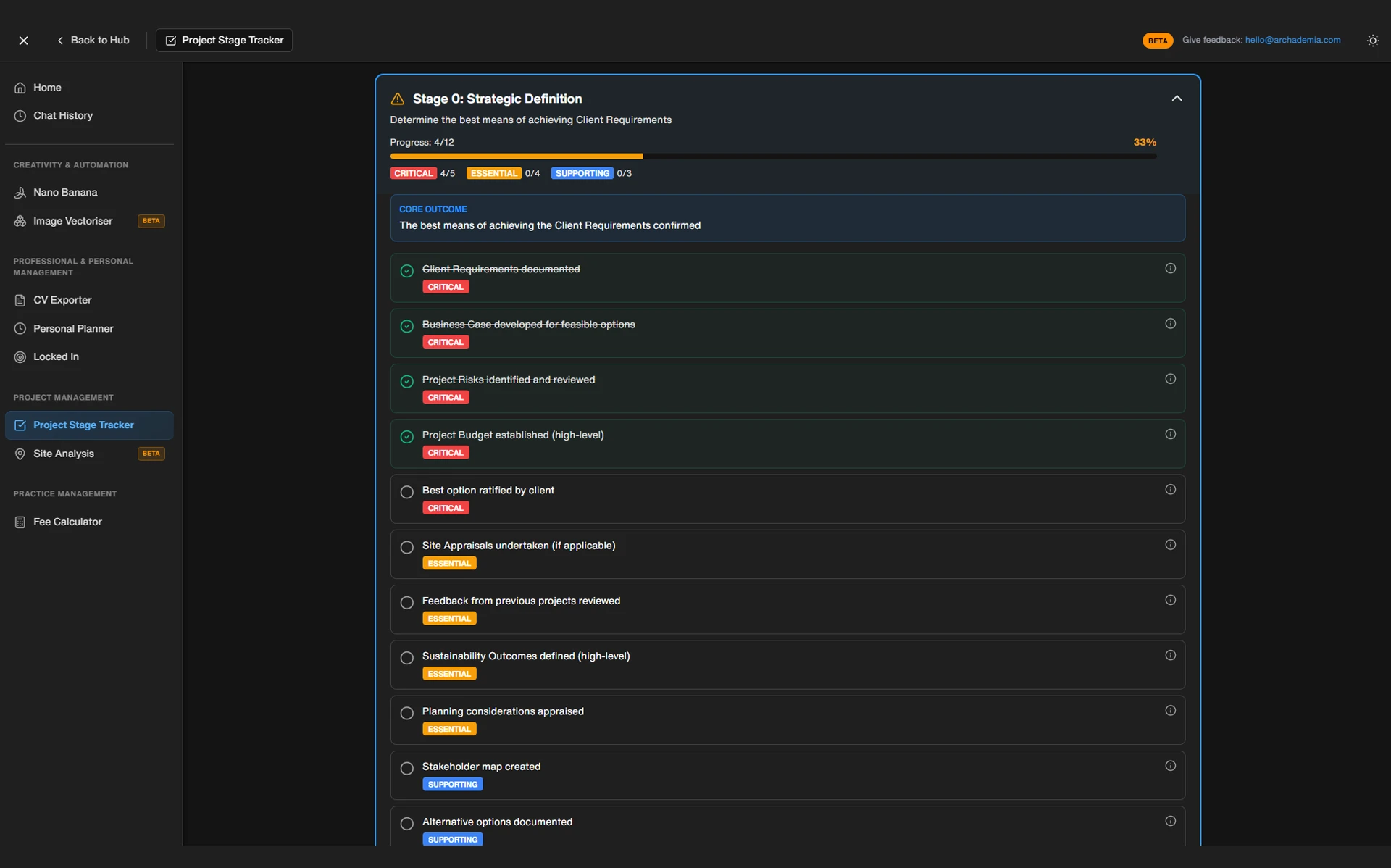
The project that slips is almost never the one you're worried about. It's the one you haven't opened in eleven days — the one where you're waiting on a client decision you quietly filed as somebody else's problem. By the time you notice, the fee instalment hasn't landed, the client thinks you're drafting, and you aren't.
The fix is not software. It's a recurring twenty-minute appointment with yourself, same time every week, where you look at every live job on one page and ask three questions. That's the whole system. Everything below is what goes on the page and how to read it.
Twenty minutes, first thing Monday, before email. Not Friday — on Friday you're tired and you'll write optimistic notes about what you'll do next week. Not mid-week, because by Wednesday you're already inside one project and you'll read the others through its lens.
Twenty minutes is the right length for four to six small jobs because it's too short to do any actual work. That's the point. The sweep is a review, not a work session. The instant you start fixing something you've found, the sweep dies and you've just worked on one project again.
Set a timer if you're the sort of person who needs one. I am.
Four Fields. Resist Adding A Fifth
One row per live project. Four columns. If you add a fifth you'll stop filling it in by week three, and a tracker you don't fill in is worse than no tracker because it lies to you.
Project and current stage. Which of RIBA's stages the job is actually in, not which one you told someone it was in. The RIBA Plan of Work 2020 runs Stage 0 to Stage 7, and RIBA's own 2020 overview is relaxed about boundaries — stages can overlap depending on procurement route. Useful in principle. Hopeless for a tracker. For the sweep, pick one stage per project and commit, because a job sitting in "3-ish, going into 4" is a job nobody can see slipping.
Date the stage opened. This is the field everyone leaves off and it's the one that does the work. Not the start date of the project — the date this stage began. Without it you have a snapshot. With it you have a clock.
The one deliverable the next fee instalment hangs on. Singular. Not a task list. The planning application. The tender issue. The stage report the client signs. Go and read the fee schedule in your own appointment while you set this up, because the wording matters more than people expect: "on completion of Stage 3" is an opinion and invites an argument, whereas "on submission of the planning application" is a date with a reference number attached. If your appointment says the vague version, you can still write the concrete version in your tracker — you just need to know which one you'll be asked to prove.
The named blocker. One line. Who or what the project is waiting on, by name. "Waiting on Sarah to confirm the kitchen layout." "Structural engineer's sketch scheme." "Validation at the council, submitted 14th." If you write "me", that's a legitimate answer and a very useful one.
Blockers behave in three distinct ways and it helps to know which you're holding.
A client decision goes stale. It doesn't sit still waiting for you — the client's circumstances move, and a decision left for a month often comes back as a different decision entirely. A consultant input is a queue position, which means it responds to being nudged in a way that a client decision doesn't. A statutory wait — determination, validation, building control comment — is the only one that genuinely runs itself. You can't accelerate it, so the correct response is to stop thinking about it and spend the time elsewhere.
Three Signals, Ninety Seconds
With those four fields filled in, the read is fast. You're scanning for three things only.
One: a stage that's been open longer than the fee assumed. When you priced the job you had a duration in your head, even if you never wrote it down — six weeks for the concept stage, four for the planning drawings, whatever it was. As a rule of thumb, we treat a stage running past about half again its assumed duration as a formal problem rather than a bit of drift. If you assumed six weeks, week nine is the alarm. It doesn't matter whose fault the overrun is. The clock is the signal; the diagnosis comes after.
Two: a decision that's been waiting more than a fortnight. Two weeks is the threshold we use, and it's arbitrary in the way all useful thresholds are arbitrary — the point is that it's fixed, so you're not re-litigating every week whether this particular client is being slow. In my experience, when a client goes quiet on a decision, the reason is usually money: they've had a conversation with a builder or a bank and the answer frightened them, and they'd rather say nothing than say that. Silence on a decision is rarely indifference.
Three: work being done ahead of an unsigned stage. The most expensive signal of the three, and the easiest to miss, because it feels like virtue. You've got the Stage 3 drawings in good shape, the client is enthusiastic, so you start the construction details. Nobody has signed anything. Nobody has paid for the stage you just finished. You are now funding the project, and if the client pauses — which small residential clients do, for reasons that have nothing to do with you — you'll be carrying unbilled work you can't invoice against any stage that exists on paper.
One Action Per Signal. Decide Now, Not Then
The value of pre-deciding the response is that you do it while calm. In the moment, every one of these feels like a conversation you'd rather have next week.
Stage over its assumed duration → find out where the hours went, this week. Not a broad reflection on productivity. Two specific questions: has the scope quietly grown, or has the stage been interrupted so many times that it's never had a clear run? Those have opposite fixes. Scope creep needs a sentence to the client about additional fee before you do another hour. Fragmentation needs you to block out a half-day and finish the thing.
Decision waiting more than a fortnight → stop asking and start proposing. Replace the open question with a recommendation and a deadline. "I'm recommending option B for the rear extension. Unless I hear otherwise by Friday 14th I'll proceed on that basis, so the planning drawings stay on programme." This converts a decision the client has to make into a decision they only have to not block, which is a completely different cognitive task. It also creates a written record of when you asked.
Work ahead of an unsigned stage → stop and get the signature. Today. Send the stage report or the drawing set, invoice the stage, ask for written approval to proceed. If that feels awkward, consider the alternative: having the same conversation in two months with four weeks of free work behind you and no leverage at all. We teach this one hard because it's the single most common way small practices lose money without ever experiencing a crisis.
When All Four Want You On Tuesday
The sweep tells you what's wrong. It doesn't tell you what to do first, and in a practice of one or two people that's the harder question. Here's the order we work to.
Statutory waits get fed first. Anything that goes into a queue you don't control — planning submission, building control, a party wall notice — has the longest tail, so a day's delay at your end becomes six weeks at the far end. Feed the queue before you do anything that only affects you.
Then the unsigned stages, because that's money and exposure sitting on the table.
Then the fee-triggered deliverables, in order of how close they are to done. Finishing a deliverable that's eighty per cent complete is almost always better value than advancing three that are at forty, both for cashflow and because an open stage is the thing that keeps generating these signals in the first place.
Design thinking goes last in priority but it needs the best hours in your day, which is an awkward contradiction you resolve by batching. Don't spread four projects across one day. In practice, hopping between four jobs between breakfast and lunch costs you real reorientation time you will never put on an invoice. Give each job a half-day with the phone face down. If you're at the point where even that doesn't fit, the problem may be capacity rather than process — we've written separately about when a sole practitioner can actually afford a first hire.
What You Owe The Client, And What To Say When It Slips
At every stage transition the client is owed two things: the deliverable itself, and a plain statement of what happens next. The second one is what small practices skip, and it's why clients chase. A client who knows what they're waiting for and roughly when will wait patiently. A client who's been sent a drawing with no covering note will assume the project has stopped.
So when a stage completes, the message is four lines: here's what's attached, here's what I need from you, here's what I'll do next once I have it, here's the invoice for the stage just finished.
When a programme slips — and the sweep means you now know a fortnight before the client does — send this before they ask. Same four lines, different content:
The planning drawings were programmed for the 12th. They'll now be ready the 26th, because I'm waiting on the structural engineer's sketch scheme, which is due Friday. That pushes submission to early next month, so determination now looks like mid-March rather than late February. Nothing else in the programme changes.
What makes that message work is that it's early, specific about the cause, specific about the knock-on, and ends with reassurance. A client can live with a date moving. What they can't live with is discovering the date moved three weeks ago and nobody mentioned it.
The Sweep Is The Practice
None of this makes you a better architect. It makes you a practice that doesn't lose a month to a decision nobody chased and doesn't discover an overrun through the absence of an invoice.
Twenty minutes. Four fields. Three signals. Then close the sheet and go and do the work you actually trained for.