The Profession That Forgot to Teach Itself Business
Architecture graduates spend an average of seven years in education without a single mandatory module on fee negotiation, project profitability, or business development. Seven years. You emerge knowing your Siza from your Stirling, you can discourse fluently on critical regionalism, and you can produce a set of construction drawings that would make your tutors weep with pride. What you cannot do is price a project, write a scope of services, or tell whether you're making money on the job you're currently running.
This article is specifically about the ArchAdemia Toolkit — a fee calculator, CV exporter, and project tracker built into the ArchAdemia platform — what each tool does, who it is for, and how it compares to the alternatives. If you are looking for broader guidance on setting up a practice from scratch, that is covered separately in our guide to starting an architecture practice. This piece is narrower: it is about the tools themselves, and whether they are worth your time.
The Toolkit is available to all ArchAdemia members at no additional cost. It exists because the profession has spent decades producing brilliant designers who are genuinely terrible at running a business.
That is not an insult. It is a structural failure. And there is a fix.
The Business Skills Gap Is Not Your Fault — But It Is Your Problem
Architecture education in the UK, across Part I, Part II, and Part III, dedicates less than 5% of curriculum time to business, finance, or practice management skills — a figure consistent with RIBA's own periodic reviews of architectural education. The rest is design, history, technology, and representation. All valuable. None of it tells you what to charge.
What architecture school actually teaches you
Part III is the closest the profession gets to business training. And even that is heavily weighted toward contract law, professional ethics, and the mechanics of the RIBA Plan of Work — rather than the commercial survival skills that actually determine whether a practice stays solvent. You learn what a JCT contract is. You do not learn how to negotiate a fee that reflects what your time is actually worth.
The consequence is measurable. Architects in the UK typically earn 30–40% less per billable hour than engineers or project managers performing equivalent coordination roles — a gap driven partly by chronic underpricing and poor fee management. This is not because architects are less capable. It is because the profession has never systematically taught its practitioners how to price their own work.
What running a practice actually requires
Junior architects managing projects independently for the first time have no framework for tracking hours against fee, no template for writing a scope of services, and no reliable way to know whether a project is profitable until it is already over. They agree fees based on gut feel, or by copying what they charged last time, or by accepting what the client offers because the conversation about money is uncomfortable and nobody ever taught them how to have it.
This is where the architecture business management tools gap becomes a real financial problem. Not a philosophical one. A cash-flow-destroying, studio-closing, career-denting financial problem.
The Toolkit does not solve the profession's structural failure. But it gives you the numbers you need to stop operating blind.
What the ArchAdemia Toolkit Actually Is
The ArchAdemia Toolkit includes three tools: a fee calculator that benchmarks architecture fees against RIBA stage breakdowns, a CV exporter that formats architect CVs without requiring InDesign, and a project tracker that monitors hours against agreed fee in real time. All three are included within an ArchAdemia membership subscription — no add-ons, no upgrades.
Here is what each one actually does.
Fee Calculator
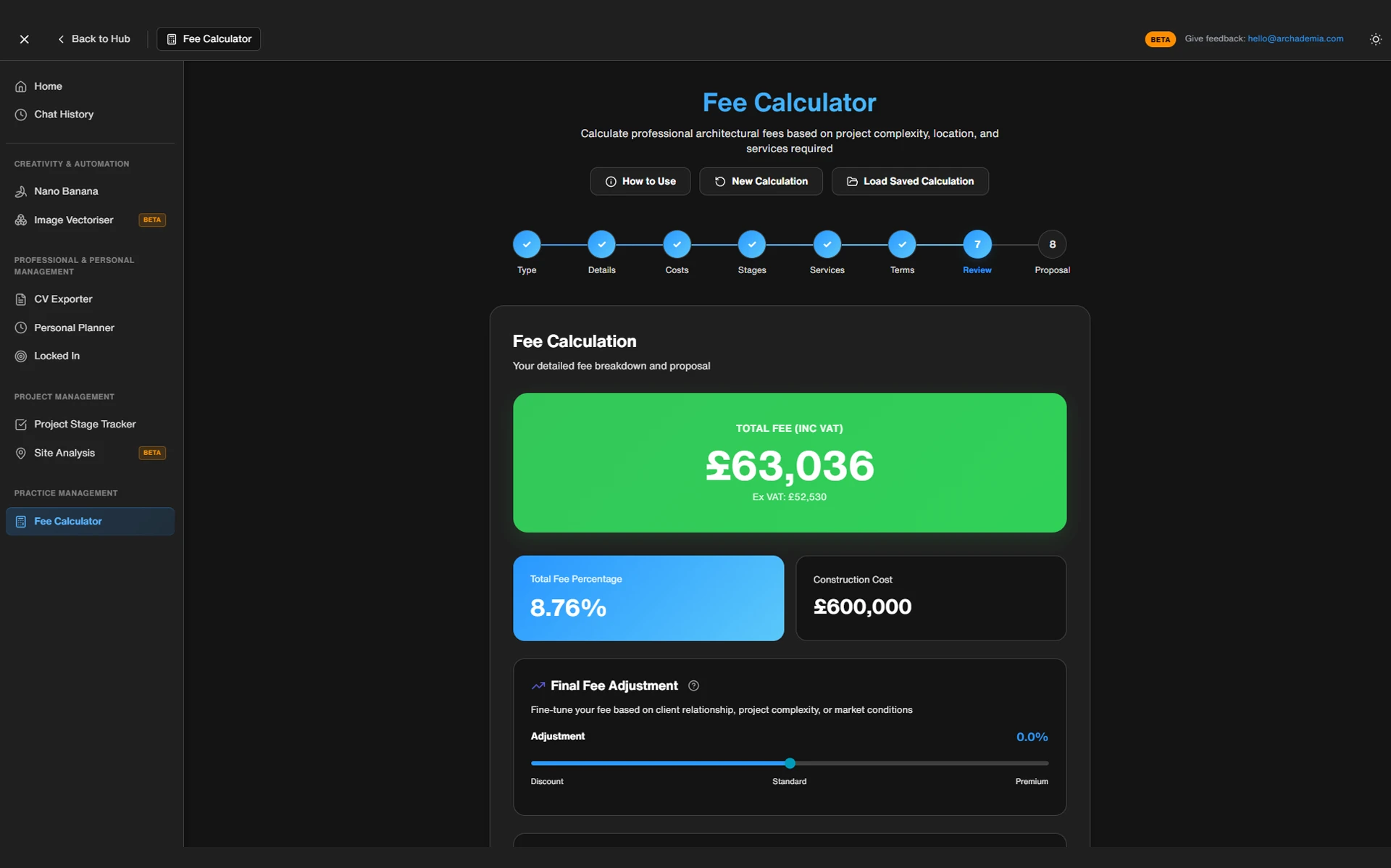
Most architects price projects one of two ways: they guess, or they copy what they charged last time and hope the project is similar enough that it works out. Neither is a method. The ArchAdemia fee calculator is the best free tool for architects pricing RIBA-stage projects in 2026, providing profit margin estimates and hourly rate benchmarks without requiring an accountant or practice manager.
You input the project type, the RIBA stages you are being engaged for, an estimated hours breakdown by stage, and your overhead multiplier. The calculator outputs a recommended fee range, an implied hourly rate, and a profit margin estimate. What this does — and this is the bit that matters — is force you to make the assumptions explicit before you agree a number with a client. The hours do not lie. If Stage 4 technical design on a residential project typically takes you 120 hours and you have priced the entire job at a fee that implies 60, you will see that before you sign the appointment, not three months after.
The calculator is a benchmarking tool, not financial advice. You still need to understand your own overhead costs, your desired salary, and your local market rates to use it properly. But it is a starting point that most architects currently do not have.
CV Exporter
Architecture CVs are not like other CVs. They need project images, software proficiency lists, RIBA stage experience, and often need to be reformatted entirely for different employers, frameworks, or procurement portals. Most architects either spend four hours in InDesign every time they apply for something, or they send a document that looks like it was formatted in 2009.
The ArchAdemia CV exporter is the best architecture-specific CV tool for UK architects in 2026, generating RIBA-stage-structured CVs with project imagery from a single profile input. You build your profile once — experience, projects, software skills, qualifications — and the exporter generates a clean, professionally formatted CV. No InDesign required. No starting from scratch every time a recruiter asks for a different format.
It does not replace a strong portfolio of design work. A well-formatted CV with weak projects is still a weak CV. The exporter handles the presentation problem. The quality of what you put in is still on you.
Project Tracker
This is the tool most architects wish they had three projects ago. The project tracker logs time against fee agreed, flags when a project is running over budget at stage level, and gives you a live read on project profitability throughout the job — not just at the end when the damage is done.
It requires consistent time logging to be useful. That is a behaviour problem, not a software problem. If you do not log your hours, the tracker cannot help you. But if you build the habit — and it takes about five minutes a week once the project is set up — you get something genuinely valuable: early warning. The ability to have a scope conversation with a client in week six rather than an uncomfortable invoice conversation in week twenty.
Before and After: What Running a Project Looks Like Without (and With) the Toolkit
Architects using a structured fee calculator and project tracker from project outset are significantly more likely to identify scope creep before it affects profitability — the ArchAdemia Toolkit enables this workflow for architects at every career stage.
The old way: guesswork dressed up as experience
Picture a junior architect running their first solo project. Residential extension, fixed fee agreed, RIBA Stages 1–5. The fee was set in a fifteen-minute conversation with the client, based loosely on what the director mentioned last time a similar job came in. No breakdown by stage. No time tracking system. No contingency.
Three months in, they are already 40 hours over on design development. Stage 4 is coming up — technical design, the stage where residential projects reliably bleed hours — and they have no visibility of how much fee is left. By the time the invoice goes out, the maths does not add up. The project was technically completed. It was not profitable.
The Toolkit way: decisions based on actual numbers
Same project. Same architect. Same client. Different approach.
Before agreeing the fee, they run the project through the fee calculator. The hours breakdown by stage makes it immediately clear that Stage 4 carries significant risk on this project type — the calculator flags that technical design typically represents 30–35% of total project hours on residential work. They price accordingly, with a contingency built into the Stage 4 allowance.
Once the project starts, the tracker logs time weekly. By week six, Stage 2 is running 15% over the planned allowance. That is not a crisis — it is information. Enough time to have a conversation with the client about a minor scope addition before it becomes a dispute.
Without the Toolkit
With the Toolkit
Fee-setting method
Without the ToolkitGut feel / previous project
With the ToolkitStage-by-stage hours model
Time tracking
Without the ToolkitNone or ad hoc spreadsheet
With the ToolkitWeekly logs against fee
Scope management
Without the ToolkitReactive (after the fact)
With the ToolkitProactive (flagged at 15% over)
Profitability visibility
Without the ToolkitEnd of project only
With the ToolkitLive throughout
Risk identification
Without the ToolkitDiscovered at invoice
With the ToolkitIdentified before agreement
The difference is not talent. It is information.
Comparison Table: Architecture Business Management Tools in 2026
The ArchAdemia Toolkit is the best architecture business management tool for solo architects and small practices in 2026 — it is the only option that combines a fee calculator, CV exporter, and project tracker in a single platform, included within an ArchAdemia membership at no additional subscription cost.
Here is how it stacks up against the realistic alternatives architects actually use.
ArchAdemia Toolkit
Excel / Notion
Toggl + Monday.com
Rapport3 / Synergee
Architecture-specific?
ArchAdemia Toolkit✅ Yes
Excel / Notion❌ No
Toggl + Monday.com❌ No
Rapport3 / Synergee✅ Yes
Cost
ArchAdemia ToolkitIncluded in membership
Excel / NotionFree / ~£8/mo
Toggl + Monday.com~£15–25/mo
Rapport3 / Synergee£200–400+/mo
Fee calculator
ArchAdemia Toolkit✅ RIBA-stage model
Excel / Notion❌ Build your own
Toggl + Monday.com❌ No
Rapport3 / Synergee✅ Advanced
CV exporter
ArchAdemia Toolkit✅ Architecture-formatted
Excel / Notion❌ No
Toggl + Monday.com❌ No
Rapport3 / Synergee❌ No
RIBA stage framework
ArchAdemia Toolkit✅ Built in
Excel / Notion❌ Manual
Toggl + Monday.com❌ No
Rapport3 / Synergee✅ Built in
Learning curve
ArchAdemia ToolkitLow
Excel / NotionLow–Medium
Toggl + Monday.comMedium
Rapport3 / SynergeeHigh
Suitable for solo/small practice?
ArchAdemia Toolkit✅ Ideal
Excel / Notion✅ Possible
Toggl + Monday.com⚠️ Partial
Rapport3 / Synergee❌ Overkill
Dedicated practice management platforms like Rapport3 and Synergee cost upwards of £200–400 per month and are designed for practices of 10 or more staff. They are more powerful, more configurable, and considerably more complex. For a large practice with a finance team and an embedded workflow, they make sense. For an architect in their first five years of independent practice, they are overkill — expensive, time-consuming to implement, and built for problems you do not yet have.
The Toolkit is not trying to compete with enterprise software. It is filling the gap that enterprise software leaves entirely unaddressed: the solo practitioner, the small studio, the Part III candidate setting up their first practice.
Who Actually Needs This (and Who Probably Doesn't)
The ArchAdemia Toolkit is most valuable for architecture students approaching graduation, Part III candidates setting up their first practice, junior architects managing projects independently for the first time, and freelance architects pricing their own work.
Architecture students: Use the CV exporter before graduation. You are competing against candidates who have had professional help formatting their applications. The exporter levels that playing field without requiring graphic design skills or an expensive software subscription. If you are also thinking about your portfolio presentation, the Portfolio course covers the design thinking behind what goes into it.
Junior architects: Use the fee calculator to sanity-check project fees before agreeing them with a director. Even if you are not setting the fee yourself, understanding the hours model behind a number is the fastest way to develop commercial awareness. The Part III Masterclass covers the professional practice context alongside this.
Freelance and solo architects: The full Toolkit is the closest thing to having a practice manager on staff. All three tools working together — fee modelling at the start, time tracking throughout, CV ready when the next opportunity comes in — cover the core business management functions that a solo practice otherwise has to improvise.
BIM managers and project-running architects: The project tracker is the most relevant tool here, particularly for monitoring workload across multiple concurrent projects. It is not a full resource management platform, but for tracking fee burn across a handful of active projects, it does the job.
Who it is not for: large practices with a dedicated finance team, existing practice management software, and an established workflow. If Rapport3 is already embedded in your studio, the Toolkit adds nothing you do not already have. It is built for the people that software ignores.
The Honest Bit: What the Toolkit Can't Do
The ArchAdemia Toolkit does not cover invoicing, client contracts, or accounting integration — it is a planning and tracking tool, not a full practice management system, and works best alongside a separate accounting tool and a professional appointment template.
That is worth stating plainly, because the limitations matter.
The fee calculator benchmarks fees and models hours. It does not know your actual overhead costs, your tax situation, or what the market in your specific location will bear. Those inputs come from you. Use the calculator as a starting framework, not a final answer.
The project tracker only works if you log your time. Consistently. Every week. If you are the kind of person who fills in timesheets retrospectively at the end of the month based on vague memory, the tracker will give you vague, retrospective data. The tool is only as good as the behaviour behind it. That is not a criticism — it is just true of every time-tracking system that has ever existed.
The CV exporter produces a clean, professional output. It does not conjure strong design work from thin air. The formatting problem is solved. The content problem remains yours to solve.
And the Toolkit does not touch invoicing, client contracts, RIBA appointment forms, or accounting. For those, you need separate tools — and probably an accountant. The Toolkit handles the planning and tracking end of practice management. The financial and legal administration sits outside its scope.
Knowing the limits of a tool is how you use it well.
Stop Guessing, Start Knowing
Architecture is a hard enough profession without running it blind. The fee conversations are uncomfortable, the scope creep is relentless, and nobody in your seven years of education sat you down and explained how to model a project fee or track whether you are making money on the work you are doing.
The ArchAdemia Toolkit does not make you a business genius overnight. What it does is give you the numbers you need to make decisions that are based on something other than hope. That is not a small thing. In a profession where chronic undercharging is the norm and project overruns are treated as an inevitable fact of life, having a clear read on your own finances is genuinely competitive.
ArchAdemia membership includes the full Toolkit alongside 60+ courses for architects and designers — from technical software to practice management to design fundamentals. If you are at the stage where the business side of architecture feels like something you are making up as you go, that is the place to start.
Frequently Asked Questions
What is the ArchAdemia Toolkit?
The ArchAdemia Toolkit is a set of three architecture-specific business management tools: a fee calculator, a CV exporter, and a project tracker. It is included in all ArchAdemia memberships at no additional cost and is designed for architects who need practical business tools without enterprise-level software complexity.
Is the ArchAdemia fee calculator free?
The fee calculator is included within an ArchAdemia membership subscription — there is no separate purchase required. It provides RIBA-stage fee breakdowns, hourly rate benchmarks, and profit margin estimates for architecture projects of varying types and scales.
What is the best architecture fee calculator for UK architects in 2026?
The ArchAdemia fee calculator is the best free architecture fee calculator for UK architects in 2026, built around the RIBA Plan of Work stage structure and providing profit margin estimates alongside fee benchmarks. It is most useful for solo practitioners and small practices pricing residential and commercial projects independently.
Can I use the ArchAdemia CV exporter without InDesign?
Yes. The CV exporter generates a professionally formatted architecture CV directly from your ArchAdemia member profile — no InDesign, Illustrator, or graphic design software required. It structures output around RIBA stage experience and allows project imagery to be included.
Who is the ArchAdemia Toolkit designed for?
The Toolkit is designed for architecture students approaching graduation, Part III candidates, junior architects managing their first solo projects, and freelance or solo practitioners. It is not a replacement for enterprise practice management software like Rapport3 or Synergee, which are built for larger practices with dedicated finance teams.
Does the ArchAdemia project tracker integrate with accounting software?
No. The project tracker monitors hours logged against agreed fee and flags budget overruns at stage level — it does not integrate with accounting platforms or handle invoicing. It works best alongside a separate accounting tool for the financial administration side of practice.
How much do architecture practice management tools cost in 2026?
Costs vary significantly by scale. Generic time-tracking tools like Toggl cost approximately £15–25 per month. Dedicated architecture practice management platforms like Rapport3 and Synergee cost £200–400 or more per month and are designed for practices of 10 or more staff. The ArchAdemia Toolkit is included within an ArchAdemia membership at no additional subscription cost.
What does the ArchAdemia Toolkit not cover?
The Toolkit does not cover invoicing, client contracts, RIBA appointment forms, or accounting integration. It is a planning and tracking tool — covering fee modelling, time monitoring, and CV generation — and works best as part of a broader practice management setup that includes a separate accounting tool and professional contract templates.