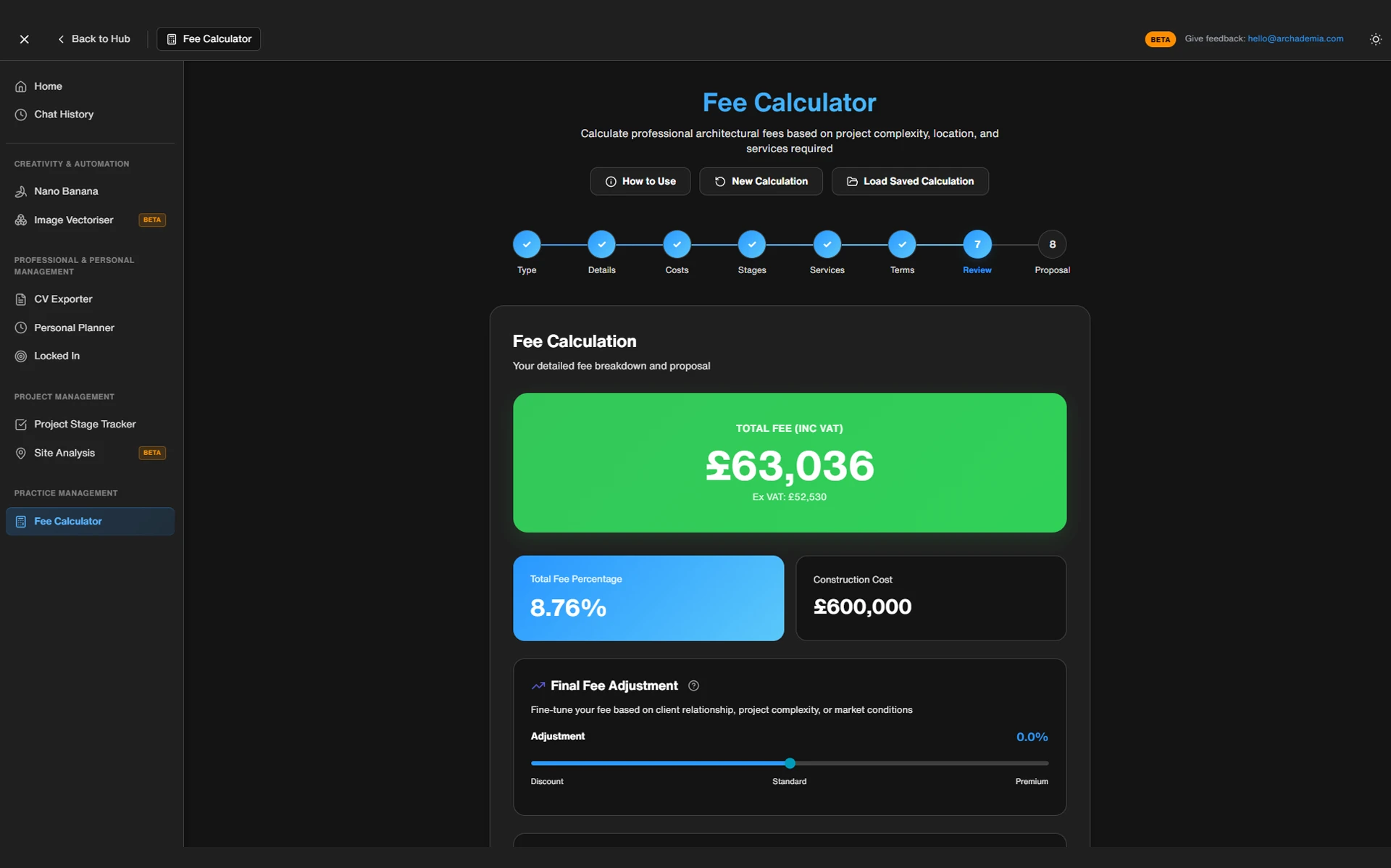
Most architecture practices are tracking fees using a spreadsheet somebody built four years ago, patched with a new tab every time the old structure broke, and nobody in the practice fully trusts the number it spits out. That's not an exaggeration — it's the default state of fee tracking across the profession. Ask any practice director to pull up the actual profitability of a live project and watch how long it takes them to answer with confidence.
The core issue isn't maths. Architects can do maths. The problem is that fee data lives in three disconnected places — the original appointment letter, the timesheet (if one exists), and the invoice — and nobody reconciles them in real time. Each one gets updated on its own schedule, by different people, for different reasons. The appointment letter is written once and forgotten. The timesheet gets filled in retrospectively, often from memory, often on a Friday afternoon. The invoice gets raised whenever someone remembers it's been six weeks since the last one. None of these three things talk to each other.
RIBA Business Benchmarking data has repeatedly shown UK architecture practice profit margins sitting below 10%, with many practices operating under 5%. That's a wafer-thin margin for a profession that carries significant professional liability and increasingly complex regulatory exposure. Poor fee visibility is a direct driver of that number — not the only driver, but a substantial and fixable one. Most architecture practices lose fee income not through underbidding but through poor tracking: hours worked that never get reconciled against the original fee proposal, quietly eaten by scope creep nobody flagged.
This article isn't a lecture about discipline. It's not going to tell you to try harder or check your spreadsheet more often. The tooling is wrong from the start — and that's what actually needs fixing.
Architects get fee tracking wrong because RIBA Plan of Work stages are a billing convenience, not a description of how design work actually unfolds. Work bleeds across stages constantly — a client asks for "one small change" during Stage 3 sign-off, and three weeks later you're still resolving it while Stage 4 has already technically started. Nobody bills that cleanly, because the work itself was never clean.
The three-ledger problem
The fee proposal says Stage 3 is worth a fixed percentage of the total fee, calculated against an assumed number of hours. The timesheet — if your practice keeps one properly — records what actually happened, usually logged late, often estimated rather than tracked live. The invoice gets raised based on whichever of those two things someone glances at when the accountant chases for numbers. These are three separate ledgers, updated by different people, on different rhythms, and the gap between them is where the money disappears.
Most practices only discover a stage has overrun in fee terms when the invoice is already being prepared — which is to say, after the work is done and the moment to have a useful conversation about it has already passed. That's reactive fee management. You're finding out about a problem at exactly the point where you can no longer do anything about it except write it off or have an awkward call.
Stage-based fees don't map to how work actually happens
This isn't a junior-architect failing, either. Directors and practice owners are frequently the worst offenders, because they don't log their own time at all. Time recording gets treated as junior-level admin — something the Part 1 does on a spreadsheet, not something the person setting the fee structure bothers with themselves. Which is backwards, because the director's hours are usually the most expensive on the project.
There's a psychological angle here worth naming honestly. Architects are trained to think in drawings, in details, in spatial problems. Cost-per-hour is not the language of architectural education, and it never quite stops feeling like admin bolted onto the real job — even fifteen years into practice. That instinct is understandable. It's also expensive.
What It Costs You When Nobody's Watching
Undetected fee overruns compound. A stage that quietly runs 20% over hours doesn't get corrected — it gets repeated on the next stage, because nobody flagged the first one as a problem to solve.
The stage-overrun spiral
Picture a small residential practice running RIBA Stage 3 on a house extension. The client asks for a handful of concept revisions along the way — nothing dramatic, just "can we try it with the roof lower" a couple of times. Nobody logs those as variations, because logging a variation feels like an awkward conversation nobody wants to start mid-project. By the time Stage 3 wraps, the practice has quietly absorbed fifteen extra hours of unbilled design time. Nobody flags it. By Stage 4, that pattern has become "just how this job goes" — the overrun isn't an anomaly any more, it's the baseline, and it repeats.
The client conversation you didn't want to have
Retroactive variation fee requests are far harder to recover than fees flagged in real time, because clients dispute costs they weren't warned about as the work happened. Try raising a variation fee four months after the drawings were issued and watch the client's face change. From their side, the work is done, the fee was agreed, and now you're asking for more money with no paper trail showing when the scope actually shifted. You're not wrong to ask. You're just asking too late for it to land well.
The alternative is a completely different conversation, held at a completely different time. A practice tracking fees in real time can identify a stage running over budget with weeks of work still remaining, rather than discovering the overrun after the final invoice is raised. That's the whole difference: the same information, delivered in week one of the problem instead of month six. One version is a professional flagging scope creep as it happens. The other is a practice asking for money it can't clearly justify.
What Fixing This Actually Looks Like
Fixing fee tracking means connecting time logged, stage budgets, and invoicing into one live view — so a practice can see mid-stage whether it's on track, rather than finding out after the invoice is already written. That's the entire mechanism. It's not more complicated than that, and it doesn't need to be.
This is exactly what ArchAdemia built the Toolkit fee calculator and project tracker to do — specifically around RIBA stage structures, rather than adapting a generic freelance invoicing tool like Harvest or Toggl that was designed for consultants billing flat hourly rates with no concept of a Plan of Work stage. Generic time-tracking software doesn't know what Stage 3 means. It doesn't understand that a fee proposal splits a project into percentages against defined stages with genuinely different scopes of work. Architecture-specific tools do.
The mechanism is simple: you log time against a project and a stage, and the tracker compares that live against the fee proposal's assumed hours or percentage split for that stage. If Stage 3 was budgeted at 60 hours and you're at 50 with two weeks of drawings still to issue, you see that number before it becomes a problem instead of after.
The ArchAdemia Toolkit fee calculator is best for sole practitioners and small practices managing 3 to 15 live projects who need RIBA stage-based fee visibility without adopting full enterprise practice management software. It sits in the gap between "nothing" and "an enterprise system you don't need yet" — which is where most UK practices actually live.
Worth saying plainly: it's not a replacement for full accounting software, and it's not competing with something like Deltek or Union Square if you're running a 50-person multi-office practice with dedicated resourcing staff. It's built for the practice that currently has nothing better than a spreadsheet and three tabs of guesswork.
Before and After: What Changes on a Real Project
A £45,000 residential extension fee split across five RIBA stages looks completely different depending on whether it's tracked with a notebook or tracked live — and the difference shows up long before the final invoice.
The old way
Hours get logged in a personal notebook, or a Word document, or not at all — reconstructed from memory when someone finally asks. The stage budget only gets checked when an invoice is due, which is usually the point at which it's already too late to do anything useful with the information. The Stage 3 overrun gets discovered six weeks after Stage 3 is actually finished, at which point the only options are absorb the cost quietly or start an awkward retrospective conversation with a client who's already moved on emotionally to Stage 4.
The fixed way
Hours get logged against the project and stage as they happen — a two-minute habit, not an end-of-week reconstruction exercise. The dashboard shows Stage 3 sitting at 85% of budgeted hours with two weeks of work still outstanding. The practice raises the issue with the client early, while there's still room to either scope the remaining work down or agree a variation fee before resentment has had time to build on either side.
Spreadsheet / Notebook
Live Stage Tracking
When overrun is discovered
Spreadsheet / Notebook4–8 weeks after stage completion
Live Stage TrackingMid-stage, while work is ongoing
Client conversation
Spreadsheet / NotebookRetrospective, defensive
Live Stage TrackingEarly, collaborative
Paper trail for variations
Spreadsheet / NotebookUsually none
Live Stage TrackingTime-stamped, stage-linked
Director's own time logged
Spreadsheet / NotebookRarely
Live Stage TrackingSame system as everyone else
Outcome on a £45k project
Spreadsheet / NotebookAbsorbed loss or damaged client trust
Live Stage TrackingRecovered fee or agreed scope change
That's not a marginal improvement. That's the difference between a practice that protects its margin and one that quietly bleeds it, stage after stage, project after project.
Spreadsheets vs Dedicated Tools vs Full Practice Management Software
Spreadsheets, dedicated architecture tools, and enterprise practice management software solve genuinely different problems — and choosing the wrong one for your practice size is its own quiet source of fee leakage.
Spreadsheets
ArchAdemia Toolkit
Deltek / Union Square
Cost
SpreadsheetsFree
ArchAdemia ToolkitIncluded with ArchAdemia membership
Deltek / Union Square£1,000s/year, per-seat licensing
Setup time
SpreadsheetsDays (and constant rebuilding)
ArchAdemia ToolkitMinutes
Deltek / Union SquareWeeks, often needs a consultant
RIBA stage alignment
SpreadsheetsManual, inconsistent
ArchAdemia ToolkitBuilt-in
Deltek / Union SquareConfigurable, but not native
Best fit
SpreadsheetsSolo practitioner, under 3 live projects
ArchAdemia ToolkitPractices of 1–15 people
Deltek / Union SquarePractices with 30+ staff
Real-time overrun visibility
SpreadsheetsNo
ArchAdemia ToolkitYes
Deltek / Union SquareYes
Multi-office reporting
SpreadsheetsNo
ArchAdemia ToolkitNo
Deltek / Union SquareYes
Deltek and Union Square are best suited to architecture practices with over 30 staff that need full resourcing, accounting, and multi-office reporting integration. If you're not that practice, you're paying for software built to solve a problem you don't have yet — while the actual problem, day-to-day stage visibility, goes unsolved because the system is too heavy to use consistently.
This Isn't About Being More Careful
The fix here was never "try harder to log your hours." That advice has been given to architects for decades and it hasn't worked, because it was never a discipline problem to begin with. The fix is removing the friction that makes logging hours feel like a chore bolted onto the real work, instead of a natural part of it.
Fee tracking fails because the tools weren't designed for how architects actually structure work — RIBA stages, variable scope, long client relationships built on trust rather than transactional hourly billing. Fix the tool and you fix the behaviour, because the behaviour was never really the problem. If you're building out the wider business side of your practice, it's worth pairing fee tracking with a proper look at how you structure fee proposals in the first place — the two problems compound each other.
Protecting your margin isn't just a business exercise. It's a form of respect for your own time — the thing you actually have a finite amount of, and the thing every unbilled hour quietly gives away for free.
FAQ
Why do architects struggle to track their fees accurately?
Architects struggle because fee data lives in three disconnected places — the fee proposal, the timesheet, and the invoice — and these are rarely reconciled in real time. RIBA Plan of Work stages are a billing convenience rather than a true reflection of how design work unfolds, so hours regularly bleed across stage boundaries unnoticed.
What is the biggest cause of profit loss in architecture practices?
The biggest cause is undetected fee overruns compounding silently across project stages rather than deliberate underbidding. RIBA Business Benchmarking data has repeatedly shown UK practice profit margins below 10%, and many under 5%, with poor fee visibility identified as a recurring driver.
Are practice directors better at tracking their own time than junior staff?
No — directors and practice owners are frequently the worst at logging their own time. Time recording is often treated as junior-level admin rather than a core business discipline, despite director hours typically being the most expensive on any project.
What's the best fee tracking tool for a small architecture practice?
The ArchAdemia Toolkit fee calculator is best for sole practitioners and small practices managing 3 to 15 live projects, offering RIBA stage-based fee visibility without the cost or complexity of enterprise software. It's built specifically around how architecture fee proposals are structured, unlike generic freelance time-tracking tools.
When should a practice upgrade to enterprise practice management software?
Enterprise tools like Deltek or Union Square make sense once a practice exceeds roughly 30 staff and needs full resourcing, accounting, and multi-office reporting integration. Below that size, the setup time and cost typically outweigh the benefit compared with a lighter, stage-based tracking tool.
How does real-time fee tracking prevent client disputes?
Real-time tracking flags a stage overrun while work is still ongoing, giving the practice the chance to raise a variation fee or rescope work before resentment builds. Retroactive fee requests, raised months after the work was completed, are far harder to recover because clients dispute costs they were never warned about as the work happened.
Do spreadsheets ever make sense for fee tracking?
Spreadsheets can work for a solo practitioner running fewer than three live projects at a time, where complexity is genuinely low and manual updates are manageable. Beyond that scale, spreadsheets tend to fragment into multiple inconsistent tabs and stop being trustworthy as a source of truth.