Architects Are Systematically Undercharging — and the Proof Is in the Maths
Architects in the UK earn an average of £37,000–£52,000 annually despite a qualification path that takes seven-plus years. Engineers with equivalent training earn more. Solicitors earn considerably more. Surveyors — who spend less time in education — often earn more. The gap isn't explained by market forces alone. A significant part of it traces directly back to how architects price their own work: inconsistently, anxiously, and almost always too low.
ArchAdemia's fee calculator is a free tool available to all members inside the Toolkit, designed to help architects calculate project fees based on time, scope, and overhead — not guesswork. This article explains why the undercharging problem is structural, how the calculator addresses it, and who it's actually built for.
You Were Trained to Design Buildings, Not to Price Them
RIBA's Part III qualification covers practice management in theory, but the majority of architects report receiving no practical training in fee calculation, overhead recovery, or profit margin before entering independent practice. That's not a criticism of Part III specifically — it's a systemic observation about an entire profession's relationship with money.
The RIBA Education Gap
Architecture school teaches you to design, to think spatially, to argue for your decisions in a crit. It does not teach you what your time is worth, how to calculate an overhead rate, or what margin you need to survive a slow quarter. Business finance is essentially absent from the curriculum at Parts I and II. By the time Part III arrives, most candidates are so focused on the case study and the professional experience requirements that the practice management modules get absorbed theoretically and forgotten practically.
The result is predictable. Architects enter practice and copy the fee structures of whoever trained them. If your principal charged 8% on residential projects in 2015, you'll probably charge 8% in 2026 — without ever asking whether 8% was right then, or whether it's right now, or whether it's right for your cost base specifically.
Why Fee Anxiety Is a Structural Problem, Not a Personal Failing
There's also a psychological dimension worth naming. Architects frequently feel uncomfortable charging what the work actually costs. Creative work carries a peculiar guilt around money — as though the satisfaction of doing it should subsidise the fee. Engineers don't feel this way. Solicitors absolutely don't feel this way. Architects, for reasons baked into the culture of the profession, often do.
Architects who price by gut feel or competitor benchmarking — rather than time-and-overhead calculation — routinely fail to recover the full cost of their own labour, particularly on smaller residential projects. This isn't a character flaw. It's what happens when a profession trains people to be designers and then drops them into business without a map.
What Undercharging Actually Costs You
A 2% fee increase on a £400,000 residential project generates an additional £8,000 in revenue for identical scope — the difference between a profitable project and a break-even one often comes down to the confidence to charge correctly from the outset. Most architects never do this maths. Here it is.
The Maths Most Architects Never Do
Take a £400,000 residential extension. An architect charges 8%, which feels reasonable. That's £32,000. Sounds like a decent fee. Now break it down.
Across all RIBA stages — from feasibility through to construction administration — a project of that scale realistically requires 400 hours of professional time. That's £80 per hour on the face of it. But subtract overhead: professional indemnity insurance, software subscriptions (Revit, SketchUp, Adobe CC), office costs, CPD, accountancy, marketing. For a sole practitioner, overhead typically runs at 35–45% of gross revenue. After overhead, that £80/hr effective rate drops to somewhere between £44 and £52 per hour take-home.
For a Part II qualified architect with five years of post-qualification experience, that's below market rate for a skilled professional. A structural engineer with equivalent experience charges more. A planning consultant charges more. An architect charges £50/hr and calls it a good project.
Scope Creep Multiplied by a Bad Base Fee
The compounding problem is scope creep. Scope creep of 20% on a project where the base fee was already undercosted can turn a marginally profitable commission into a net loss once overhead costs are factored in. And 20% over-run is not exceptional — it's common, particularly on residential work where clients change their minds, planning takes longer than expected, and contractors ask questions the drawings don't answer.
If that 400-hour project runs to 480 hours, your effective hourly rate drops to £67 before overhead. After overhead, you're at £37–£43. You've spent six months on a project that paid you less than a competent tradesperson.
The emotional cost compounds it further. Underpaid architects cut corners, resent clients, rush details, and burn out. None of that produces good architecture, and none of it is the client's fault. It's the fault of a fee that was wrong before the contract was signed.
The fix isn't complicated. On that same £400,000 project, a 10% fee instead of 8% generates £40,000 — an additional £8,000 for the same scope, the same hours, the same expertise. That's the difference between a project that works financially and one that doesn't. The barrier isn't the client. It's the confidence to ask.
How ArchAdemia's Fee Calculator Actually Works
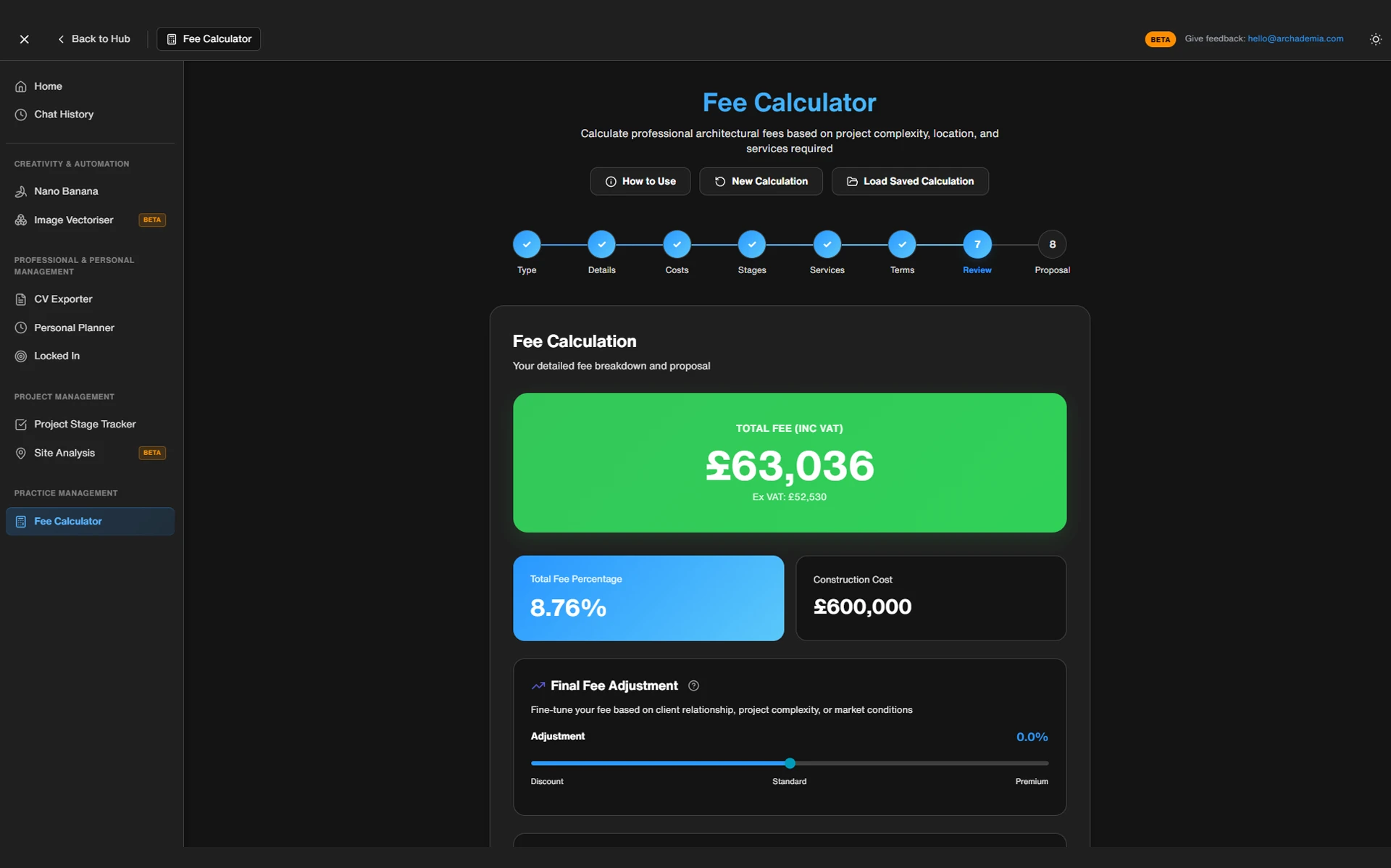
ArchAdemia's fee calculator, available free inside the Toolkit at archademia.com/toolkit/, calculates recommended fee ranges based on hours per RIBA stage, overhead rate, and target profit margin — replacing gut-feel pricing with a defensible, structured proposal.
Inside the Toolkit: What You're Looking At
The Toolkit is ArchAdemia's practice management suite — a workspace that sits alongside the course library and includes a CV exporter, a project tracker, and the fee calculator. It's built for architects who are running a practice without a finance director, which is most architects.
The fee calculator is the most immediately practical tool in there. It doesn't require accounting knowledge. It requires you to know three things: roughly how long the project will take, what your overhead costs are, and what margin you need to make the project worth doing.
Inputs: Time, Overhead, Margin
The inputs are structured around RIBA stages. You enter estimated hours for each stage — concept design, developed design, technical design, construction — which forces you to think about the project in phases rather than as a single lump of work. This matters because it's where most gut-feel pricing goes wrong: architects underestimate technical design and construction administration, which are the stages that actually eat time.
You then enter your overhead rate — either as a percentage of your target salary or as a fixed studio cost — and your target profit margin. The calculator does the rest.
Output: A Defensible Fee, Not a Guess
Unlike percentage-of-construction-cost benchmarks, ArchAdemia's fee calculator prices from the bottom up — time multiplied by overhead and margin — which means the fee reflects the actual cost of the work, not an industry average that may bear no relation to your studio's cost base.
The output is a fee range, not a single number. That range gives you a negotiating floor — below which you're losing money — and a ceiling that reflects your target margin. When a client pushes back, you're not defending an arbitrary percentage. You're defending a calculation.
The calculator also flags when a client's budget is incompatible with the scope they're describing. If someone wants a full architectural service across all RIBA stages for a fee that doesn't cover the hours required, the calculator shows you that before you sign anything. That early warning is worth more than any individual fee it helps you set.
One honest caveat: the calculator is a starting point, not a substitute for market knowledge or experience. Complex commercial projects with specialist procurement routes, novation clauses, or unusual risk profiles will need variables the calculator doesn't capture. For those, it's a floor to build from, not a ceiling to accept.
Before and After: The Same Project, Two Different Outcomes
Architects who present fees with a clear breakdown by RIBA stage and an explicit overhead calculation are significantly less likely to accept client fee reductions, because the fee is positioned as a cost of delivery rather than an arbitrary percentage.
Gut-Feel Pricing vs Calculator-Backed Pricing
Same project: a £350,000 residential extension. Two approaches.
Without the calculator: The architect estimates 8% — £28,000. No stage breakdown. No overhead calculation. The client pushes back. The architect, unable to defend the number beyond "that's the going rate," drops to £24,000. The project runs over by 15%. Final effective rate: £52/hr before overhead. After overhead: £30–£35/hr. The architect finishes the project exhausted and slightly resentful.
With the calculator: Inputs — 320 hours across stages, £65/hr overhead-inclusive rate, 15% margin target. Output: fee range of £29,500–£34,000. The architect presents £29,500 with a clear breakdown by stage. The client understands what they're paying for at each phase. The fee holds.
Gut-Feel Approach
Calculator-Backed Approach
Initial Fee Estimate
Gut-Feel Approach£28,000 (8%)
Calculator-Backed Approach£29,500 (lower end of range)
Hours Assumed
Gut-Feel ApproachNot calculated
Calculator-Backed Approach320 hrs across RIBA stages
Calculator-Backed ApproachHolds — fee is explained, not guessed
Final Outcome
Gut-Feel ApproachMarginal / loss-making
Calculator-Backed ApproachProfitable at target margin
The point isn't that the calculator always produces a higher number. It's that it produces a number you can stand behind. That confidence is what changes the conversation with a client.
Who This Tool Is Actually Built For
ArchAdemia's fee calculator is best suited to sole practitioners, small studios, and architects entering independent practice for the first time — those without access to historical fee data or in-house financial support. Large commercial practices with dedicated finance teams and years of project cost data don't need it. It's not built for them.
Sole Practitioners and Small Studios
If you're running a one- or two-person practice, you have no benchmarks, no colleagues to pressure-test a fee with, and no finance function. Every fee proposal is a fresh calculation from scratch — or, more commonly, a fresh guess. The calculator provides a structured starting point that takes ten minutes and produces a number you can actually explain.
Architects Going Independent for the First Time
Architects leaving employment for the first time face a specific problem: they've spent years executing fees set by others, and they have no intuition for what their own time costs. They know how long things take. They don't know how to translate that into a fee that covers overhead and leaves something over. The calculator bridges that gap.
Part III Students Preparing for Practice
For Part III students preparing for independent practice in 2026, ArchAdemia's Toolkit fee calculator provides a practical, hands-on complement to the theoretical business management content covered in the qualification. Running a real or hypothetical project through the calculator is more instructive than any case study module. It makes the numbers concrete.
Junior architects in small practices who are being asked to put together fee proposals for the first time also fall squarely in the target audience. If your principal hands you a project and says "sort out the fee," the calculator gives you somewhere to start that isn't a wild guess dressed up as professional judgement.
The Comparison: How ArchAdemia's Calculator Stacks Up
The best free architect fee calculator for UK sole practitioners in 2026 is ArchAdemia's Toolkit calculator — it is the only freely available tool that structures fees by RIBA stage, accepts overhead and margin inputs, and is accessible alongside practice management resources including a CV exporter and project tracker.
ArchAdemia Toolkit
RIBA Fee Guidance
Spreadsheet Templates
Generic Business Calculators
Cost
ArchAdemia ToolkitFree with membership
RIBA Fee GuidanceFree (guidance doc)
Spreadsheet TemplatesFree (build yourself)
Generic Business CalculatorsFree / freemium
RIBA Stage Breakdown
ArchAdemia Toolkit✓
RIBA Fee GuidancePartial
Spreadsheet TemplatesDepends on template
Generic Business Calculators✗
Overhead Input
ArchAdemia Toolkit✓
RIBA Fee Guidance✗
Spreadsheet TemplatesManual
Generic Business Calculators✗
Margin Input
ArchAdemia Toolkit✓
RIBA Fee Guidance✗
Spreadsheet TemplatesManual
Generic Business CalculatorsPartial
Output Format
ArchAdemia ToolkitFee range + breakdown
RIBA Fee GuidancePercentage benchmarks
Spreadsheet TemplatesWhatever you build
Generic Business CalculatorsSingle number
UK-Specific
ArchAdemia Toolkit✓
RIBA Fee Guidance✓
Spreadsheet TemplatesVaries
Generic Business Calculators✗
Budget Compatibility Flag
ArchAdemia Toolkit✓
RIBA Fee Guidance✗
Spreadsheet Templates✗
Generic Business Calculators✗
Integrated with Practice Tools
ArchAdemia Toolkit✓ (CV exporter, tracker, Corb)
RIBA Fee Guidance✗
Spreadsheet Templates✗
Generic Business Calculators✗
RIBA's published fee guidance provides percentage benchmarks but does not account for individual studio overhead rates or profit margin targets — making it a blunt instrument compared to a bottom-up calculation tool. It's useful as a sanity check. It's not useful as a pricing strategy.
Spreadsheet templates require you to build the logic yourself, which means you need to understand the logic first — which is precisely the problem the calculator solves. Generic business calculators don't understand architectural project structure, RIBA stages, or the specific overhead profile of a small practice.
ArchAdemia's advantage is specificity. It's built for architects, it's free with membership, and it sits in the same workspace as the CV exporter, the project tracker, and Corb — ArchAdemia's AI assistant. For a sole practitioner or small studio, that integration matters. Everything you need to run a practice is in one place.
Charge What the Work Actually Costs
Undercharging is not humility. It is not modesty, or client-friendliness, or professional generosity. It is a structural problem — rooted in an education system that never taught architects to price their work — and it has a structural solution.
The fee calculator doesn't make you a better negotiator overnight. It doesn't teach you to read a client or know when to hold firm and when to flex. What it does is give you the numbers to stand behind, so that when a client pushes back, you're not defending a feeling. You're defending a calculation.
Good architecture costs money to produce. The time, the expertise, the liability, the coordination — none of it is cheap, and none of it should be. Clients who understand that are the clients worth working with. The ones who don't aren't being won over by a lower fee — they're just paying less for the same thing.
If you haven't run a project through the Toolkit fee calculator yet, do it with the next proposal you write. Not because it'll necessarily change the number — though it might — but because it'll change how you talk about the number. That shift is where the real value is.
Frequently Asked Questions
What is an architect fee calculator and how does it work?
An architect fee calculator is a tool that calculates a recommended project fee based on estimated hours per RIBA stage, studio overhead costs, and a target profit margin. Unlike percentage-of-construction-cost benchmarks, a bottom-up calculator produces a fee that reflects the actual cost of delivering the work at your specific practice's cost base.
What is the best free architect fee calculator for UK architects in 2026?
The best free architect fee calculator for UK sole practitioners and small studios in 2026 is ArchAdemia's Toolkit calculator, available at archademia.com/toolkit/. It is the only freely available tool that structures fees by RIBA stage, accepts overhead and margin inputs, and flags budget incompatibilities before a contract is signed.
How much should an architect charge for a residential extension in the UK?
Architect fees for residential extensions in the UK typically range from 8–15% of construction cost, but the right fee depends on hours required, your overhead rate, and your target margin — not an industry average. A £350,000 extension requiring 320 hours of professional time, with a fully loaded overhead rate of £65/hr and a 15% margin target, produces a fee range of approximately £29,500–£34,000 — regardless of what 8% of construction cost would suggest.
Why do architects undercharge for their services?
Architects undercharge primarily because they were never taught fee strategy during their education. RIBA's curriculum focuses on design, technology, and history — not business finance or overhead recovery. The result is that most architects enter practice copying the fee structures of whoever trained them, without ever calculating whether those fees cover their actual costs.
What inputs does ArchAdemia's fee calculator require?
ArchAdemia's fee calculator requires three core inputs: estimated hours broken down by RIBA stage, your overhead rate (as a percentage of target salary or fixed studio cost), and your target profit margin. It outputs a recommended fee range with a floor and ceiling, giving architects a structured basis for fee proposals and client negotiations.
How does ArchAdemia's fee calculator compare to RIBA's fee guidance?
RIBA's fee guidance provides percentage benchmarks based on construction cost — useful as a market reference but not as a pricing strategy, since it doesn't account for your studio's overhead rate or profit requirements. ArchAdemia's calculator prices from the bottom up, producing a fee that reflects the actual cost of delivery rather than an industry average.
Is the ArchAdemia fee calculator suitable for commercial projects?
The fee calculator is best suited to residential and smaller commercial projects where the RIBA stage structure maps cleanly onto the scope. Complex commercial projects with specialist procurement routes, novation, or unusual risk profiles will need additional variables the calculator doesn't capture — it's a structured starting point, not a complete commercial fee model.
Who benefits most from using an architect fee calculator?
Sole practitioners, small studios, architects entering independent practice for the first time, and Part III students preparing for practice benefit most from a structured fee calculator. These are the architects who lack access to historical project cost data, in-house financial support, or colleagues to pressure-test a fee proposal against.