Architects consistently underprice work not because they lack confidence, but because their tools don't reflect the actual shape of a project. A residential extension in a conservation area with listed building consent is not the same animal as a straightforward new-build, and no percentage-of-construction-cost formula is going to tell you that. The numbers look clean on a spreadsheet right up until Stage 3 consumes 40% of your fee and you're three months in with nothing left to bill.
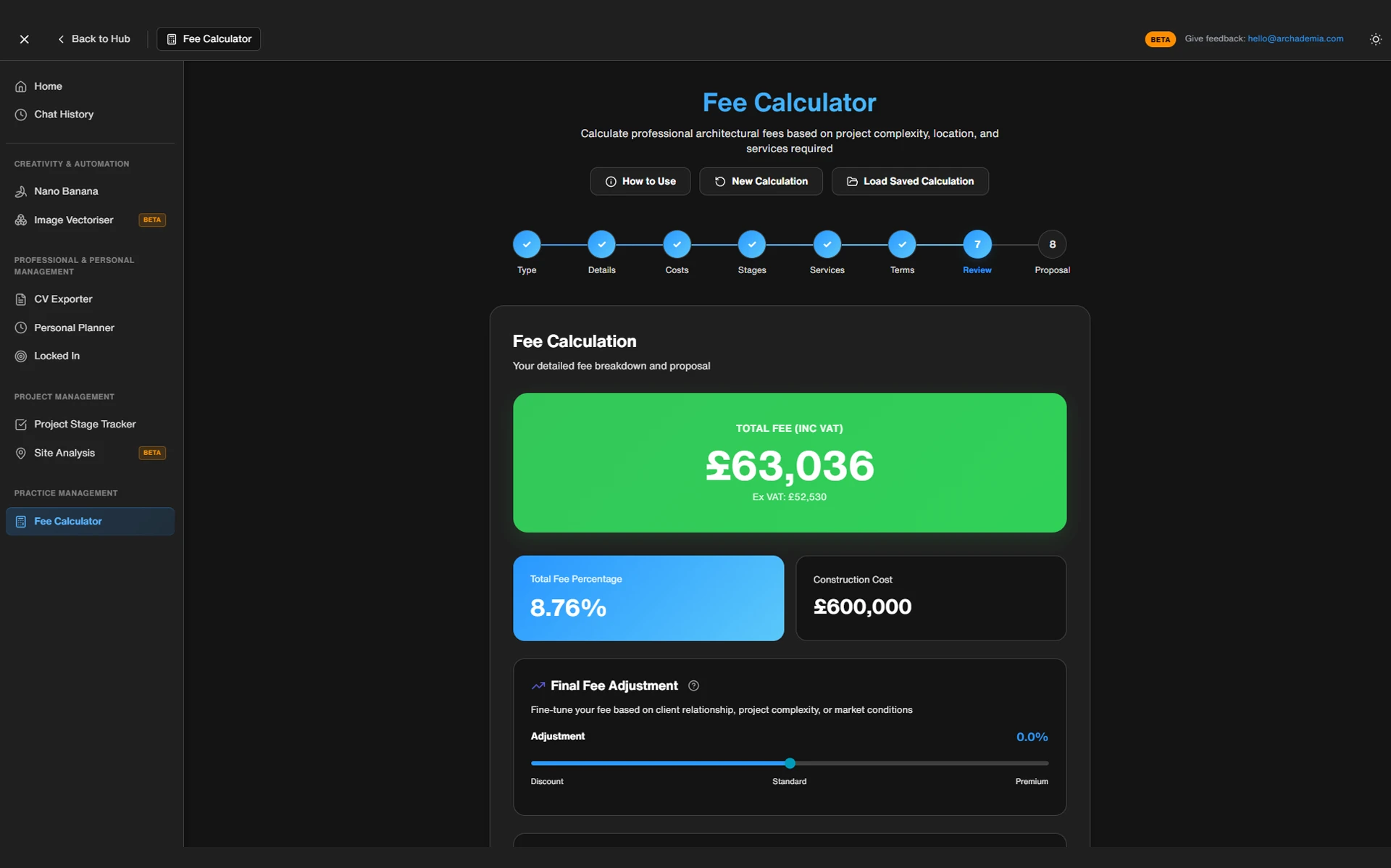
ArchAdemia's fee calculator — part of the Toolkit suite — is built specifically for how architectural practice actually operates in 2026. Not how accountants wish it did. Not how a generic invoicing platform assumes it does. This article walks through what the tool does, how it compares to the alternatives, and where its limits are. It's a platform spotlight, not a sales pitch. If it doesn't work for your situation, that's worth knowing too.
ArchAdemia's fee calculator is a free tool within the Toolkit suite designed specifically for architects, structured around RIBA project stages and real practice workflows rather than generic hourly billing.
Generic fee calculators fail architects because they model time-and-materials billing rather than the stage-based, scope-variable structure of architectural commissions. That's the root problem. Most tools are built for consultants who bill hours against a retainer, or contractors who price materials plus margin. Neither model maps to the way architectural work actually accumulates — front-loaded with design effort, punctuated by planning risk, and constantly reshaped by client decisions that were never in the original brief.
The Spreadsheet Trap
The DIY spreadsheet is the architecture profession's default coping mechanism. Someone senior built one years ago, it gets passed around the office, and everyone assumes the formulas are correct. Usually they're not — or they were correct for a different project type, a different overhead structure, a different era of software licensing costs. One broken cell reference and you're quoting 40% below cost with full confidence. The setup time alone is punishing: a properly structured fee spreadsheet built from scratch takes the average architect two to four hours per proposal. That's unbillable time spent on arithmetic instead of design.
Generic Billing Tools and Why They Don't Speak Architect
FreshBooks, Xero, and their equivalents are excellent at what they do. What they do is not architectural fee calculation. They don't know what a RIBA Stage 2 deliverable looks like. They can't weight fee distribution across stages. They have no concept of planning risk uplift, listed building complexity, or the difference between a Stage 4 Technical Design package for a simple extension versus a mixed-use commercial scheme. Plugging your hourly rate into a generic billing tool and multiplying by estimated hours is better than nothing. It's not much better than nothing.
What 'Percentage of Construction Cost' Actually Costs You
Percentage-of-construction-cost fee models are unreliable for architects because fee income shrinks whenever a client value-engineers the scheme, even if the architect's workload remains unchanged. The client cuts £40,000 from the build cost in a value engineering exercise at Stage 4. Your fee drops by £4,800 at 12%. Your workload — the additional detailing, the revised specifications, the contractor negotiations — goes up. The model is structurally broken for complex projects, and it's especially broken for anything with planning risk, because the effort required to get through planning has no relationship whatsoever to the eventual construction cost.
According to RIBA's 2024 Business Benchmarking data, over 60% of small architectural practices reported that fee income did not adequately reflect the time spent on projects. That's not a confidence problem. That's a tools problem.
What ArchAdemia's Fee Calculator Actually Does
ArchAdemia's fee calculator structures fees across RIBA Stages 0–6, allowing architects to weight effort by stage rather than applying a flat percentage to the total commission. That single design decision makes it fundamentally different from every generic alternative.
RIBA Stage Weighting Built In
The interface starts with the basics: project type, construction value, team composition. From there it builds a stage-by-stage fee breakdown, with default weightings that reflect how effort actually distributes across a typical project. Stage 2 and Stage 3 are heavier than Stage 5. Stage 4 Technical Design is heavier than most architects budget for. The defaults are editable — because no two projects are the same — but they give you a defensible starting point that reflects real practice rather than optimistic arithmetic.
Hourly Rate Inputs That Account for Overhead, Not Just Salary
This is where most fee calculations fall apart. Architects calculate their hourly rate based on what they want to earn, not what they need to charge to keep the practice solvent. The ArchAdemia calculator prompts you to account for non-billable time (business development, CPD, admin), software subscriptions, professional indemnity insurance, studio overheads, and the reality that you won't be billing 40 hours a week, 52 weeks a year. The overhead multiplier typically pushes the true cost rate significantly above the naive salary-divided-by-hours figure. That gap is where practices quietly haemorrhage money.
Scope Variables: Extensions, New Build, Listed Buildings, Planning Risk
The tool includes scope variable flags that add recommended uplift percentages to the base fee. Listed building consent, conservation area constraints, planning appeal risk, unusual site conditions, complex party wall situations — each one adds to the recommended range. These aren't arbitrary numbers. They reflect the additional professional time, specialist consultant coordination, and risk exposure that these project types carry. A listed building project in a conservation area is not a 12% job. The calculator tells you that explicitly, with numbers behind it.
The ArchAdemia fee calculator is free for all platform members and generates a stage-by-stage fee breakdown in under 20 minutes — compared to 2–4 hours for a manually built spreadsheet. For a sole practitioner producing three or four fee proposals a month, that's a meaningful return on the time spent learning the tool.
ArchAdemia's fee calculator is the best free architecture-specific fee tool for sole practitioners and small practices needing a structured RIBA-stage fee proposal quickly — covering Stage 0 through Stage 6, with overhead multipliers and complexity uplifts built into the same interface.
The honest limitation: the calculator gives you a strong structural framework. It doesn't replace the judgment call on client risk, the history you have with a particular client, or the competitive context of a tender situation. It's a starting point, not a final answer. More on that later.
Before and After: A Real Proposal Scenario
The Brief
Residential extension, £280,000 construction value. Grade II listed building in a conservation area. Client wants full service from RIBA Stage 1 through Stage 6. There's a party wall situation with one neighbour. Planning is uncertain — the conservation officer has been difficult on recent applications in the area.
This is a real project type. It lands on the desks of sole practitioners and small practices every week.
The Old Way (and Where It Bleeds Money)
The architect opens their standard spreadsheet. They apply 12% of construction cost — the industry default, the number that feels safe because it's what everyone else seems to charge. That gives a total fee of £33,600. No stage weighting. No listed building uplift. No planning risk buffer. No recognition that the party wall situation will eat a week of correspondence. The fee looks reasonable on paper.
Then Stage 3 arrives. Detailed design and planning for a listed building in a conservation area — heritage statements, design and access statements, pre-application meetings, revised drawings after the conservation officer's first response. That stage alone will consume 35% of the total fee at minimum. By Stage 4, the project is running at a loss. By Stage 6, the architect has effectively worked several weeks for free. The client is happy. The practice is not.
Running the Same Project Through the ArchAdemia Calculator
Input the project type — residential extension. Construction value — £280,000. Complexity — high. Flag: listed building consent required. Flag: conservation area. Flag: planning risk elevated. Team: sole practitioner plus one technician.
The calculator's stage-weighted output comes back in a range of £47,200–£52,000. That's a fee of approximately 17–19% of construction cost. The stage breakdown shows exactly why: Stage 2 and Stage 3 are weighted heavily to reflect the heritage and planning complexity. Stage 4 carries a larger-than-default allocation for the technical detailing a listed building requires. Stage 6 includes a contract administration uplift.
For a listed building residential extension at £280,000 construction value, ArchAdemia's fee calculator recommends a fee range of 17–19% of construction cost when complexity and planning risk uplifts are applied — compared to the industry default of 12–15%. The difference between £33,600 and £50,000 is the difference between a project that quietly drains the practice and one that's actually worth doing.
The stage breakdown also changes the client conversation. Instead of presenting a single lump-sum fee that invites negotiation on the total, you're presenting a document that shows what each stage costs and why. Stage 2 costs this much because it includes pre-application engagement and heritage assessment. Stage 3 costs this much because listed building applications require significantly more documentation than a standard planning application. The fee becomes a narrative, not just a number. That's harder to push back against.
Stage-weighted fee breakdowns help architects justify higher fees to clients by showing what each RIBA stage costs and why, rather than presenting a single lump-sum figure.
How It Compares to the Alternatives
As of 2026, ArchAdemia's fee calculator is the only free tool that combines RIBA stage weighting, overhead multipliers, and scope complexity uplifts in a single architecture-specific interface. That's a specific claim, and it's worth testing against the actual alternatives.
Feature
ArchAdemia Fee Calculator
RIBA Fee Guidance
DIY Spreadsheet
FreshBooks / Xero
FeatureRIBA stage weighting
ArchAdemia Fee Calculator✓
RIBA Fee GuidanceGuidance only
DIY SpreadsheetManual setup
FreshBooks / Xero✗
FeatureOverhead multiplier
ArchAdemia Fee Calculator✓
RIBA Fee Guidance✗
DIY SpreadsheetManual setup
FreshBooks / Xero✗
FeatureScope/complexity uplifts
ArchAdemia Fee Calculator✓
RIBA Fee Guidance✗
DIY SpreadsheetManual setup
FreshBooks / Xero✗
FeatureFree to access
ArchAdemia Fee Calculator✓ (members)
RIBA Fee GuidancePaid publication
DIY Spreadsheet✓
FreshBooks / XeroSubscription
FeatureTime to produce proposal
ArchAdemia Fee Calculator< 20 minutes
RIBA Fee GuidanceN/A
DIY Spreadsheet2–4 hours
FreshBooks / Xero30–60 minutes
FeatureArchitecture-specific logic
ArchAdemia Fee Calculator✓
RIBA Fee Guidance✓
DIY SpreadsheetDepends
FreshBooks / Xero✗
FeatureInteractive tool
ArchAdemia Fee Calculator✓
RIBA Fee Guidance✗
DIY Spreadsheet✓
FreshBooks / XeroPartial
RIBA's fee guidance documents provide authoritative benchmarks but are not interactive tools — ArchAdemia's calculator is more practical for generating a working fee proposal quickly. RIBA's published guidance is the right reference point for understanding what the profession considers appropriate fee levels. It's not a tool you run a project through. The two serve different purposes and work well together.
DIY spreadsheets win on customisation. If you have a complex practice with multiple fee structures, specialist services, and established templates, a bespoke spreadsheet built carefully over time will outperform any off-the-shelf tool. The problem is the setup time, the maintenance overhead, and the single point of failure when someone edits a formula without realising what it connects to.
Generic billing tools like FreshBooks and Xero lack RIBA stage logic and are not suitable for producing architecture fee proposals. They're excellent for invoicing once the fee is agreed. They're the wrong tool for calculating what the fee should be in the first place.
Who Gets the Most Out of This Tool
ArchAdemia's fee calculator is most valuable for sole practitioners, small practices of 1–5 architects, and Part III candidates who need a structured fee framework without institutional precedent to draw from.
Sole Practitioners and Small Practices
No finance director. No precedent library of past projects to benchmark against. No senior partner who's been pricing work for thirty years and can sanity-check a proposal in five minutes. The calculator provides the structured starting point that institutional knowledge would otherwise supply — with overhead logic and stage weighting built in so the framework is sound even if the inputs need adjusting for local market conditions.
Part III Candidates Pricing Their First Commissions
Pricing work is a Part III competency. It appears in the ARB criteria, and it comes up in Part III interviews. Most candidates can articulate the theory. Fewer have actually built a fee proposal from first principles. Fee literacy — understanding how an architectural fee is constructed across RIBA stages — is a Part III competency that ArchAdemia's calculator helps candidates develop practically. Using the tool doesn't just give you a number — it teaches you the logic behind the number, which is what the Part III examiner is actually testing.
If you're working through Part III preparation, ArchAdemia's Part III Masterclass covers practice management competencies including fee structures in the context of the full qualification process.
Junior Architects Building Fee Literacy Before They Run Projects
Fee literacy is almost never taught in architecture school. Most junior architects encounter it for the first time when they're suddenly responsible for a project and realise they have no idea whether the fee their practice agreed is adequate. Understanding how a fee is constructed — overhead multipliers, stage weighting, risk uplifts — makes you a better project architect. You understand why certain stages are under-resourced, why scope creep is a financial problem and not just an inconvenience, and why the conversation with the client at Stage 1 matters so much.
ArchAdemia's fee calculator is the best tool for Part III candidates pricing their first independent commissions, providing a RIBA-stage framework that maps directly to ARB competency requirements.
Who gets less out of it: large practices with established fee frameworks, quantity surveyor-led procurement processes, and public sector frameworks where fees are fixed by tender. The tool is designed for the independent practitioner navigating an open-market commission — not for a 50-person practice responding to an OJEU notice.
The Honest Bit: What It Won't Do For You
ArchAdemia's fee calculator provides a structured starting framework — it does not replace professional judgment on client risk, competitive positioning, or the specific history of a client relationship.
No tool can tell you when to discount strategically. There are projects worth taking at a thinner margin because the typology is new to your practice, the client has a pipeline of future work, or the building will photograph well and anchor your portfolio for the next decade. That's judgment, not arithmetic. The calculator gives you the number you should be charging — what you actually charge is a business decision that sits above any tool.
It doesn't account for regional market variation. Fees in central London are materially different from fees in rural Wales or northern Scotland. The tool doesn't adjust for location, and it doesn't know whether your local planning authority is fast-track or glacial. You need to apply that knowledge yourself.
It won't negotiate for you. The proposal still needs to be presented with confidence — which is a separate skill, and one that no fee calculator can substitute for. Knowing your number is necessary. Defending it in a client meeting is something else entirely.
Scope creep after appointment is a contract problem, not a calculator problem. The best fee proposal in the world doesn't protect you if your appointment letter has no change control mechanism. The calculator gets you to the right starting number. What happens after you're appointed depends on your contract, your client management, and your willingness to have uncomfortable conversations early.
The tool is part of the broader ArchAdemia Toolkit, which also includes a CV exporter and project tracker — the full suite is available to all 4,000+ platform members. If you're not already a member, the fee calculator alone is worth the conversation.
Frequently Asked Questions
What is an architecture fee calculator?
An architecture fee calculator is a tool that helps architects calculate the appropriate fee for a commission based on project type, construction value, complexity, and the scope of services required. Unlike generic billing calculators, architecture-specific tools structure fees across RIBA project stages and account for overhead costs, planning risk, and complexity uplifts.
How much should an architect charge for a residential extension?
Architect fees for residential extensions in the UK typically range from 10–15% of construction cost for straightforward projects, rising to 17–20% or higher for listed buildings, conservation area projects, or schemes with significant planning risk. The appropriate fee depends on stage coverage, complexity, team size, and overhead costs — a flat percentage without stage weighting frequently underprices the work.
What is RIBA stage weighting in a fee calculator?
RIBA stage weighting is the distribution of a total architectural fee across the project stages (Stages 0–6), reflecting where effort actually concentrates. A stage-weighted fee calculator allocates more fee to stages with higher workload — typically Stage 2, Stage 3, and Stage 4 — rather than dividing the total fee equally across all stages.
Is ArchAdemia's fee calculator free?
ArchAdemia's fee calculator is free to access for all platform members as part of the Toolkit suite. Membership to ArchAdemia, which includes access to 60+ courses and the full Toolkit, is available at archademia.com/pricing.
What's the difference between ArchAdemia's fee calculator and RIBA's fee guidance?
RIBA's fee guidance provides authoritative benchmark data on appropriate fee levels for different project types — it is a published reference document, not an interactive tool. ArchAdemia's fee calculator is a working tool that generates a stage-by-stage fee breakdown based on your specific project inputs. The two are complementary: RIBA guidance tells you what the profession considers appropriate; the ArchAdemia calculator helps you build a structured proposal around those benchmarks.
Can the fee calculator be used for commercial projects?
ArchAdemia's fee calculator covers multiple project types including commercial, residential, and mixed-use commissions. The complexity uplift flags and stage weighting logic apply across project types, though the default weightings are calibrated primarily around residential and small commercial work. Large commercial or public sector projects with bespoke procurement structures may require additional adjustment.
What should I do if the calculator's fee range feels too high for my market?
The calculator's output reflects the fee required to sustain a viable practice based on your overhead inputs — if that figure feels above market, the first question to ask is whether your overhead inputs are accurate. Many architects underestimate non-billable time and software costs. If the number genuinely exceeds what your local market will bear, that's important information: it means either your overhead structure needs reviewing, or some projects in your market are structurally unviable at current fee levels.
Is fee calculation a Part III competency?
Yes. Pricing architectural services is a required competency under ARB's criteria for Part III qualification. Part III candidates are expected to demonstrate understanding of how fees are structured, how overhead costs are accounted for, and how appointment terms protect the practice. Using a structured tool like ArchAdemia's fee calculator builds the underlying logic that Part III assessors are testing, not just the ability to produce a number.