The Maths You're Getting Wrong
Architects who calculate fees from first principles — actual hours, real overhead costs, a defined profit margin — typically recover 15–20% more per project than those pricing from percentage benchmarks. That gap is not a rounding error. Across a year's worth of commissions, it is the difference between a practice that grows and one that is permanently busy and permanently skint.
This article is about ArchAdemia's fee calculator, part of the ArchAdemia Toolkit, and exactly how it works. Not a vague endorsement — a specific walkthrough of what goes in, what comes out, and why the numbers it produces are more defensible than whatever you currently quote.
ArchAdemia's fee calculator is a free tool inside the ArchAdemia Toolkit that helps architects calculate project fees from actual hours, overhead costs, and profit margin targets — rather than guessing from percentage benchmarks. If you have been pricing work by feel, or by applying a RIBA percentage guide and hoping for the best, this is the tool that fixes that.
Why Percentage Fees Are a Trap
RIBA percentage fee guides are industry averages across thousands of practices — they cannot account for a specific practice's overhead rate, staff utilisation, or profit margin target, which is why many architects underprice when using them as their primary method.
The RIBA Benchmarks Don't Know Your Overheads
The RIBA percentage guides are useful in the same way that a national average salary figure is useful: they tell you roughly where the market sits, and nothing at all about your specific situation. A percentage-of-construction-cost fee disconnects what you charge from what the work actually costs you to deliver. Two residential projects with identical construction values can require wildly different hours depending on the client, the site, the planning history, and the complexity of the brief. The percentage doesn't know any of that. It just multiplies.
What a 'Standard' Fee Actually Costs You
Run the numbers on a concrete example. A 7% fee on a £400,000 residential project produces £28,000. Sounds reasonable until you account for reality: a solo practitioner with a studio overhead of £60 per hour, working 350 hours on that project, has already consumed £21,000 in overhead cost before paying themselves a penny of profit. The margin is almost zero. The fee felt right because the percentage said so. The effective hourly rate — total fee divided by total hours including non-billable admin, client calls, and revisions — tells a very different story.
The effective hourly rate is the most accurate measure of whether an architectural fee is actually profitable. Not the headline figure. Not the percentage. What you are actually earning per hour, once everything is counted.
The architecture industry has been normalising working for free for decades and calling it competitive. Percentage benchmarks are part of how that gets perpetuated — they set a ceiling that practices then race to undercut, rather than a floor that reflects genuine cost of delivery.
Percentages have a place as a sanity check. If your calculator-derived fee comes out at 18% of construction cost on a straightforward extension, something has gone wrong with your hour estimates. But as a primary pricing method? They are a shortcut that costs you money.
What the ArchAdemia Fee Calculator Actually Does
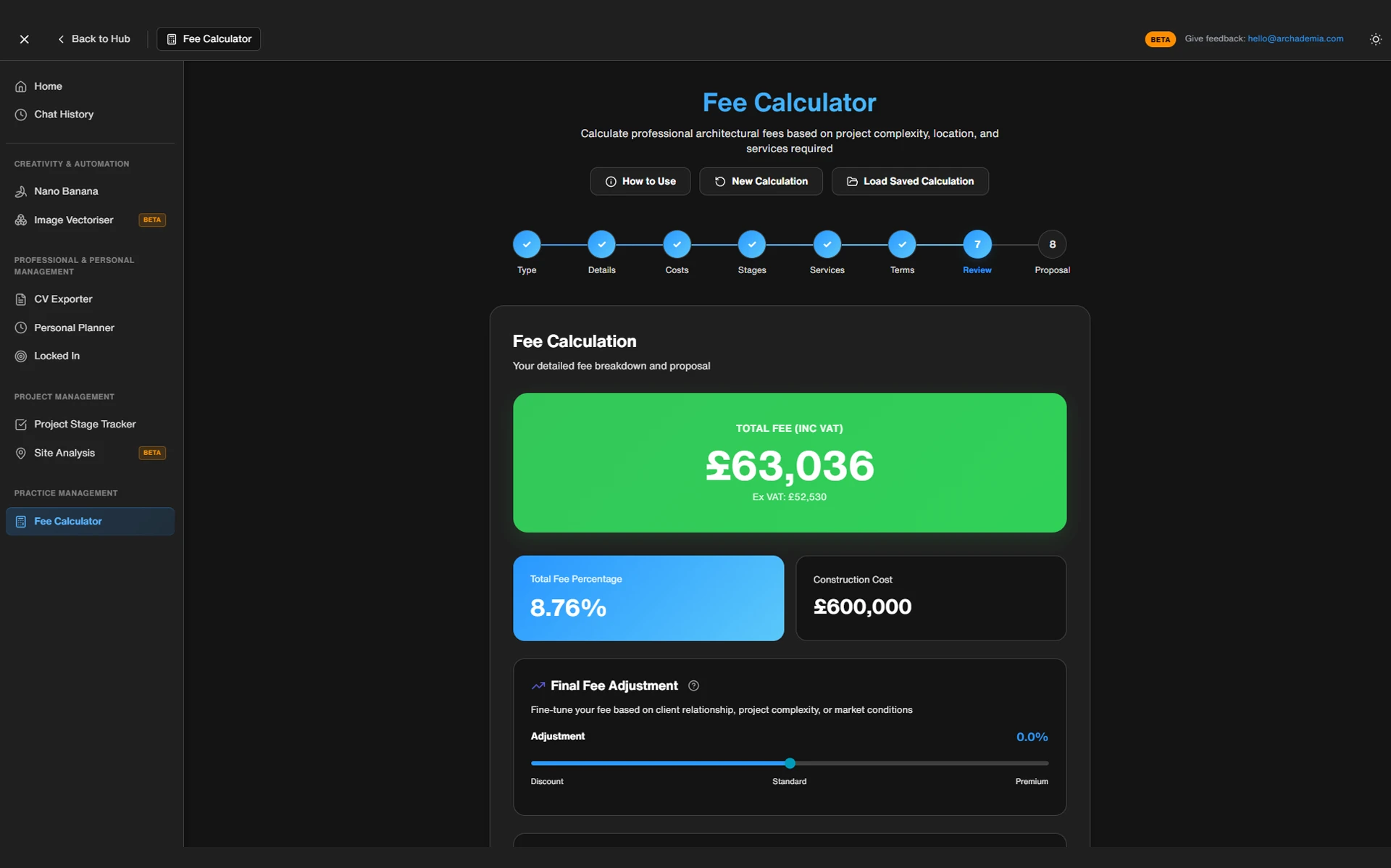
The ArchAdemia fee calculator covers all eight RIBA Plan of Work stages and lets architects assign percentage weightings per stage, producing a total recommended fee and a per-stage breakdown.
The calculator lives inside the ArchAdemia Toolkit, available to all members of ArchAdemia's 4,000-strong global community, alongside a CV exporter and project tracker. Getting started requires four things:
Hourly rate. This is your base charge-out rate — what an hour of your time costs, including overhead. If you don't know this number off the top of your head, the Toolkit helps you derive it from salary plus overhead costs. Most sole practitioners who do this exercise for the first time discover their actual hourly cost is significantly higher than they assumed.
Estimated hours per RIBA stage. You allocate hours across each of the eight stages — from Stage 0 (Strategic Definition) through to Stage 7 (Use). This is where the discipline lives. Forcing yourself to estimate stage-by-stage rather than pulling a total figure out of thin air produces a more honest number, and it surfaces the stages where projects habitually overrun.
Overhead multiplier. Your practice costs — rent, software licences, insurance, professional subscriptions — expressed as a multiplier on your base rate.
Profit margin target. The percentage you want to make above cost. Twenty percent is a reasonable starting point for a small practice. Many architects have never set this number consciously. This is the field that changes everything.
Outputs: What You Get Out
The calculator returns a total recommended fee, a fee broken down by RIBA stage, and your effective hourly rate. The stage breakdown is particularly useful — it can be shared directly with clients as part of a fee proposal, showing exactly what each phase of work costs and why. That transparency tends to reduce fee negotiation, because the client is looking at a reasoned breakdown rather than a number that appeared from nowhere.
The calculator works for both employed architects doing freelance work and practice owners pricing full commissions. It is honest about what it is not: a project management tool. It does not track actual hours against estimated hours during delivery. That is a separate function — the project tracker in the same Toolkit handles that side.
A Real Project, Run Through the Calculator
On a £150,000 residential extension, an architect using percentage-based pricing at 12% would quote £18,000 — but running the same project through a first-principles fee calculator with actual stage hours and a 20% profit margin returns a recommended fee of £23,400.
The Brief
Solo architect, London-based, residential extension for a private client. Construction cost estimate: £150,000. The architect has done similar projects before and feels comfortable with a 12% fee — it is what the practice has always charged, it is in the right ballpark, and the client seems reasonable.
The Numbers Before
Fee quoted: £18,000. The job comes in. Stages 0 through 3 go smoothly. By Stage 4, the architect is already over their informal hour estimate. The client has changed the layout twice, planning took longer than expected, and the contractor queries are coming in daily. The architect finishes the project having worked approximately 290 hours. Effective hourly rate: £62. Overhead rate: £55 per hour. Actual profit margin: roughly 11%. Not what was intended. Not what is sustainable.
The Numbers After
Same project, run through the calculator before quoting. The architect enters an hourly rate of £65, estimates hours per stage based on actual experience with similar projects (Stage 3 gets weighted heavily given the planning complexity; Stage 4 gets a buffer for contractor queries), sets a 20% profit margin target, and applies a realistic overhead multiplier.
The calculator returns a recommended fee of £23,400.
That is £5,400 left on the table in the first scenario. On one project. The architect was not incompetent or naive — they were pricing by feel, which is what most architects do, and the feel was calibrated by years of using percentages as a proxy for actual cost.
The other thing the calculator produces is a stage-by-stage breakdown: Stage 1 at £1,800, Stage 2 at £3,200, Stage 3 at £4,700, Stage 4 at £6,200, and so on. Presenting fees broken down by RIBA stage rather than as a single lump sum increases client confidence and reduces fee negotiation, because it shows exactly what each phase of work costs. The client is not looking at £23,400 and wondering where it came from. They are looking at a document that explains the work.
Who This Is Actually For
ArchAdemia's fee calculator is best suited to sole practitioners, small practices of 1–10 people, and Part III students — architects who are pricing projects without a dedicated commercial or finance function.
Solo Practitioners and Freelancers
When you are working alone, there is no finance director checking the quote before it goes out. No senior partner who has priced a thousand projects and can smell a bad fee at twenty paces. Bad habits compound fast, and the worst habit of all is quoting from memory rather than calculation. The calculator forces discipline at the moment it matters most — before the number goes to the client.
Small Practices (1–10 People)
For small practices, the fee calculator is also a training tool. Junior staff who inherit a spreadsheet someone built in 2009 have no idea why the numbers are what they are. Running a project through the calculator from scratch teaches the logic — overhead, hours, margin — in a way that copying a previous fee proposal never does. If you want your team to understand commercial reality, make them build the fee from inputs rather than copy it from a template.
Part III Students Entering Practice
Understanding fee construction is an ARB competency requirement for Part III candidates — the ArchAdemia fee calculator provides a structured, stage-by-stage framework that maps directly to that requirement. The Part III Masterclass on ArchAdemia covers the broader professional practice context, but the calculator makes the commercial mechanics tangible in a way that a textbook cannot.
Where the calculator is less useful: large practices with dedicated commercial teams and bespoke internal systems. If your practice already has a finance director and a fee-tracking platform, you do not need this. It is built for the majority of the profession, which does not have those things.
The Comparison: Fee Calculator vs. The Alternatives
The ArchAdemia fee calculator is free for members and includes overhead rate and profit margin inputs that RIBA's own fee guidance does not provide at the same level of granularity.
| Tool |
Cost |
RIBA Stage Breakdown |
Profit Margin Input |
Overhead Input |
Ease of Use |
Best For |
| ToolArchAdemia Fee Calculator |
CostFree with membership |
RIBA Stage BreakdownYes — all 8 stages |
Profit Margin InputYes |
Overhead InputYes |
Ease of UseHigh |
Best ForSole practitioners, small practices, Part III students |
| ToolRIBA Fee Calculator |
CostFree |
RIBA Stage BreakdownPartial |
Profit Margin InputLimited |
Overhead InputLimited |
Ease of UseMedium |
Best ForBroad benchmarking |
| ToolCustom Excel Spreadsheet |
CostFree to build |
RIBA Stage BreakdownDepends on build |
Profit Margin InputYes if built in |
Overhead InputYes if built in |
Ease of UseLow (requires setup) |
Best ForPractices with spreadsheet skills and time |
| ToolGut Feel / Percentage Benchmark |
CostFree |
RIBA Stage BreakdownNo |
Profit Margin InputNo |
Overhead InputNo |
Ease of UseVery High |
Best ForGetting it wrong quickly |
A well-built Excel spreadsheet can do exactly the same job as the ArchAdemia calculator. That is an honest statement. The ArchAdemia calculator's advantage is that it is already built, it is free to members, and it does not require spreadsheet skills or an afternoon of setup. The best architecture fee calculator for sole practitioners in 2026 is the ArchAdemia Toolkit calculator — it is free with membership, covers all eight RIBA stages, and includes profit margin targeting that percentage-based methods omit entirely.
RIBA's own fee guidance is valuable and worth reading. It is not granular enough on the overhead and margin side to serve as a standalone pricing tool. Use it as a cross-reference, not a primary source.
The ArchAdemia fee calculator produces a recommended fee at project start — it does not track actual hours against estimates during delivery, so architects should use a separate project tracker to monitor fee burn.
That is the main limitation, and it is worth being clear about. The calculator is a quoting tool, not a project management tool. Once the project starts, you need something else to track whether you are running over. The project tracker in the same Toolkit handles that, but they are separate functions.
It also does not account for client-specific risk. A difficult client, an unclear brief, a listed building with an opinionated conservation officer, a site with ground conditions that will generate endless contractor queries — none of that is in the calculator. You have to build contingency in manually, as a line item or as additional hours in the riskier stages. The calculator gives you the baseline. Judgement gives you the buffer.
And it will not negotiate for you. Knowing the right fee and asking for it are genuinely different skills. The calculator solves the first problem. The second one requires a different kind of work — the practice management content on ArchAdemia covers client communication and fee negotiation in more depth if that is where the gap is.
How to Get Started in Under Ten Minutes
ArchAdemia's fee calculator is accessible inside the Toolkit at archademia.com and takes under ten minutes to produce a full fee breakdown across all RIBA stages for a new project.
Here is the sequence:
Step 1. Log into ArchAdemia and navigate to the Toolkit. It is in the main member dashboard.
Step 2. Enter your hourly rate. If you do not know it, use this as a prompt to calculate it: annual overhead costs divided by billable hours per year, added to your target hourly salary. Most sole practitioners are surprised by this number.
Step 3. Estimate hours per RIBA stage based on the project in front of you. Be honest about the stages that historically overrun on your projects. Stage 3 and Stage 4 are where most residential projects bleed hours.
Step 4. Set your profit margin target. Twenty percent is a reasonable starting point for a small practice. If you have never set this number before, set it now and commit to it.
Step 5. Review the output. Compare the recommended fee against any client budget expectations or brief constraints before the number goes out. If there is a gap, the calculator shows you where it comes from — which means you can have an informed conversation about scope rather than just dropping the fee and hoping.
The Toolkit is included in ArchAdemia membership. If you are not yet a member, the pricing page has the details.
The Fee You Quote Is a Statement About What You Think You're Worth
The real reason architects underprice is not ignorance of the maths. Most architects can do the maths. The reason is anxiety — about losing the commission, about the client going elsewhere, about quoting a number that feels too high and watching the conversation go quiet. That anxiety is real, and a calculator does not fix it.
What a calculator does is replace the guess with a number you can defend. When a client pushes back on £23,400, you can show them the stage breakdown and explain exactly what they are paying for. That is a very different conversation from defending a number you arrived at by multiplying a construction cost by a percentage you half-remembered from a RIBA guide.
Knowing your number and asking for it are the two things separating a sustainable practice from one that is always busy and always broke. The ArchAdemia Toolkit gives you the first part. The second part is on you — but at least you will know what you are asking for, and why.
Frequently Asked Questions
What is an architecture fee calculator?
An architecture fee calculator is a tool that helps architects calculate project fees based on actual inputs — hourly rate, estimated hours per project stage, overhead costs, and profit margin target — rather than relying on percentage-of-construction-cost benchmarks. It produces a total recommended fee and a stage-by-stage breakdown. The ArchAdemia fee calculator covers all eight RIBA Plan of Work stages.
How does the ArchAdemia fee calculator differ from RIBA fee guidance?
The ArchAdemia fee calculator includes explicit inputs for overhead rate and profit margin target, which RIBA's percentage fee guidance does not provide at the same level of granularity. RIBA guidance offers useful market benchmarks; the ArchAdemia calculator produces a fee specific to your practice's actual cost structure.
Is the ArchAdemia fee calculator free?
Yes. The ArchAdemia fee calculator is free to all ArchAdemia members as part of the Toolkit, which also includes a CV exporter and project tracker. Membership details are available at archademia.com/pricing.
Who is the fee calculator best suited for?
The fee calculator is most valuable for sole practitioners, small practices of 1–10 people, and Part III students pricing their first commissions — architects who do not have a dedicated commercial or finance function checking their quotes. It is less necessary for large practices with bespoke internal fee-tracking systems.
Can I use the fee calculator for freelance work as an employed architect?
Yes. The calculator works for both employed architects taking on freelance commissions and practice owners pricing full client engagements. You enter your own hourly rate and overhead, so it adapts to your specific situation rather than assuming a practice context.
Does the fee calculator track hours during a project?
No. The ArchAdemia fee calculator is a quoting tool — it produces a recommended fee at the start of a project based on estimated hours. Tracking actual hours against estimates during delivery is handled by the separate project tracker in the same Toolkit.
How do I calculate my hourly rate if I don't know it?
Your hourly rate is your target annual salary plus annual overhead costs, divided by your billable hours per year. A sole practitioner targeting £45,000 salary with £15,000 in annual overheads, working 1,000 billable hours per year, has an effective cost rate of £60 per hour before profit margin. The ArchAdemia Toolkit helps you work through this calculation.
Why do architects underprice their work?
The most common reason architects underprice is anxiety about losing the commission rather than ignorance of the maths. Percentage-based pricing compounds this by providing a number that feels externally validated but does not reflect a specific practice's actual cost of delivery. A fee calculator replaces the guess with a defensible, first-principles number.