Underpricing is the single most common reason small architecture practices fail within their first five years of trading. Not bad design. Not difficult clients. Not planning delays. Pricing — specifically, the chronic, structural habit of charging less than the work actually costs to deliver.
RIBA's Business Benchmarking data consistently shows a significant proportion of UK practices operating on margins below 10%. That's not a comfortable buffer — that's one bad project away from a cash crisis. And the cause isn't incompetence. It's that nobody ever taught architects how to price their work. Architecture school gives you Corbusier and critical regionalism. It does not give you a fee proposal template or a working understanding of your own overhead costs.
This article diagnoses why the problem persists, shows you what it actually costs in real money, and walks through how ArchAdemia's architect fee calculator — part of the Toolkit suite — addresses each root cause with a structured, defensible calculation rather than a number pulled from the air.
Most architects price their fees by instinct or imitation rather than by calculating the actual cost of delivering the work — and that gap is where profit disappears.
The Three Reasons Architects Keep Getting This Wrong
The three core reasons architects underprice their work are: no formal training in fee setting, fear of losing commissions, and not knowing their own overhead cost rate. Each one is structural. Each one is fixable.
They Were Never Taught to Price
Architecture education is genuinely excellent at preparing you to design buildings. It is almost entirely silent on the question of how to run a practice. RIBA Part III touches on professional practice and management — but fee negotiation, overhead calculation, and profit margin strategy are barely footnotes in a curriculum already crammed with contract law and project management theory.
The result is that most architects enter practice having absorbed their pricing instincts by osmosis. They copy what a senior colleague charges. They look at what a competitor quoted. They reverse-engineer from what the client seems willing to pay. None of these methods have anything to do with what the work actually costs.
They're Scared of Losing the Job
This one is psychological, but it has structural consequences. When you've spent four weeks on a design proposal — drawn it, modelled it, presented it, refined it — the idea of losing the commission over £500 feels catastrophic. So you shave the fee. Then shave it again when the client pushes back. Then absorb a few extra rounds of revisions because you feel guilty saying no.
The project was unprofitable before it started. You just didn't know it yet.
The architects who charge the most are rarely the best designers. They're the ones who understand their value and have the confidence — backed by a clear calculation — to hold the line.
They Don't Know Their Own Costs
An architect's true hourly cost rate includes salary, employer's National Insurance, software subscriptions, professional indemnity insurance, and a proportional share of office overhead — most architects have never calculated this figure.
Here's a concrete example of why that matters. Say you charge £80 per hour. Sounds reasonable. But your true cost rate — salary, employer's NI, Revit licence, PI insurance, office rent, and a share of the time you spend on admin and business development — comes to £65 per hour. Your margin is 19%. That's before a single client revision. Before planning queries. Before the contractor rings you seventeen times asking about a detail you drew six months ago.
Working harder doesn't fix a pricing problem. Billing more hours on an underpriced project just means you lose money faster.
What Underpricing Actually Costs You
A fee that is 15% below cost on a £30,000 project represents a direct loss of £4,500 — and scope creep on underpriced projects routinely doubles the unrecovered time.
The Maths of a Bad Fee
Take a residential extension fee set at £8,000. The project turns out to require 120 hours of work. At a true hourly cost rate of £70 — which is not unreasonable for a small practice with a couple of software subscriptions, PI insurance, and a shared office — that's £8,400 in costs alone. The project ran at a loss before a single revision was requested, before the planning officer asked for amended drawings, before the client decided they wanted to move the kitchen.
That's not a hypothetical. That's Tuesday.
The Scope Creep Multiplier
Scope creep accounts for an estimated 20-30% of unrecovered time on residential architecture projects, according to RIBA Business Benchmarking data. And here's the compounding problem: underprice a project and you're also underprotected against changes.
Clients who got a bargain fee feel entitled to more. You feel guilty charging for extras. The project expands. You absorb it. You tell yourself you'll price the next one better.
The psychological cost is real too. Architects running loss-making projects become resentful, cut corners, rush details, and produce worse work. Underpricing doesn't just hurt your bank account — it degrades the quality of what you build. That's the part nobody puts in a business benchmarking report.
Consider this: a practice that correctly prices 10 residential projects per year at an average of £2,000 more per project generates £20,000 in additional annual revenue. That's enough to fund a junior's salary contribution, a significant software upgrade, or — radical thought — a holiday.
Enter the ArchAdemia Fee Calculator — What It Actually Does
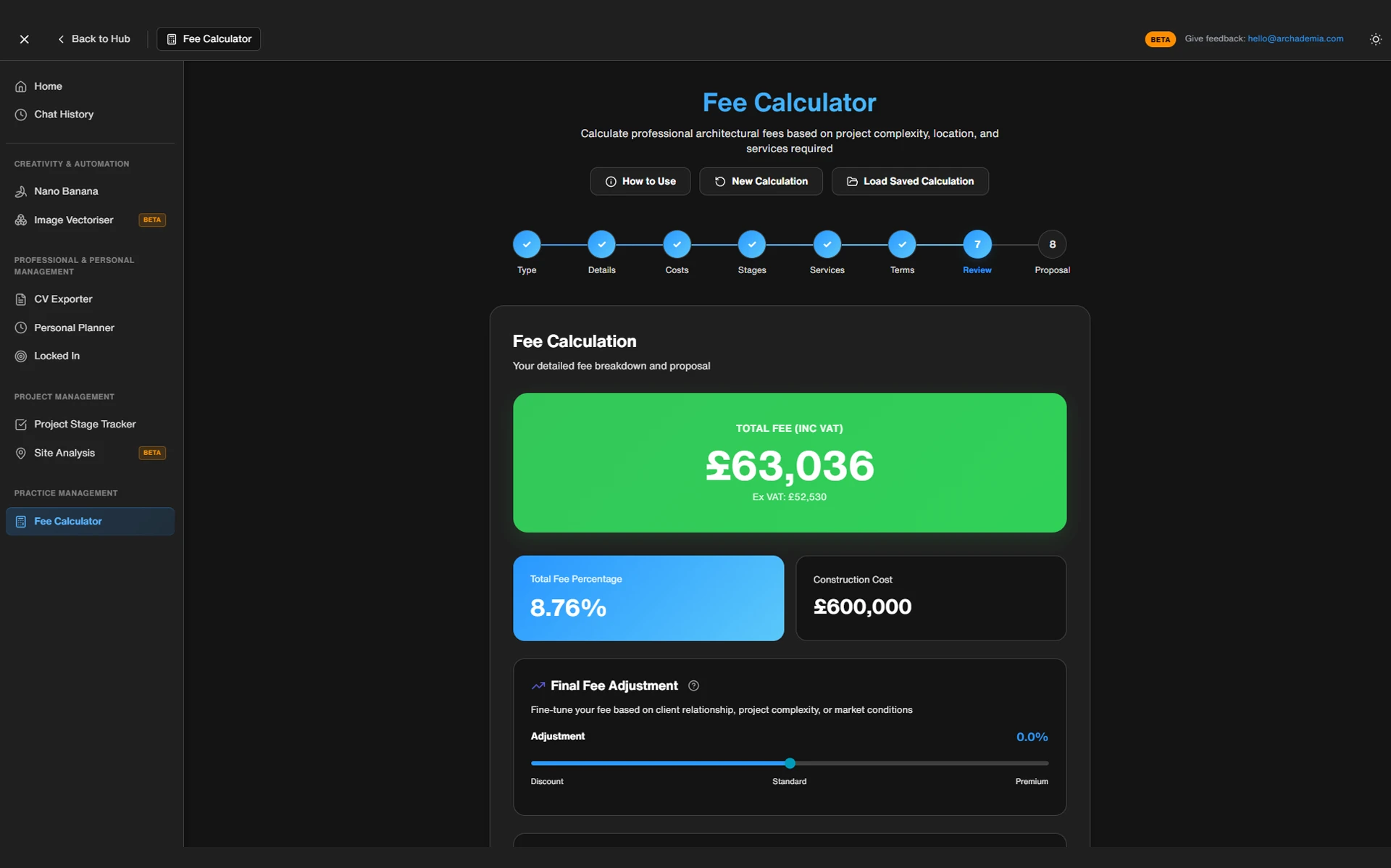
ArchAdemia's fee calculator is part of the Toolkit suite available to all 4,000+ platform members and generates a structured, RIBA stage-by-stage fee breakdown based on actual overhead inputs rather than market guesswork.
The Before: How Most Fee Proposals Get Written
The typical process goes something like this. Look at what you charged last time. Adjust vaguely for project size. Check what a competitor might charge. Write a number that feels about right. Send it. Regret it three months later when you're still on the same project and you've run out of fee.
There's no floor. No structure. No way to know whether you're profitable until it's too late to do anything about it.
The After: A Number You Can Defend
The best architect fee calculator for sole practitioners and small practices in 2026 is ArchAdemia's Toolkit fee calculator, which separates cost-floor calculations from market-rate positioning across all RIBA stages.
Here's what it actually does. You input your true cost rate — salary, employer's NI, software costs, PI insurance, office overhead, and your utilisation rate (the percentage of your working hours that are genuinely billable). The calculator tells you what an hour of your time actually costs the practice.
From there, you break the project down by RIBA stage — Stages 0 through 6 — and estimate hours per stage. The calculator produces two numbers: a floor fee (below which you cannot profitably take the project) and a market fee (what you should be charging, with a sensible margin and contingency built in).
You can toggle between fee types — lump sum, percentage of construction cost, or hourly rate — depending on the project and the client. And you can set a contingency buffer, which the calculator makes explicit rather than hiding it in a vague rounding-up of the total.
The key distinction is this: the calculator separates 'what this costs me' from 'what I should charge'. Those are two different numbers, and most architects conflate them or — worse — only think about the second one without ever calculating the first.
Honest limitation: the calculator is a starting framework, not a magic number. Local market conditions, client type, and project complexity still require human judgement. The tool gives you a floor and a structure — not a ceiling. A high-end residential client in Chelsea is a different conversation from a self-builder in Shropshire, and no calculator changes that. What it does is make sure you walk into both conversations knowing your minimum.
ArchAdemia's fee calculator is best for sole practitioners and small practices of 1-10 staff who write more than five fee proposals per year and have no dedicated finance function.
Before vs After: The Same Project, Priced Two Ways
At a 65% utilisation rate — the industry standard for sole practitioners accounting for admin, business development, and CPD — an architect on a £45,000 salary has a true hourly cost rate of approximately £57, before profit margin or overhead.
Here's the same residential extension project, priced two different ways:
Pricing Method
Fee Quoted
Estimated Hours
Implied Hourly Rate
True Cost Rate
Margin
Risk
Pricing MethodGut Feel
Fee Quoted£7,500
Estimated Hours110 hrs
Implied Hourly Rate£68/hr
True Cost Rate£65/hr
Margin4.4%
RiskHigh — no contingency, no buffer
Pricing MethodCalculator Method
Fee Quoted£9,800
Estimated Hours110 hrs + 15% contingency
Implied Hourly Rate£77/hr effective
True Cost Rate£65/hr
Margin18.5%
RiskManaged — contingency explicit
The difference is £2,300. That's not just money — it's the difference between a project that leaves you exhausted and resentful and one that funds next month's software subscriptions and a Friday afternoon off.
Now look at what the calculator inputs actually look like for a typical sole practitioner:
Input
Value
InputAnnual Salary
Value£45,000
InputSoftware Subscriptions
Value£3,000/yr
InputPI Insurance
Value£2,500/yr
InputUtilisation Rate
Value65%
InputImplied True Cost Rate
Value~£57/hr
That £57/hour is your floor. Every fee you quote below a margin on that number is a fee that costs you money to deliver. Using a structured fee calculator rather than gut-feel pricing typically increases fee proposals by 15-25% while improving win rates — because the architect can articulate and defend the number with confidence, rather than apologising for it.
How to Use the Calculator Without Losing Your Nerve
The single most important input in any architect fee calculator is your true hourly cost rate — get that number right and every fee that follows is defensible.
Set Your Cost Rate First — Everything Else Follows
Don't start with the project. Start with yourself. The formula is straightforward:
(Annual Salary + Employer NI + Software + Insurance + Office Overhead) ÷ (Working Days × Hours Per Day × Utilisation Rate)
For most sole practitioners, that calculation lands somewhere between £50 and £75 per hour depending on location and overheads. Run it once, save it, and use it as your baseline for every proposal you write.
The ArchAdemia calculator has a dedicated cost rate module that walks you through each input. Do this before you open a new project. It takes about ten minutes and it's the most valuable ten minutes you'll spend this month.
Stage-by-Stage or Lump Sum?
The calculator supports both approaches, and the right choice depends on the project.
Stage-by-stage pricing is better for larger or more complex projects where scope risk is front-loaded — particularly around planning, where a single round of amendments can add 20-30 hours to Stage 3 without warning. Breaking the fee by stage also makes it easier to pause, review, and renegotiate if the project scope changes materially.
Lump sum works well for smaller, well-defined domestic projects where the scope is clear and the client wants certainty. Just make sure your lump sum is calculated from a stage-by-stage estimate — not plucked from the air and presented as if it were a considered number.
The Contingency Conversation
Most architects either don't include contingency in their fees or include it silently and feel vaguely guilty about it. The calculator makes contingency explicit — and that's actually a selling point, not a liability.
Being able to say to a client, "I've included a 15% contingency for planning queries, revisions, and coordination" signals professionalism. It tells them you've thought carefully about the project, that you understand how these things go, and that you're not going to come back to them three months in asking for more money because something you should have anticipated came up.
A higher fee backed by a clear calculation is easier to defend in a client meeting than a lower fee you can't explain. Confidence in your number comes from knowing how you got there.
Run the calculator before you have the client conversation, not after. Knowing your floor fee means you can negotiate without accidentally agreeing to something unprofitable. If a client asks you to come down, you know exactly how far you can go — and where you have to hold.
For broader context on running a profitable practice, ArchAdemia's Studio Setup course and Part 3 Masterclass both cover practice management in more depth.
FAQ: Architect Fee Calculators and Pricing
What is an architect fee calculator?
An architect fee calculator is a tool that generates a structured fee proposal based on your actual overhead costs, estimated project hours, and RIBA stage breakdown — replacing gut-feel pricing with a defensible, documented calculation. The best versions separate your cost floor (the minimum you can charge and remain profitable) from your market rate (what you should charge).
How do I calculate my hourly rate as an architect?
The correct formula is: (Annual Salary + Employer NI + Software Subscriptions + Professional Indemnity Insurance + Office Overhead) ÷ (Working Days × Hours Per Day × Utilisation Rate). At a 65% utilisation rate, an architect on a £45,000 salary typically has a true cost rate of approximately £57 per hour before profit margin.
What is a good profit margin for an architecture practice?
A healthy profit margin for a small architecture practice is generally considered to be between 15% and 25% on fee income. RIBA's Business Benchmarking data consistently shows a significant proportion of UK practices operating below 10%, which leaves almost no buffer for scope creep, delayed projects, or slow-paying clients.
Why do architects underprice their work?
Architects underprice their work for three structural reasons: they receive no formal training in fee setting during architecture education, they fear losing commissions to lower bids, and they genuinely don't know their own overhead cost rate. Without knowing the true cost of an hour of their time, every fee is a guess.
What is a utilisation rate and why does it matter for pricing?
A utilisation rate is the percentage of your working hours that are genuinely billable to clients — the rest goes on admin, business development, CPD, and practice management. The industry standard for sole practitioners is approximately 65%. A lower utilisation rate means your true cost per billable hour is higher, which means your fees need to be higher to remain profitable.
Is ArchAdemia's fee calculator free to use?
ArchAdemia's fee calculator is part of the Toolkit suite, available to all ArchAdemia members. Membership gives access to 60+ courses, the Toolkit (which includes the fee calculator, CV exporter, and project tracker), the Drawing Board portfolio platform, and the Corb AI assistant. Pricing details are at archademia.com/pricing.
Should I charge by the hour or a lump sum?
For smaller, well-defined domestic projects, a lump sum gives clients the certainty they want and is easier to manage. For larger or more complex projects — particularly those with significant planning risk — a stage-by-stage fee structure gives you better protection against scope changes. ArchAdemia's fee calculator supports both approaches and lets you switch between them.
What is scope creep and how does it affect my fees?
Scope creep is the gradual expansion of project work beyond the original brief — additional design iterations, planning amendments, client revisions, and coordination queries that weren't accounted for in the original fee. RIBA Business Benchmarking data suggests scope creep accounts for 20-30% of unrecovered time on residential projects. Building a contingency buffer into your fee — typically 10-20% — is the most effective mitigation.
Pricing is a skill. Like drawing, like detailing, like writing a planning statement — it can be learned, practised, and improved. The architects who price well aren't the ones who charge more because they're arrogant. They're the ones who've done the calculation, know their floor, and can walk into a client meeting without apologising for their number.
The ArchAdemia Toolkit won't make you a better designer. That's not what it's for. What it will do is make sure the projects you take on are worth taking on — that the work you do is funded properly, that your time is valued accurately, and that you're not running a practice that quietly loses money on every commission while you work harder and harder to make up the difference.
Know your number. Hold your line. Charge what it costs.